Tiffany Hanssen on Tony Soprano, Writing Antiheroes, and Fictionalizing Family Members
The author of My Name Was Gerry Sass humanizes morally complicated characters
In the early 2000s, the television show, The Sopranos, was a cultural phenomenon. It was appointment viewing, back when that was still a thing. Though millions of people tuned in, however, I did not. I was in the mommy bubble, changing diapers, feeding my squawking chicks and wishing for sleep.
Almost twenty years later, I found myself living across the Hudson River from Tony Soprano’s stomping grounds and figured it was time to see what all the fuss was about. Of course I was immediately sucked in. A mobster doing mobster stuff while also grappling with a full-blown identity crisis? I was all in!
Around the same time, I was noodling with the idea of writing a book about my father, Gerry. Not a memoir, but a fictionalized version of him. Since he’d ditched my mother soon after she’d become pregnant with me, I’d spent most of my life making up stories about him. So why not turn those into a book?
From what I’d heard from my mother and half-siblings, he’d been a smart, charismatic, vaguely criminal lout who’d abused the women in his life, abandoned several of his children and died, by all accounts, an unhappy man. In other words, the perfect antihero protagonist. Just the sort of wicked, out-sized character to ground a crime novel with the sheer force of his gravitational pull.
Writing about him, however, proved to be a struggle. Even the highly fictionalized version of him seemed irredeemable and unlikable. I needed to find a way to construct this made-up Gerry in a way that made him more intriguing, for me and the reader.
Enter Tony Soprano.
James Gandolfini’s character is relatable in the most ordinary ways. He drinks orange juice from the carton. He saunters out every morning in his bathrobe to get the newspaper. He’s a beer-bellied, steak-grilling suburban dad. He also has a therapist! In her office, he considers his purpose in life. He breaks free from any societal and familial expectations and digs into his feelings (sort of). And when he gets too close to the truth, he rages.
We, the omniscient observers of his story, feel his pain. We sympathize with him and, over the course of the series, even learn to like him. Somehow, we end up rooting for his success.
Immediately, I realized that in order to root for my fictionalized Gerry, I needed him to be more like Tony. He’d have to break out of the caricature I’d imagined him to be. He’d slit guy’s throat at midnight and make his daughter breakfast in the morning. He’d struggle against an unjust world. He’d love and laugh and, occasionally, lose. And, perhaps most importantly, he’d reach some level of self-awareness.
But how? However much I enjoyed seeing Tony Soprano in therapy, I always found it unlikely that a belligerent man like him would ruminate on life’s existential questions. Especially with a sensible shoe wearing therapist. It seemed like a stretch. So, for Gerry, I knew I had to humanize him in a way that felt more believable.
Bad guy characters have been softened, or made to feel more human, in a thousand different ways. Saul Goodman, the titular character played by Bob Odenkirk in Better Call Saul, is a sharky, scumbag lawyer who has very relatable money troubles.
During one scene in Boardwalk Empire actor Bobby Canavale’s character, Gyp Rosetti, lays himself bare in prayer. “I’m what?” he asks. “A mistake you made?” It’s heart-wrenching. In The Godfather, Al Pacino’s Michael Corleone is portrayed, at least initially, as the shy, quiet type. A relative softie who falls in love. Real love. We’re led to believe that he’s not at all like the other Corleones.
Those other Corleones, those quintessential mobsters Vito, Sonny and Fredo, are, necessarily, more one dimensional. They do the heavy lifting when it comes to moving the plot along and amping up tension and excitement. As “flatter” characters, they provide the backdrop against which Michael appears fuller. Set in relief, he seems a more sympathetic character. A man who is unwillingly dragged into the drama, forced into his role as the head of the family.
Likewise, I knew that my fictionalized Gerry would have to be dragged, kicking and screaming, into his self-awareness. Into a situation in which radical self-examination was inevitable, or required of him. The real Gerry was dead. He died when I was in his school. So, I wondered, what if fictional Gerry (and maybe even the real Gerry) was in purgatory? What if he’d been brought to his knees by his Creator demanding his atonement?
There, in limbo, he’d be compelled to review not only his mistakes but also to relive his softer moments. How they would stand out for him when held against the backdrop of his depravity. He’d come to see his innate goodness as not as a fault or a weakness but as the singular quality that might save him from eternal damnation. Maybe.
There’s a great series on Paramount+ about the making of The Godfather called The Offer. It depicts the ordeal producer Al Ruddy went through in order to get the original film made. Between the author, Mario Puzo, and the studio heads and director Francis Ford Coppola, who had an unwavering vision for how he wanted the book to be translated for the screen, Ruddy had his hands full.
Added into that mix were members of the actual Mafia who had no intention of letting their families be ridiculed for entertainment’s sake. Joe Colombo, a ruthless boss in the Colombo crime family, wanted to put a bullet in the project and kill it. Eventually, he came around when, thanks to Al Ruddy, it became clear to him that the goal of the movie was not to dehumanize the fictionalized Corleones but to portray them as real God-fearing, patriotic, loyal-to-a-fault people. Average Joes who just so happen to also be murderers.
In The Offer, in his pitch to the studio head, Robert Evans, Francis Ford Coppola asks, “Why is it that The Godfather is selling more copies than the Bible?”
Evans pops an olive from his martini into his mouth dismissively.
“You think it’s about the drug trade. 1946, New York City?” he says. “Not at all.”
It is, Coppola brilliantly adds, about capitalism and the “mythical battle for control” and a failed justice system. “It’s Shakespeare. It’s Greek. Biblical. Epic.” But, he says, The Godfather is, at its core, about family.
Like the Corleones, bad guys like Walter White in Breaking Bad or H.I. McDonnough in Raising Arizona are of a similar ilk. They’re family men. Men who live messy lives with gravy dribbled down the front of their shirts and a hitch in their gaits. Men who struggle, like we all do, to survive in a mad, mad world.
In my book, My Name Was Gerry Sass, the fictionalized version of my father is equally confused and complex. He’s casual with his cutting insults. He assassinates people for a quick payday. He launders money for the Mob. But Gerry also loves his daughter unconditionally. He fears for her safety and does everything he can to protect her. She is his “why.”
“I did what I had to do to give that girl everything she deserved,” Gerry says. At its core, it’s a book about family.
To write a compelling antihero who is obsessed with family, how they are humanized for the reader is equally as important as how they dehumanize others. Dr. Jekyll is as important as Mr. Hyde. Or, as one of the characters in my book says, “Ain’t no light without the dark.” It’s how the character balances those forces of light and dark that centers their struggle in a way that is relatable.
We’re not, most of us, capable of murder, but we are all capable of love. We’re all capable of doing our best with the hand we’ve been dealt. And that’s why, when Gerry comes back, over and over, with his catch phrase, we completely get it—and him.
“It’s a life,” he says.
It’s a beautifully freeing sentiment and one that Tony Soprano would likely agree with.
***


Tiffany Hanssen
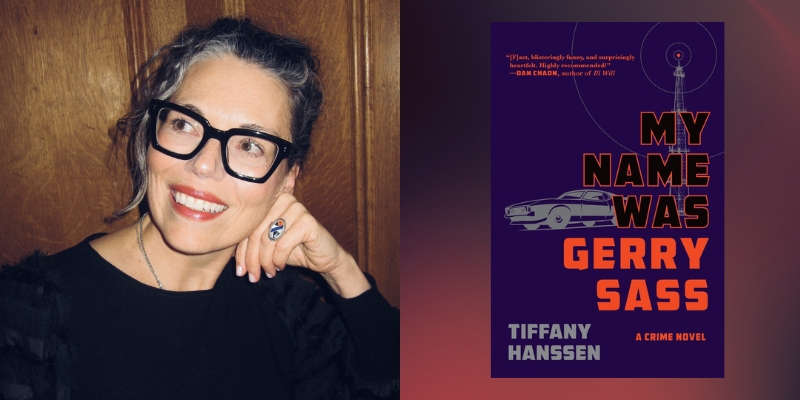
Tiffany Hanssen is an on-air host at public radio station WNYC in New York City. During her decades-long career in broadcasting, she has produced award-winning national programs and worked at stations from Las Vegas to Washington D.C. She is also a screenwriter and mom to two boys. And although she was born in Iowa and spent many years in Minnesota, she currently lives in Manhattan. She is the author of My Name Was Gerry Sass.