
R.M. Caldwell on Writing a Regency-Era 'Fast and the Furious', Neurodivergence, and More
The author of Fast and Fastidious in conversation with Alex Dueben
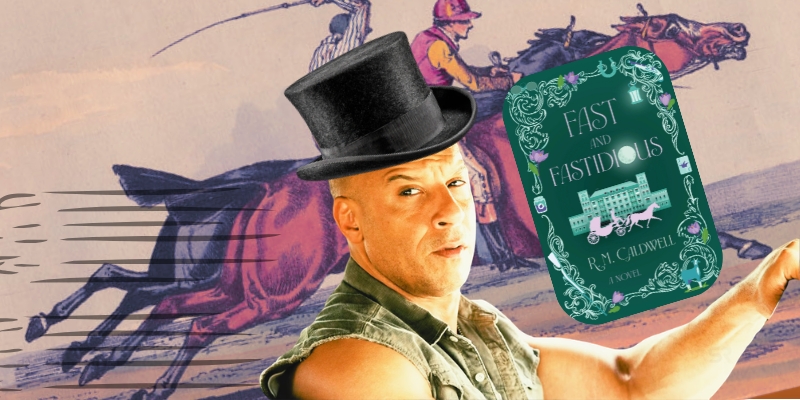
The new novel Fast and Fastidious is, as the name suggests, a mashup of Pride and Prejudice and The Fast and the Furious. The story of a neurodivergent heiress who becomes obsessed with the Night Races, illicit carriage races that attract spectators and competitors of all races, ethnicities and backgrounds.
The book manages to be an irreverent but realistic take on 1810 England as Lucy becomes enamored of their new neighbor, Captain James Dashwood, as the novel manages to be both a period-accurate Regency romance to a story where the two are thrust into a plot involving murder and robbery, culminating in a carriage race involving treason and stolen weapon. It’s realistic in the way that The Fast and Furious movies are realistic, and like those movies, and the Regency stories that it draws inspiration from, a lot of fun.
The debut novel of Hamilton, New Zealand-based theater writer and director R.M. Caldwell, we spoke over zoom recently about the book’s origin, what had to be included in mashing up the two genres, and not researching engineering.
*
Alex Dueben: What exactly was the beginning of this idea for you?
R.M. Caldwell: There’s two elements. One was the name, which came to mind as Pride and Prejudice, oh, Fast and Fastidious. I thought, that’s obviously the name. The other origin was from an unfinished play that I was writing about a Regency heroine and highwayman. It never quite took off, but some of that structure ended up in what became the novel. Once I had the name, everything else started gradually falling into place.
AD: That’s interesting, but within the name was it being a Regency story, the Fast and the Furious, the character of Lucy.
RMC: Lucy came later. The idea was, you’re going to have a Regency story. An Austenian romance. You’ve got to have racing, obviously, so coach racing. You’ve got to have crime. You’ve got to have some mystery. Those wove together. I actually wrote about six or seven chapters back in 2016 and sort of ran out of steam.
It wasn’t until I reread these chapters during the COVID lockdowns, for the first time in years, it became incredibly obvious to me that this was a neurodivergent main character. Which I had not considered at all when I’d written it. Once I realized that, I thought, okay, now I know that character a bit more, I can expand on that. It made the rest of it a lot flow a lot easier once I knew who my main character was.
AD: It’s such an interesting idea and an obvious one, because who would be the Recency era equivalent of a gearhead? A neurodivergent person with this mechanical-oriented mind.
RMC: That realization that there are things that have been with us throughout history. We think of them as now existing, but they’ve always been there. That was what it made me go, okay, this is someone who can be in this position, but still be fascinated by these things.
I did a little bit of research and there’s quite a lot of theories that Mr. Darcy in Pride and Prejudice has a lot of neurodivergent traits. The way that he’s very brusque and straightforward with his manner, avoids things, doesn’t necessarily pick up on cues.
AD: That is interesting. One of the characters in the book is from Switzerland and has known people who think similarly. Which makes sense because of course Swiss watchmakers would hire people who think like this to do that kind of work.
RMC: Mechanical minds. That idea of a spectrum. Elsa in the novel mentions her brother, who’s this extreme side of it. Whereas Lucy connects with people, she just has difficulty with it. It’s not a natural trait. I think that’s something that really helped form the book as well. If someone isn’t naturally skilled with social cues, in modern society, we have so many social cues we all take for granted. The Regency era, with it’s really strict, codified rules, would be a benefit to someone in that regard, because they could actually lean back on those rules. What does the book say that I have to do in this situation?
AD: Lucy keeps a literal book of all the rules which are not obvious, so she can keep them straight. Also a great way for readers who are not as familiar with the period or have read other Regency novels, Lucy’s narration explains a lot.
RMC: She can explain some of those rules. It’s a bit of a cheat. [laughs]
AD: Talk a little about the night races. It’s a great concept and the idea fits so naturally into this period and just as an idea.
RMC: They probably existed in some form. People racing coaches and racing horses. Thinking, okay, what’s going to be the Regency era equivalent of street racing from Fast and Furious? It’s a little bit underground. It’s not necessarily criminal.
Then you had your limitations. You’ve got courses and you’ve got carriages, what elements of this do you add in? I’ll do a circuit around lakes so people can watch it. Otherwise people can’t actually see what’s going on. You have to do it at moonlight cause there’s no street lighting. Those sort of elements fell into place.
It allowed me to put in a lot of it’s techno babble. I wasn’t going to investigate the engineering of racing, which is I think quite in line with the Fast and Furious movies. [laughs]
The tech is nonsense, you just have to explain what it does. It doesn’t matter how it works, you just have to explain what it does. For example, they’ve got mechanisms that release horses if anything goes wrong. Which was important to put in because otherwise horses could be in accidents and that would be a bit rough. Let’s not do that.
AD: The races are that rare space where class and ethnicity get shoved aside, and that happens because it’s in a not quite illegal, but illicit space.
RMC: The fastest ride is what counts and nothing else. I thought that was quite fascinating as well, because it meant that you created these parallel worlds. It meant that Lucy could participate in the crime and mystery elements, where if you had strictly stuck to a regency romance setting, you could still certainly absolutely fit that in, but it allowed me to push her into other areas, which of course pushes her comfort zone. Which also makes for some interesting character moments. I obviously needed a space to introduce those other characters. That was a way to introduce her to that world, which otherwise she would never really engage with.
AD: When I mentioned the book to a friend they asked about the tone, and I said that’s not a joke, you treat this is a serious, realistic manner–or, realistic in the way that the Fast and the Furious movies are realistic.
RMC: If you were observing the plot thread of Lucy and Dashwood and her parents, and you didn’t see any of the street racing, everything would be consistent with an Austenian novel. I wanted to keep that language and the tone and everything still within that framework. You want to make everything feel real within that world, that barring some questionable physics here and there, you’re still keeping with the world that they’re in.
AD: Part of that as you said is the language. We all know what sounds wrong in a period piece, but what’s right, that’s hard to judge.
RMC: There were two things in that regard that came out of the editing process. Which overall, I really enjoyed. I loved that editing phase. One was paring down a little bit on the overly verbose language. Because sometimes you just sort of too many clauses in the sentence. It was because you were trying to sort of emulate a bit more of that style.
There was another interesting thing towards the end where we went, when did this word first appear in literature? And would they use this word? We pared back a few of them. Most of them I kept in place. I set myself this rule that we can use slightly archaic language, so long as it’s in the text, not the mouths of the characters. So you can describe something to a contemporary audience, but the characters themselves should only be using language that they would use.
You try and avoid them, but occasionally, that word didn’t come in until twenty years later, but it really fits and I can’t find anything better. Which is also a fascinating process for finding out, that word’s much newer than I thought it was. Or that word’s much older than I thought it was, which is always fascinating as well.
AD: I feel like words are either much older or much more recent than we think. The OED is a great resource for this, but they’re only tracking the first time it saw print. So there’s a question of the nature of language, would people use it in conversation for years or decades years before anyone actually put it in print?
RMC: I found a fascinating little piece of trivia the other day that Mansfield Park by Jane Austen, is one of the earliest print references of the word “baseball.” They think it might not be the same kind of baseball, but it may be the earliest version of the word.
AD: That is fascinating. But as you said, you can’t write this like a nineteenth-century novel, you’re instead trying to emulate the feel, or how we remember it feeling, as opposed to how and how it would actually read.
RMC: That’s where I think there’s that flexibility. You’re trying to emulate this style, which was definitely what I was going for when I was writing it. Let’s write it this way so it could feel like a novel of the time, excluding the elements that we know don’t fit.
AD: Was this book in part just you that like Jane Austen and Regency stories and you like action movies like The Fast and the Furious, and this connection just popped into your brain one day?
RMC: This is my first published novel, but I’ve done quite a bit of theatre. Something that often comes up is, you take two existing things and you put them together in a way that people have never seen before. So I’ve got a Shakespeare play, which is a mashup of two Shakespeare plays. So a character from one ends up in the other and then things start derailing. All the language is still Shakespeare, but the plot becomes quite different. What if this, but this? I think that’s where that came from.
I have not read every, every Jane Austen novel. I’ve not seen every Fast and the Furious movie. But you know that world and think, what parts of these work together? Would it be interesting if this? Exploring different ways that stories can be structured. That’s what I really like doing.
Thinking in those terms, what for you were the essential parts of each that had to be included?
You had to have a couple who was going to be your designated romantic couple. They had to meet and engage on quite a lot of Austenian ground, which means there’s going to be a ball, and there’s going to be a few of those. There had to be coach racing. I realized, I want this to end in a chase. There’s going to be an action sequence at the end– for some reason. Which is really good, because it means that everything you’re doing and putting in place has to work towards that. You know where you’re going. Which is often how I write. I like to know what the end is before I start writing.
AD: So you had this world and you were building to a big chase at the end, but you didn’t necessarily know what this chase would be.
RMC: Yeah. And then I thought, okay, Fast and Furious, it’s going to be something criminal. If you’re going to have a crime, it’s got to be a coach-related crime, because, again, Fast and Furious, it can’t just be a robbery. It’s got to be a car-related robbery. [laughs]
So you had those elements and then you started going, okay, who’s your character? It really didn’t have that many essential elements. Austen, coach racing, and a goal. And then how do you get there and what are your twists and turns along the way? Once you had a mystery, okay, who’s involved? Is it these guys? Is it these guys? Where are your suspicions?
AD: One of the aspects in the book that was really interesting was Lucy’s relationship with her sister.
RMC: That was there very early. That iteration of the sisters fell within that first six chapters. I think it primarily came out of Pride and Prejudice. There are multiple sisters and they are good friends. They support each other and they have things that they argue about.
It also gives Lucy someone she’s close with. Her sister doesn’t know about the night races and that sort of thing. Lucy’s fairly guarded about that, but it means that she’s comfortable with this person. She can talk with this person. Whereas if you had an isolated person with those neurotypical traits, it could be difficult to have open conversations with people. By giving her a sister who had those elements, it made it a lot more fluid.
I really liked the way that they have quite a wingman relationship, which is very Pride and Prejudice. Let’s get a suitable match for your sister. I liked that side. Margaret is tall. She’s a six-foot woman in Regency, England, which is going to have challenges, but she’s aware of them. She’s smart, like Lucy. Not quite as technically minded, but it meant that she’s got some sympathies with Lucy for being different. Building out that, that relationship with them and their family.
I think everybody in the book has relatively well-grounded relationships with everybody else, to different extents. I thought that was an important, both from a Regency perspective of where you stand and what these connections are, and just how you get on with a person.
There’s a conversation that Lucy has with Charlotte Wyndham, who goes off on flights of fancy. She’s talking about this ghostly headless horseman that rides at night. Lucy tears it apart logically, and her sister tells her off, which I think that was probably directly taken from Emma.
There’s a scene in Emma where a similar thing occurs and she gets told off for putting someone down publicly. But Charlotte was like, no, I really did see a headless horseman so now what do I do? I go to the most logical person I know and tell her about it because she’s not going to put up with any nonsense and she’s going to pick holes in it.
I quite liked that moment of this person respecting Lucy enough to say, you’re a very rational person, and in this circumstance, I need that. It’s a small relationship with a side character, but it’s actually a fairly complicated and evolving relationship. I liked that side of them.
AD: It was also something that pointed to Lucy as this valued member of the community. An odd eccentric character, but one whom people know and respect.
RMC: If you ask someone what Fast and Furious is about, they’ll say cars and they’ll say family. Because that’s become the joke, but it actually is an undercurrent that I wanted to put in there. That family is important. Whether it’s the Elliott family, who are a very closely knit family, or Torres and his crew, which are a found family. When they say family within that context, it’s about finding your people, and finding the people that work for you.
There’s a short mention that I added about a possible suitor for Lucy. That she seemed to get on with really well and eventually she realized, this guy’s just agreeing with everything and he doesn’t really have any ideas of his own. He eventually married someone who was also relatively simple. She just imagined them sitting quietly and happily. Nothing’s really going on outside, nothing’s really going on inside, but they have a happy life. [laughs] Finding someone who gets you.
That’s key as well with the main relationship in this story. Her and Dashwood are quite different people, but they understand each other. They get each other. That’s really vital. I think both in a romance connection, but also in just a general community connection.
AD: Dashwood’s proposal at the end, which I’m sure many readers would find deeply unromantic in their own lives, fits perfectly.
RMC: It’s the perfect proposal for them.
AD: It is. I will note that you had a scene early on with Torres and Dashwood and I remember making a note that it was a big bombastic Vin Diesel moment. But was also a scene that worked for 1810. [laughs]
RMC: [laughs] It comes to a mutual respect. He and Dashwood are quite similar people. You can very much imagine if they swapped lives, they’d fit quite well into each other’s lives to a certain extent. They have this rivalry that is polite. It’s a polite societal rivalry– within their terms. They’re not necessarily within the rules and the society of Regency England, but they’ve got their own rules. Their own code of honor. It’s a solid form of masculinity. They are confident in themselves. It doesn’t mean you’re rude, it doesn’t mean you’re aggressive, it means you’re confident in what you can do.
AD: The book was a lot of fun to read. I know this is not always the case, but was it fun to write?
RMC: I would say it was. It generally flowed pretty well. Generally how I try and write is that I flesh out enough ideas. I know my characters, I know my beginning, I know my end. I know one or two things that happen along the way. Then you just sit down and write until you’re finished. I would set myself, I’m going to sit down every night and handwrite three to four pages, and eventually you get there.
It means that by the time you’ve typed it out, you’re kind of on your second draft, which is nice. You go, okay, that doesn’t work, or you’ve written a note to yourself saying, go back and check this later. You can do that quite easily in a written note. It flowed really well. I really loved it. There’s just so many nice moments in that book that I go back to and go, that’s cool. That’s fun. It’s enjoyable to reread. There’s no right way to do this, but if you are enjoying what you’ve written, it’s a good sign.
I am curious about your pen name.
RMC: It got picked up here in New Zealand, and then it quite quickly got picked up international through America. They wanted to go with a gender neutral pen name. So I just went with my initials and surname. The publisher already had on their books someone with that exact same initials and name! [laughs] I thought, what am I going to change it to? So I changed the surname. I went with an old family name of mine. The name kind of feels a little bit Regency. It’s this interesting situation where it’s a pen name, but it’s not a secret identity.
So what are you working on now? Are you doing more theater? Do you want to write another novel?
RMC: I’m fleshing out lots of ideas. My next project is a side gig I do. I design puzzles for pop up escape rooms. I run them annually in the gardens festival. Novel-wise, at the moment I have ideas. I always have quite a few ideas at different stages. I’ve got one which is sort of a spiritual sequel to this, and which would be a similar style, but different characters, different setting. More Dickensian timeframe, so 1850s rather than your 1810s Regency.
I’ve got another one, which is a bit more sort of fairy tale-inspired leaning more into the action side of things. Last year I converted a play of mine to a novel, and I’m currently in the process of typing out my handwritten notes. So there’s all sorts of ideas. I might ask my publishers, what should I lean into? But definitely there’ll be something coming.
***


Alex Dueben
Alex Dueben has written for The Believer, Vulture, The Millions, The Los Angeles Review of Books, The Brooklyn Rail, and many other publications. He is the writer and editor of the artist monograph Hurricane Nancy, and his debut novel is forthcoming.