

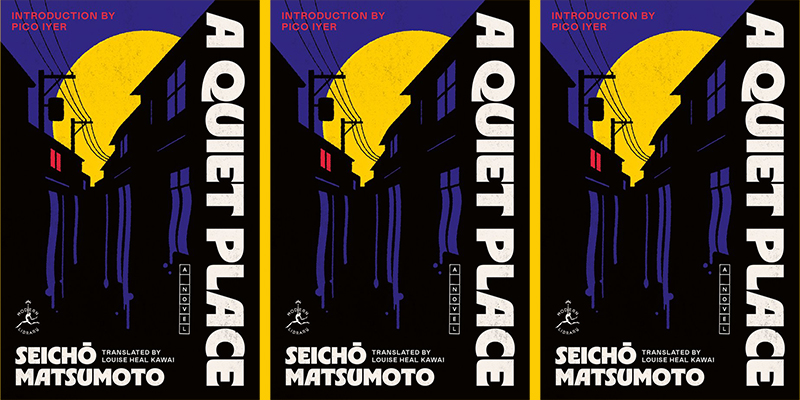
Seicho Matsumoto's A Quiet Place Is a Dark Fairy-Tale of Post-War Japan
Pico Iyer reflects on a reissued masterpiece of psychological fiction
Japan, more than anywhere I know, runs along straight and well-determined lines, bringing you to where you need to be as smartly as a bullet-train. When A Quiet Place begins, we’re at a typical corporate dinner, of the kind that’s playing out all around me as I sit at my desk here in Nara. Everyone knows his place and almost everything is scripted in advance. The host entertains the visitor, an agreement is decided upon without words being exchanged, and success is more or less guaranteed.
Yet the crafty genius of Seichō Matsumoto’s gripping and subversive work is to show how one small detail slips off-track—a phone-call comes in from Tokyo—and suddenly a bland-seeming bureaucrat, Asai, is plunging through a manhole into an unknown realm for which nothing has prepared him. His wife’s natural death, the kind that can happen anywhere, excites his curiosity, and the next thing we know, we’re in parts of Tokyo—and parts of our protagonist—that we could never have guessed existed.
The Japanese title of the book—Kikanakatta Basho—can be translated as “A Place Unheard-from” a phrase that carries any number of charged associations. It could refer to the hushed and shadowy corners of Tokyo that we venture into, or to the unlit wilderness in which a climactic confrontation takes place. But most of all it seems to speak for the unvisited places within Asai that come to light as, inch by inch, he begins to edge out of his well-lit routine. “The night enveloped him,” we read. “It was like a scene from a dark fairy-tale, with the faint lights from distant habitations barely making it through the swirling fog.”
*
I have to admit that when first I read Matsumoto, soon after I came to live in Japan, 38 years ago, I sped through his police procedurals for their racy and evocative surfaces. Yet A Quiet Place is deeper than the other books of his I’ve read insofar as it’s less interested in plot than in psychology. It feels like an unsparing X-ray of Matsumoto’s native land that lays bare, indelibly, the secret world—or mind—that lies behind the grey suits and white shirts, beneath the company pins attached to every lapel. The country’s most celebrated post-war writers—Junichiro Tanizaki, Yasunari Kawabata and Yukio Mishima—generally go straight to the complex, almost twisted lives of their protagonists. What makes Matsumoto so unsettling is that he describes in great detail the workaday public life of his main character, the “Second Section Chief” in the “Department of Staple Foods at the Ministry of Agriculture and Forestry,” at the same time as this bureaucrat is becoming a stranger, even a traitor, to his formal and upstanding self.
[The novel] lays bare, indelibly, the secret world—or mind—that lies behind the grey suits and white shirts, beneath the company pins attached to every lapel.
In that respect, the scene with which the novel opens is representative; it plays out like a public pageant (even though the geisha in the room will step a little beyond her public duties). Part of Matsumoto’s cunning strategy is to show how it’s Asai’s entirely conventional ambitions—all he hopes for is to become division chief—that lay the foundations for his downfall. Other men may die trying to protect their loved ones; Asai could come unraveled simply through his wish for a promotion. Under the author’s fiendish logic, doing little more than trying to understand something of his young wife’s heart attack leads Asai into a feral netherworld of murder and blackmail.
In no time at all, in fact, our mild-mannered hero is leading a double life as complex as the one he’s trying to uncover. There’s no fanfare here, and there are no cheap effects; but somehow, with a feeling of inevitability, one unprepossessing scene after another leads towards something horrifying. The novel comes to feel like a series of hand-grenades placed under the placid surface of Japanese life; as we tiptoe from one moment to the next, we never know whether we’ll be greeted by an explosion, or by a quiet that may be even more disturbing.
*
Japan has long presented itself as a land of equals, in which everyone is to some extent acting in the service of collective harmony, like members of an orchestra; in surveys, ninety per cent of its citizens have traditionally described themselves as middle-class. Hierarchy may govern the workplace, but the everyday current of public life is designed to place everyone in agreement, working from a common script.
Yet Matsumoto is pleased to remind us how many rifts lie beneath that public chorus. Asai is painfully aware—we read again and again—that he didn’t go to an elite university, of the kind that allows Old Boys all around him to glide smoothly to the top of government and corporate life; he has to work harder than anyone—to become “The Demon” and “The Walking Encyclopedia”—in order to scramble up the ladder. This rhymes, perhaps, with the way the neon of dodgy hotels starts to flicker in a sleek area of high-end homes, and even a courteous shopkeeper can turn out to be the mistress of a married man. The shiny official order is riddled with fault lines.
At times, quite wonderfully, the rift between public and private—always the central drama in Japanese life—becomes almost comical here: in one startling scene, we see Asai earnestly discussing the minutiae of ham and sausage processing even as his imagination is filling up with seedy details worthy of a tabloid. And soon, remorselessly, he’s turning down all the work assignments to which he’s been so devoted because he has more and more to cover up; handing out a fake name and address, stealing off to shady corners of the city in dark glasses. Asai has turned into a private investigator of sorts, whose main quarry seems to be himself.
We start to tumble completely out of the well-rehearsed costume drama of Japanese society and fall deeper and deeper into a haunted subconscious; even worse, Asai seems to come to richest life as he begins to access his darker side. At last, he’s acting on impulse, following no prompts other than his own urges. “His whole body felt on fire,” we read at one point, and “all ties to his consciousness had been severed.”
*
Matsumoto was always something of a rebel, himself. He never went to secondary school or to college, which is rare in by-the-book Japan. He always scented secrets beneath the public courtesies of his uptight and aspiring land. Starting to publish in the years soon after World War 2, he spoke for those who were troubled, sometimes outraged, by the way the country was claiming to transform itself and keeping up appearances even as demons and deceits were mounting in every corner.
Matsumoto is pleased to remind us how many rifts lie beneath that public chorus.
Thus it’s the silences in his writing that often shout at you. Almost everything takes place between the lines, and great shifts play out through the smallest details. Since everyone knows what he is supposed to do—public Japan is even now too much a gentlemen’s club—the slightest deviation can set off a trail of consequences that bring down everything.
It’s remarkable, in fact, how quickly and quietly Matsumoto—who had worked in an advertising division and would become the most popular novelist in the land in the 1960s—upends the society around him. The opening banquet, he stresses, is a “high-class” affair, yet within a few pages we’re reading detailed accounts of the sex lives of a civil servant and his wife, then edging into curtained hotels and shadowy detective agencies. Public Japan keeps plotting and droning in its offices, but a sudden heart attack, an earthquake, remind us how fragile it all remains.
It’s as if the entire edifice of society is collapsing. Asai offers an apology and even that seems to blow up in his face; he realizes that his boss hardly knows who he is. And the boss himself, when standing alone, “looked like a complete nobody,” no different from the guards who stand at the Ministry’s main entrance. Everyone, we come to suspect, is leading a seamy second life. A quiet and unremarkable businessman, once cornered, becomes a “weakened, trapped animal,” from whom “uncanny sounds” emerge, his voice “no longer human.”
*
It may be helpful to recall that Matsumoto was working at a time when Japan was being remade by America and filmed versions of stories by the likes of Raymond Chandler and James M. Cain were disseminating a new kind of noir. Chandler’s great gift was for evoking an entire landscape of lust and greed amidst the pretty bougainvillea and languorous breezes of California. And in Cain’s Double Indemnity, as here, we’re encouraged to identify with a hapless lunk in a boring office job who’s suddenly visited by something new that speaks of passion; before long, he’s on the wrong side of the law, the claws of justice tightening around hm.
For me, the fascination of Japan has always lain in the fact that the gap that separates its polished public surface from the depths within is unreadable. You know that people are not the roles they take on, but—since they almost never invite you into their homes or let down their polite guard—you don’t know how exactly they differ. In that sense, this society of exquisite manners and stagecraft is always a mystery, one that you can’t stop looking at and longing to investigate, in spite of all you suspect you’ll never see.
This is Matsumoto’s world, and he can fashion a riveting story out of an everyday death and a somewhat featureless man talking to colleagues from an Agricultural Co-operative. The police hardly appear, a detective agency is barely described; we’re in the realm of business cards and production statistics that workers can recite in their sleep. But we can’t stop reading, to find out what a quiet woman might really have been doing while heading out each week to her haiku club.
*
His melancholy poetry and social themes may be profoundly Japanese, but I can’t help feeling that Matsumoto can get into any reader’s being as few writers do. Many of us probably think of ourselves as normal, law-abiding souls trying to do the best we can. We have ambitions, we’re sometimes a little more careless than we ought to be, we may not mention everything in our tax returns, but we don’t seem to be harboring any great vices or sins.
Yet A Quiet Place shows how innocent enquiry—nothing more—can unlock creatures we never knew we had within us and, in time, violent monsters, too. Reading it, I felt implicated, even incriminated; I’ve covered up things here and there myself, and they still rise up at times to spook me.
The unflinching power of the story suggests that none of us is innocent or immune from detective drama, and the enveloping intensity of the writing means that we’re inside not just Asai, but ourselves. We feel for him, we inhabit his predicament, and then we find ourselves understanding, even rooting for acts that are unspeakable. Every time I go back to A Quiet Place I find myself in a world that’s terrifying in part because it’s so precise, so familiar, and so direct. Any of us, it seems, through the smallest sequence of circumstances, could find ourselves committing murder.
***

Pico Iyer
Pico Iyer is the author of 17 books, translated into 23 languages, including three works—The Lady and the Monk, Autumn Light and A Beginner’s Guide to Japan—based on his 38 years of living around Kyoto and Nara.