Jack Friday on 'The Big Sleep', Invented Cities, and Chronicling a Changing Austin, Texas
The author of Killer Vibes writes a queer sleuth and grapples with Raymond Chandler's shortcomings
All cities are invented, but few cities were invented as thoroughly as Los Angeles. “Every city can be regarded as an artificial construct, an audacious projection of human will, imagination, and vanity onto the natural landscape,” writes Gary Krist in his excellent history of LA, The Mirage Factory. “But none was more artificial—or more audacious—than this one.”
In 1900, LA was a cowtown of 100,000 people. By 1930, it was home to 1.2 million, a bustling hub of trade and glamor, of oil and cinema, of poverty and violence, of bleeding-edge technology and old-school corruption.
With the spread of the railroads and aggressive national marketing, the city was already growing rapidly before the arrival of the film industry. Once the picture business arrived and made Hollywood into Hollywoodland, Los Angeles became that dreaded thing: a city that is as much a brand—a monetized dream of itself—as it is a home.
No wonder LA became fertile ground for crime fiction. Raymond Chandler’s The Big Sleep is rife with references to the city’s artifice, something which seems to seep into both the landscape and the people who inhabit it.
Tough-guy lingo is so thick on the ground it starts to feel like self-conscious performance, if not outright parody. A gangster gives his fingernails a blasé examination moments before the guns come out the way “Hollywood has taught it should be done.” The estate of the wealthy client who kicks off Detective Philip Marlowe’s adventure is immaculate and green and “look[s] as though it had been made about ten minutes before.”
This nouveau riche facade has produced two (cartoonishly) lethal daughters and a whole lot of pain. It’s not exactly a hot take to discern that a fake environment produces false people, but Chandler is too good a writer not to wring a lot of juice from the metaphor regardless.
There’s a reason The Big Sleep is so often imitated, though people tend to parrot its worst elements and overlook its best. Philip Marlowe, the private investigator narrating the story, is remarkably tedious company. He takes pleasure in nothing, makes life dramatically more difficult for himself than it needs to be, holds himself to a chivalric code with all of a martyr’s showy, long-suffering endurance.
Chandler has a phenomenal knack for dialogue but all of that tough-guy lingo rapidly starts to feel ridiculous, same with the endless stream of similes and hardboiled asides in the prose. One can’t shake the feeling that Chandler spent just a little too long in private school. He needs to make sure everyone knows he’s Self Aware, that he understands Metaphor, that he’s deploying all of these techniques with a Wink and a Nod.
It’s not that Chandler acts like he’s slumming it by writing crime fiction per sé. It’s just that he seems so intent on Elevating the Material he starts to feel like one of those tediously smart men who haunt dance floors, the ones who have to shout into your ear about Radiohead deep cuts and Steve Reich’s influence on techno when they should be shutting their mouth and grooving.
Raymond Chandler, in other words, can’t get out of his own way.
All that being said, The Big Sleep improves dramatically as it goes along—it starts treating women like human beings, for one thing—and it reveals one of Chandler’s greatest strengths: an incredible eye for class tension, for wealth and all its attendant corruption. Almost every character in the novel is poorer than they want to appear and are running some sort of grift in hopes of fixing that.
The only person not running a grift is old General Sternwood, Marlowe’s client, but one gets the impression the general was up to plenty of chicanery in the days his oil fields were first making him rich. Those fields—the source of his wealth—are now a desolate hellscape, dried up and rotten, and the site of at least one corpse that we know of.
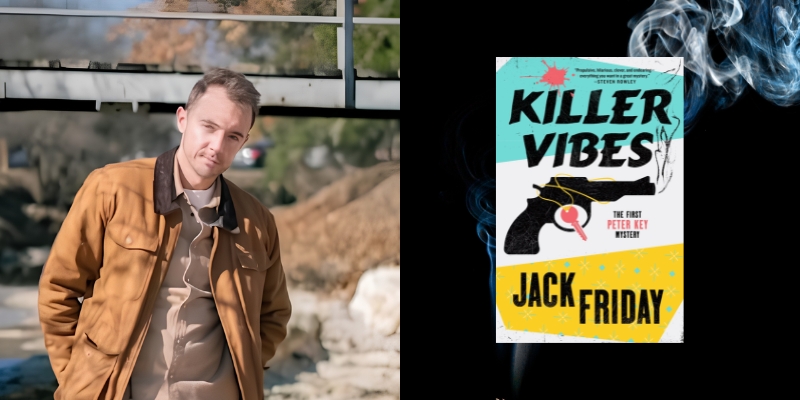
It was this quality—this awareness of the way fast money and artificial identities corrupt everyone they touch—that I sought to imitate when I started writing my own private detective novel, Killer Vibes. In that book, an aimless young man named Peter Key has coasted through most of his twenties on good looks and marijuana, but his thirties are looming, and so are the consequences of his (in)actions.
Peter suddenly himself on the verge of homelessness, only to be rescued by the news that his uncle has died and left Peter with a house in Hyde Park, one of the most desirable neighborhoods in Austin, Texas. It’s not long before Peter realizes that his uncle’s death might not have been an accident, though Peter also soon realizes something else: he’s pretty good at solving mysteries.
Austin isn’t Los Angeles, but it’s a fertile setting for a crime novel for much the same reasons outlined above. Similar to LA, it went through a wild expansion and evolution, growing from a lazy college town into a booming tech mecca in a few short decades. In the same way that national advertising and the railroads allowed LA’s boosters to attract new citizens from across the country, savvy social media marketing and the rise of remote work allowed hordes of white collar workers to sell their expensive California homes and buy in Austin for half the price, rapidly swallowing the city’s available housing stock and driving property values through the roof.
For a time, Austin was growing so fast that ninety-seven percent of its apartments were occupied. It was also, tellingly, one of the only cities in the country with a shrinking Black population, thanks to aggressive gentrification and brutal property taxes.
It was a tough time for the city. And what did we get in exchange? Eight million micro-influencers trying to launch their own energy drink companies, swathes of thirty-something tech bros who dabble with hallucinogens to pretend they’re not getting older and a shrinking service class that can barely afford the rent and will never be able to buy.
I’m being facetious about the first two categories (but only barely) and sincere about the third. Austin is a city that looks gorgeous, is full of hot people and cool cars and funky murals, that prides itself on being “the liberal blueberry in the cherry pie of Texas,” but it all feels a little hollow, a little desperate to impress. At its core, Austin is just another example of hyper-capitalist extravagance not so different from Chandler’s LA. It, too, has become a brand of itself.
Peter Key, my lazy stoner PI, soon finds himself navigating trouble up and down Austin’s class ladder. He pisses off rich millionaires and poor thugs, wards off real estate agents and property managers and a dozen other grifters trying to scrape some cream off the city’s frothing property market.
But Peter does it in a way that, I hope, sloughs off some of the more exasperating qualities of Chandler. Peter doesn’t have of Marlowe’s dour posturing or preening fatalism. As an out and proud bisexual, Peter (hopefully) possesses none of Chandler’s obvious fear of women or repressed homoeroticism (it’s telling that no female characters in The Big Sleep are ever described with more than a few lines, nor in a way that betrays a hint of desire, but the handsome houseboy of a gay pornographer is given a half-page’s worth of ogling and the chance to literally wrestle around, at length, with Marlowe.)
But Peter hopefully possesses some of Marlowe’s finer qualities. He’s an outsider, a man with nothing to lose, has a moral code sturdy enough to endure the twenty-first century’s brutality but flexible enough not to break its owner. Peter has, above all, a skeptical eye and a good nose for bullshit, the two greatest traits Chandler gave to his own detective. And like Marlowe in LA, Peter finds plenty of both in Austin, along with a whole pile of trouble.
***

Jack Friday
Jack Friday is the pen name of John Fram, the author of several queer supernatural thrillers such as The Bright Lands and The Midnight Knock. He lives in Austin, where he does as little as possible.