Heather Harper Ellett on Narrative Therapy, Southern Noir, and "Re-authoring" Our Lives
The author of 'Ain't Nobody Nobody' on changing endings.
In the fall of 2019, my debut novel came out: Ain’t Nobody Nobody—a quirky, small town literary crime novel set in East Texas. It was reviewed well. I got compared to Carl Hiassen, which would never hurt my feelings, and I got supportive feedback, especially from people with rural roots: “Oh, Gabby’s my aunt! Oh, Mayhill’s my grandaddy!”
Second only to Animal Farm, it was a bestseller in literature with swine on the book jacket. I also became The Person you texted if you saw a news story about feral hog invasions. It was a glamorous time.
A debut is an exciting time for any author, but looking back at fall 2019, I’m reminded of the Hitchcock line so oft-repeated I’m reluctant to repeat it here: “If [a bomb goes off], the public is surprised….But in a suspense situation…the public knows [the bomb] is going to explode….”
Now, of course, we know that in the fall of 2019, the bomb was already falling, and we would soon be Cloroxing our spaghetti squash and meeting our book clubs in weird circles of lawn chairs outside, screaming from six feet increments: “WHAT DO YOU THINK THE WHALE SYMBOLIZED, CAROL?!”
More locally though, in a bit of foreshadowing, three weeks after my book’s release, a tornado destroyed the beautiful bookstore where my book launch took place. Six weeks after that, my long-time mentor died.
And, in the course of the next two years, four of my dearest friends would pass away. And so did my brother. Unexpectedly. In fact, the last conversation I had with one of those friends was about a line in my book in which a tragic character contemplated buzzards circling overhead and what it means to be lucky in this life. We never could decide.
In all that time, I was giving regular talks at bookstores and book clubs and the occasional conference, but the ending of Ain’t Nobody Nobody always bothered me. The ending was darker than I had intended and darker than I felt the book deserved. I could defend the ending like a good literary student. It was technically correct. I could point to the Hero’s Journey and explain how the protagonist’s want was set in motion by the Inciting Incident and realized by the Resurrection.
But it never set right with me. It had been a last-minute change that, I felt, spoke more to the Southern Noir genre that the novel was being pitched as.
As a consequence, I felt very weird talking about the book. “The ending surprised me,” readers would say—not unkindly but a little wanting—like they were waiting for some justification. One woman cried to me about it. Cried! The best I could muster was one of those cryptic authorly adages that I would have eye-rolled had it not been me saying it: “The ending surprised me too.”
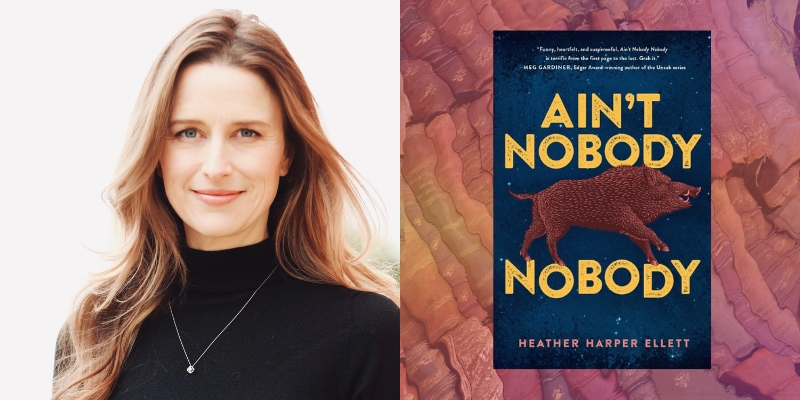
A few years later, the book’s publisher, Polis Books, closed its doors, and sold Ain’t Nobody Nobody to a wonderful new publisher, Datura Books. Not only would Datura reprint the book; ANN would get an entirely new marketing campaign, an audio book, a new cover (with a way better hog than Animal Farm), and a new editor.
It was that brilliant new editor, Daniel Culver, to whom I confessed how much I hated the ending. And it was also Daniel—lover of cats, unfortunate hater of excessive similes—who said in his authoritative British accent, “You know, I think if the ending has bothered you this long, seems like a reason to change it.”
And so, I was granted permission to do the unthinkable: change the ending of my novel.
*
Here on Crime Reads in February, Christopher Huang asserted that crime fiction is a proxy for real life justice, something that is especially needed right now. I’d go a step further and say that all novels are a proxy for whatever we’re working out, the way our dreams are a clearing house for randomness.
It doesn’t take a therapist (which, ahem, I am) to figure out that I was probably so hung up by the ending all those years later because of all the grief I experienced shortly after its publication.
Or maybe I was bothered that I let a last-minute rewrite change the direction of something I had worked so hard on for so long. Or maybe it was debut jitters. Maybe it was the woman who cried. Cried!
Maybe. Probably. I don’t know. And I’m not sure the why of it even matters.
One of the most important things I’ve learned as a therapist is that our stories are living, wild things that take on different shapes, depending on when we recall them.
There’s a form of therapy called narrative therapy in which we “re-author” the parts of our life that aren’t working. It’s not that we deny reality and change the facts. We change the angles. We change the protagonist. We change the perspective.
A classic example is someone who has survived a horrific attack. For obvious reasons, the person starts out telling their story as a victim of a terrible crime, but, over time, in narrative therapy, the story is re-authored to emphasize the survival and resilience that existed in the tragedy all along.
At the end of the day, the purpose of reading and writing fiction is to work out our feelings on a subject, to figure out what’s true for us. What’s true for me is I prefer stories that emphasize life and weirdness and justice and hope and happier conclusions. What’s true is I’ve always been a little dark, but there’s always hope poking out around the edges, like a full solar eclipse. What’s true is I’ve always been less Southern Noir and more Southern Gris. All it took was for me to publish a few thousand copies of a book to find that truth.
I like the idea of re-authoring in fiction. I wish more authors would do it. Not just for the havoc it will cause at book clubs. But because it says that all stories are a conversation, and we are all participants. That whenever you want, you can write a story in which the good guys win and the bomb under the table never went off.
And that’s okay because, even in crime fiction, sometimes the world needs a happier ending. Sometimes the author needs that.
***


Heather Harper Ellett
Born and raised in in the Piney Woods of East Texas, Heather Harper Ellett is a graduate of SMU and a therapist in private practice. She lives in Dallas with her husband and son. Her debut novel, AIN'T NOBODY NOBODY, will be published in Fall 2019 by Polis Books.