
Sparkle: Teen Dreams and Ghetto Superstars
Michael Gonzales on a classic of 1970s NYC cinema.
While most movies released during the 1970s Blaxploitation era were action flicks about pimps, drug dealers and rogue vigilantes, Sparkle (1976) told a different story. With a plot about struggling recording artists during the late-1950s/ early-1960s, romance and a tight family struggling to overcome adversities, Sparkle was directed with atmospheric flair by Sam O’Steen. Still, it would be dishonest to make a flick about the music industry without showing the crime aspects as well; Sparkle went heavy into the shady side which included mafia gangsters, heavy drugs, near deaths and no-good men just leeching off of talented youngsters.
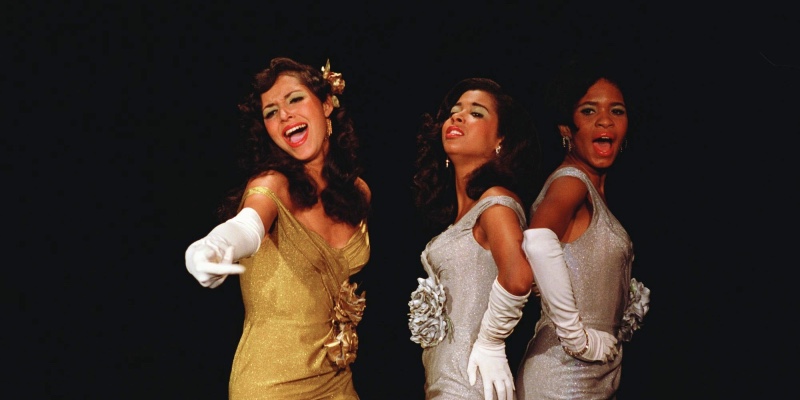
A period piece that begins in 1958, Sparkle details the rise and fall of a trio of female siblings played by then-newcomers Lonette McKee (Sister), Dwan Smith (Delores) and Irene Cara (Sparkle). Determined to sing their way out of the hood of Harlem, the film also stars Dorian Harewood as Levi, a former group member turned gangster, and future heartthrob Phillip Michael Thomas (Miami Vice) as Sparkle’s beau and struggling songwriter/manager Stix.
In reality, the film’s stellar songs were written and produced by Curtis Mayfield, the Chicago native who proved his genius on the seminal soundtracks Super Fly (1972) and Claudine (1974). As the former maestro and lead singer for the Impressions, Mayfield also wrote and produced 1960s soul sides for early girl groups the Fascinations and Patti Labelle and the Bluebelles.
From the first scene of the girls singing in the church choir, the camera follows them into their modest tenement apartment, headed by their no-nonsense, yet loving mother Effie (Mary Alice) who works as a domestic. “Mary Alice delivers a sympathetic and impactful portrayal as a mother who struggles to keep her family grounded,” explains Philadelphia radio personality and Unsung commentator Dyana Williams. From the sage advice Effie gives her daughters to staring down the “rat” gangster Satin inside a smoky nightclub, she is no joke. “Fifty years later, her performance still comes across as solid.”
In a magazine interview Irene Cara, who died in 2022, said that she was “familiar with ghetto life” after her family traded their modest beginnings for Manhattan to aid her showbiz ambitions. Beginning as a child actress, Cara made her film debut the year before in Aaron Loves Angela. “The 1970s began a renaissance in black cinema,” said Cara, who later starred in the film Fame. “It’s nice to be a pioneer.”
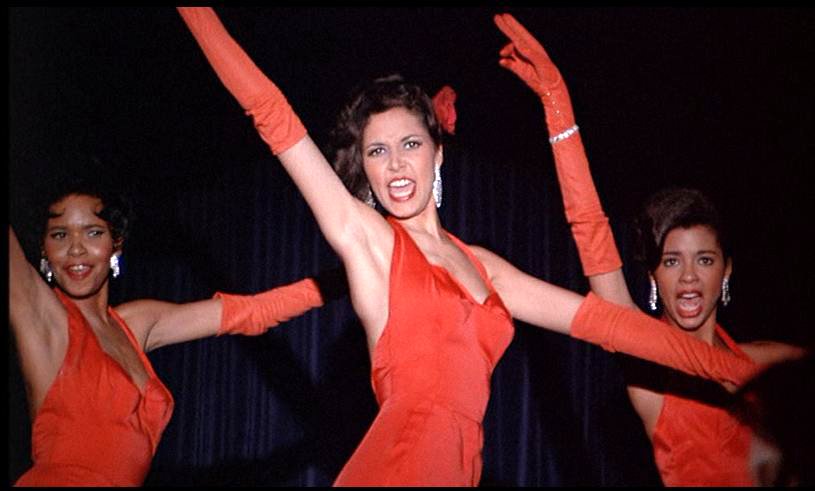
Penned by native New Yorker and future director Joel (The Lost Boys, Falling Down) Schumacher, who was supposed to direct the film version of Dreamgirls, the Sparkle script was the cinematic version of a melodramatic pop song as it examined the early girl group period.
Undeniably, Harlem from the 50s and 60s was where many female singers emerged from and thrived, at least for awhile. Harmonizing on stoops, rooftops and (hopefully) the stage of the Apollo, some of the pristine voices floating from the streets went on to become Brill Building wonders. Sporting fancy names like the Bobbettes and the Shirelles, many of the groups achieved exhilarating success before painfully crashing back to earth.
“The girl group era was a wonderful time,” remembers Nona Hendryx, formerly a member of Patti Labelle and the Bluebelles; the group changed their name to Labelle in 1970. “Girl groups provided a magical matching of voices that were something special.” Although Barry Gordy’s sequined dolls The Supremes later became superstars, it was those earlier artists from the 1950s (The Teen Dreams, The Chantels and The Chordettes) who laid the foundation for everyone from the Ronettes to En Vogue, who remade “Giving Him Something,” a song from the film, in 1992.
In the beginning of Sparkle, the movie focuses on the ambitious oldest child Sister, a character who transforms from neighborhood hottie to fierce lead singer of Sister and the Sisters. “I want the big time,” she said boldly. Portrayed by Detroit native Lonette McKee in her screen debut, in 2011 she told me from her home in New York, “When I was younger, I was a little wild, but I wasn’t bad. I modeled the character on my older sister, who was really fast. To me, bad girls are always more interesting to play.”
Yet, while Sister has the beauty and sass to become a star, she didn’t have the brains to maintain her rising fame. She hooks up with sharply dressed Harlem kingpin Satin Struthers (Tony King), who beats Sister constantly and gets her addicted to cocaine. “Sister can’t fly on one wing,” she says sorrowfully backstage at the Shan-Doo Club before taking a hit. While the Sister character was clichéd, riffing on the drug-addled legacy of Billie Holiday, the performance McKee delivered was powerful.
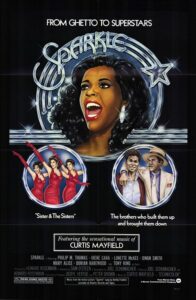
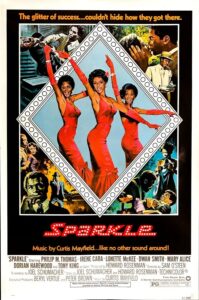
Acclaimed New Yorker magazine film critic Pauline Kael compared McKee to the “sexy brazenness of Ava Gardner” while lambasting the predictability of Sister’s downfall at the hard hands of Satin. “Tony (King) played a tough guy, but off-screen he was very sweet and compassionate person,” McKee said. “He and I are still friends.” 1970s film fans will recognize King, a former professional football player with the Buffalo Bills, from Shaft and Report to the Commissioner.
Contemporary soul singer Goapele recalls, “I saw Sparkle when I was a teenager and it was scary when Sister overdosed on drugs and died; thinking about it now, I’m reminded of Amy Winehouse as well as Jimi Hendrix and Janis Joplin. I’ve wanted to be a singer since I was a kid, so those scenes served as a warning of how I didn’t want to go out.”
Writer Erika Blount, a fan of the film since the days of her youth growing-up in DC, said, “My only problem with the movie was the death of Sister. She had a certain freedom about her as well as being the best singer and dancer in the group. She should have been celebrated instead of killed off.”
Before her death, Sister and the Sisters proved to be stylish performers as they flounced on stage singing Mayfield’s songs dressed in gorgeous gowns. “One of the important elements of the film was Lester Wilson’s choreography,” said dance aficionado Brian Scott. “Wilson, who later worked on Saturday Night Fever, put beautiful movements into every word sung. From Sister’s breakout in the ‘Jump’ scene to the last number of Sparkle Williams and the Soul Ladies doing ‘Loving You Baby,’ the moves are subtle and natural.”
After Sister was buried and the mourning was done, the second half of the picture centers on Stix grooming Sparkle to head-up a new group. After borrowing cash from Effie’s gangster employer, a move that almost got him killed when the mob wanted a bigger slice of the musical pie, Stix also romances Sparkle. Inspiring her to record a couple of hits (the duet “Look Into Your Heart” and “Loving You Baby”), the film ends with Sparkle performing at the prestigious Carnage Hall.
Utilizing his trademark smooth crushed velvet vibe, seductive grooves and swooning vocals on “Something He Can Feel” and “Hooked on Your Love,” Mayfield’s songs were as much the stars of Sparkle as any of the actors. Mayfield’s arrangements are silky, the harmonies are gorgeous and his lyrical visions enchanting.
“When I first started making music in 1958, a song was 2:45 at the longest,” Curtis Mayfield recalled at his Atlanta home in 1996. “I would get ideas from meditations or by the laughter and happiness of the moment, or just good down to earth, one on one conversations. All the hurt and reflecting on life, that also went into the songs.”
While the talented actresses in Sparkle sang Mayfield’s material in the movie, when it came time to record the official soundtrack album, Mayfield chose Atlantic Records soul star Aretha Franklin. “Nothing against the Queen of Soul, but in retrospect that was a crazy decision,” said McKee. Still, needing a comeback in her corner, the Sparkle soundtrack proved a major success for Franklin.
In 1996, I asked Mayfield if he gave Franklin much direction in the studio. “Who am I to tell Aretha how to sing?” he replied. “Her voice just speaks for itself. However, we got into little disagreements, but it was no big deal.
“As artists, we can all be a little temperamental, but here was a lady who was a star for many years. I had everything prepared in such a manner that when Aretha arrived the arrangements were done, and all she had to do was sing the songs. Lucky for me, they were good songs. The importance is the final outcome.”
In the end, the soundtrack for Sparkle initially did much better than the film itself. “I don’t think the producers really knew what to do with the movie,” McKee, who later co-starred in Francis Ford Coppola’s Cotton Club (1984) and Spike Lee’s Jungle Fever (1991) told me. “The Blaxploitation era was nearly over and Sparkle was a period piece musical, so the studio was baffled on how to market us.”
Fortunately, through various repertory movie houses, film festivals, college campus screenings, video tapes, TCM and finally, in 2007, DVD, Sparkle found its audience. “One of the best things to emerge from the film version of Dreamgirls is the (DVD) release of an even better movie,” Entertainment Weekly film critic Ken Tucker wrote about Sparkle in 2007.
In August 2012, 36-years after the original, a remake of Sparkle starring Jordin Sparks as Sparkle, Carmen Ejogo as Sister, Whitney Houston as Effie and Mike Epps as Satin was in theaters. “I have nothing against the remake, but it will be highly scrutinized by the millions who loved the original,” McKee told me a year before it was released. “Filmmakers always want to try and remake a classic and Sparkle is definitely a classic.”
Sparkle via YouTube: https://www.youtube.com/watch?v=-jybRUMM-Fo

Michael Gonzales
Harlem native Michael A. Gonzales is a cultural critic, short story scribe and essayist who has written for The Paris Review, The Village Voice, Wax Poetics, The Wire UK, Maggot Brain and Pitchfork. His fiction has appeared in Under the Thumb: Stories of Police Oppression edited by S.A. Cosby, Taint Taint Taint, Dead-End Jobs: A Hit Man Anthology edited by Andrew J. Rausch, Black Pulp edited by Gary Phillips and The Root. Upcoming stories will appear in The Book of Extraordinary Femme Fatale Stories edited by Maxim Jakubowski, Get Up Offa That Thing: Crime Fiction Inspired by James Brown edited by Gary Phillips, Killens Review of Arts & Letters and Obsidian Literature & Arts in the African Diaspora.