

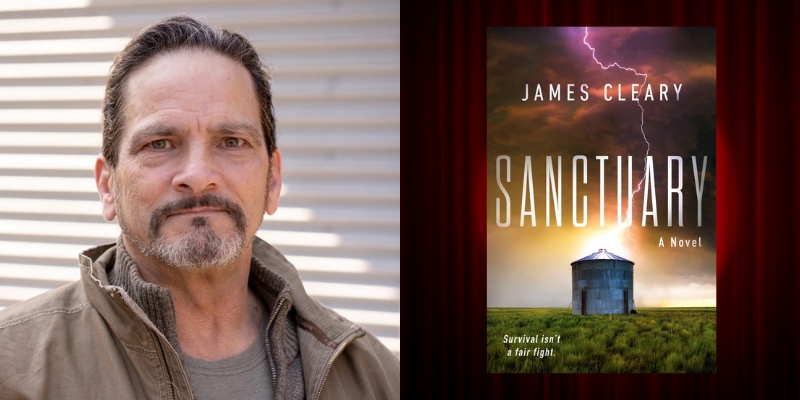
James Cleary on What Stage Acting Taught Him About Writing and Storytelling
The author of Sanctuary compares lousy rehearsals to lousy first drafts
“ACT I
SCENE 1
A country road. A tree. Evening. Estragon, sitting on a low mound, is trying to take off his boot. He pulls at it with both hands, panting. He gives up, exhausted, rests, tries again. As before. Enter Vladimir.”
These are the opening stage directions to Samuel Beckett’s masterpiece, Waiting for Godot, which I had the pleasure of performing in many years ago. My day-job (well, actually, night–job), which has made it financially possible for me to be a writer, is acting in the theater. I know. Irony of ironies.
Acting, however, has been a godsend to me as a writer. First off, the theater’s work day traditionally begins at noon, which has allowed me to maintain an early a.m. writing schedule over the years.
But secondly, and more important, it has allowed me to be deeply exposed to—literally inside of—some of the world’s greatest literature. Ever since I was a young, un-read, man, fascinated but ill-equipped with language, the theater has been my Harvard and my Yale, to paraphrase what Melville said of whaling. (I could never have gotten into those schools anyway. I’m a community college poster child.)
The similarities I have found between writing and acting continue to intrigue and fascinate me. One lends itself so fully to the other.
Which brings me back to Waiting for Godot. There is an early scene in play where the dialogue is extremely dense with religious allusions, metaphor, symbolism, biblical half-quotes—every line could be mined for a deeper meaning than first appears on the page. I was playing Estragon, and in this first scene I was trying to get my shoe back from the other character, Vladimir. (There’s a lot of vaudevillian hat and shoe “business” in the play.) I’m not sure what I was doing, but the director was clearly not very happy with it. My acting choices were very deep, very complicated, very sub-textually driven—very boring.
But I thought at the time that I was fulfilling the demands of the language: digging deeply into the metaphors and similes, lingering on the religious symbolism and thematic undercurrents. (It’s a tragicomedy, not just a tragi.)
One day, during a particularly overwrought, and I imagine excruciatingly ponderous rehearsal, the director finally shouted at me from behind his table.
“JUST GET THE DAMN SHOE!”
(me) “The…I’m sorry, you mean…do you—”
“JUST USE THE WORDS YOU HAVE TO GET THE SHOE!”
Note taken.
And a great one.
Once I used the words to get the shoe, the language began to take care of itself.
Embarrassing as a ‘teachable moment’ like this may be—and I have had many—the good thing is, I never forget the lesson. (Mostly because it’s been seared into my brain through public humiliation.) This, however, doesn’t mean that I’m always able to avoid making the same mistakes in the future. But I do begin to notice them. Which is step number one. And then, eventually, hopefully, with enough noticing, I can begin to police myself. And, if not, I enlist my colleagues—the director, other trusted actors—to join the force and help watch and listen (like good editors).
The goal is always, of course, whatever is best for the story. Engaging, clear, truthful, storytelling. The audience wanting, needing, to know “what’s going to happen next” is at the very heart of theater.
For me, it is theater.
I have found this also to be true of my writing. I’ve also found that I sometimes stumble into the same pitfalls while writing. Although I may have different words for them while writing, the objectives are pretty darn similar: engaging, clear, truthful, storytelling. The reader wanting, needing, to know ‘what’s going to happen next’.
I’m sure most of you have heard of Anne Lamott’s wonderful book on writing (and life) called Bird by Bird. I’m known for being the largest purchaser of the book in Wisconsin, where I live, because I give it out yearly to young writers I meet, and young actors, because I find the coaching in her book extremely applicable to both. It’s one of those books where you can simply substitute whatever art form you practice, or your vocation, or job, or craft, and it will speak to you.
When I was engaging in all kinds of extremely weird things training to be an actor (don’t ask), required reading in acting school at the time had been Zen and the Art of Archery. This is my Zen and the Art of Reading Anne Lamott.
I’m particularly fond of her chapter entitled “Shitty First Drafts.” (Thank you, Anne.) I read it whenever I am feeling a little overwhelmed by the page.
Interestingly enough, for me, I find shitty first rehearsals nearly identical to shitty first drafts. I need the space, the permission, to suck. My goal, of course, is not to suck, but if I’m worrying too much about sucking, while I’m writing or rehearsing, I inevitable do suck. I try to chase those thoughts away. There will be plenty of time later to find out whether I was sucky or not. I’ll finish a rehearsal and know that it was a hot mess, or the director will tell me it was a hot mess, or maybe only ninety percent of it was a hot mess, but that other ten percent—well, that was a keeper. I save it and build from there.
It’s so very much the same for me while writing. Sometimes I’ll look at the previous day’s work and think, “Who in god’s name wrote this? Was I drunk?” Sections that are overwritten or overwrought, or pat, or where you hear the writer (me) up on the soapbox.
But—like Ms. Lamott says—nobody’s going to see my shitty work (hopefully), so it’s okay. It’s in process. And sometimes, in all my messy writing, there’s a page, or a paragraph, or a single sentence, or maybe even just the beginnings of an idea. And it’s a keeper. It may even be the moment that changes the entire course of the book. The same is true for me in theater: a little moment discovered in the middle of an otherwise lackluster rehearsal may just change your entire approach to the character.
But I may never have found that moment (as Ms. Lamott reminds us) had I not slogged through the “other” stuff. I’ve come to accept—no, I’ve actually come to embrace—that the “other stuff” is actually my process. I didn’t know I had a process. I always kind of wanted one. People used to ask me, and I didn’t know what to say. I guess that’s it.
For many years, I’ve had a secret mantra that would sound in mind while writing, to help quiet the inner critics in my mind (the “screaming monkeys,” as Ms. Lamott so wonderfully calls them). The mantra was, “Shut up and write!” Rebuking myself worked pretty well for a while.
In acting, I had a similar mantra: “Shut up and talk!” That worked pretty well too. For a while. Later, it shifted to “Shut up and listen!” (Listening being the real key to acting.)
My writing mantra also changed over the years. When the shrieking meanies on my shoulder were clamoring that I was going down the wrong road, again, and I really should stick to filleting fish (another story), a new mantra showed itself. It snuck in kind of quietly, saying: “This is the work.” Just keep going. This is the work. Still later (I’ve been doing this a long time), the voice simply said, “Trust.”
I kind of like that one.
A gentler coach seems to be strolling the bleacher seats of my mind now. A less punitive one. Probably because I’m getting older and bootcamp tactics just don’t work that well anymore. But the message is still the same. Just a different delivery. A little kinder.
Trust.
***


James Cleary
James Cleary is a pseudonym for James DeVita. He is a native of Long Island, NY, and a recipient of the National Endowment for the Arts Literature Fellowship for Fiction. James is also a theater professional, and has worked extensively as an actor, director, and playwright. He is the author of Sanctuary.