
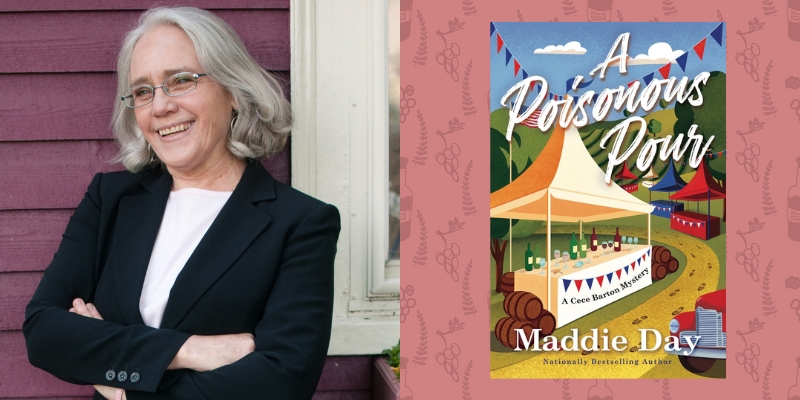
Maddie Day on Cozies, Touring Wineries, and Turning Book Research into Fun
The author of A Poisonous Pour treks through California wine country
Readers should know that I’m a fourth-generation Californian, despite having now lived in Massachusetts for forty-five years. When my Kensington editor asked if I’d like to write a new series set on the west coast, I said, “Yes, please!”
I offered him a choice of three California locations, and he chose wine country. As a person fond of sipping wines, both award-winning and quotidian, I didn’t have trouble figuring out how to start my research for the Cece Barton Mysteries.
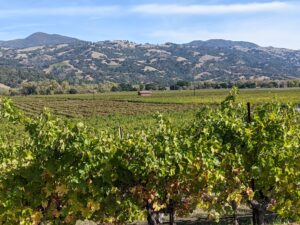
I anchored the series in beautiful Alexander Valley in the top part of Sonoma County about ninety minutes north of San Francisco. It’s a rich wine-producing region but less well-known than Napa. Cece lives in the fictional town of Colinas (which appropriately means ‘hills’ in Spanish) somewhere in the valley and owns the Vino y Vida wine bar.
I was lucky enough several times to grab a solo writing retreat in my San Francisco uncle’s vacation home in Geyserville, which also served as a home base for my research in the valley.
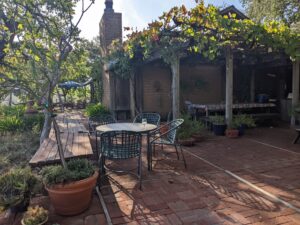
On one of my first research trips, I drove all around the area. I stopped for lunch with former college friends in the town of Healdsburg, where I also wandered through the farmers’ market and tasted local olive oil. After that I had to stop at the eponymous Alexander Valley Winery nearby. I stood at the bar and tasted several delicious wines.
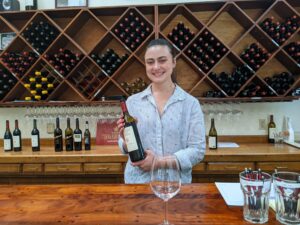 Alexander Valley Winery Tasting
I picked the brain of the young woman pouring. I asked what they did with half-full bottles at the end of the day. I learned about the gas they pump in to preserve the wine overnight and the kinds of corks that both let them pour and also keep oxygen out. She told me about the family who owns the vineyard, where workers live, and that the owner makes olive oil from their own trees (the oil I’d tasted in Healdsburg).
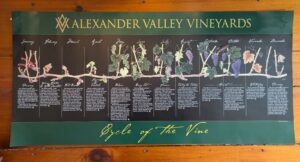
I even bought a wonderful poster showing the timeline of the grapevines and the work done on them each month of the year.
Another day I visited the historic adobe structures on Geyserville’s main drag and stopped into a tasting room. Adobe is a classic building material of the entire southwest region, and I wanted to include it in the series because of its addition to the flavor of the setting. Those adobes inspired the string of four adobes in the Cece Barton books—one of which houses Vino y Vida, her wine bar.
The woman serving wine at the Locals Tasting Room also provided details about the business, including prices and busy times. They serve wine from eight local wineries, a detail I thought would be good for Cece’s establishment.
A neighbor of my uncle’s invited me over for supper that evening. Jo is a wine writer and owns one of the kits that sommeliers use to study the identifying scents and aromas of wine. It held over a hundred tiny vials to sniff and included flash cards so people could study to pass their sommelier tests.
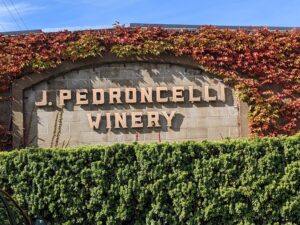
When Murder Uncorked, the first book in the series came out, that same friend helped arrange a book launch party at the Pedroncelli Winery, another family-owned vineyard in the area. The owners were generous and hospitable, and we filled their tasting room with book- and wine-lovers.
Before the launch party, my San Francisco cousins took me out to a wine tasting at a different winery. We sat outside overlooking the Twomey vineyards, tasted the wines explained by our presenter, and nibbled on an amazing spread of charcuteries. I brought home the menu for the wines and have mentioned several of them in the books.
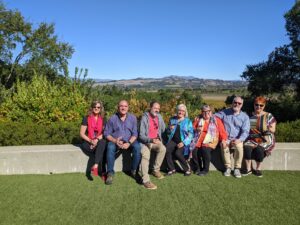
For Deadly Crush, the second book, I wanted to learn about vineyard equipment. On my next trip back, the Pedroncelli owner connected me with the vineyard field manager, who was amused when I asked to see any lethally sharp tools the workers use—but not too amused to display them for me.
On another visit, a different friend of my uncle’s arranged a visit to a big wine production facility where someone she knows is the facility manager. Victoria loves mystery novels, and the two of us kept exclaiming about potentially dangerous parts of the industrial process where ripe grapes are turned into wine. Some of those bits of research made it into the new book, A Poisonous Pour.
Here’s a different kind of research. One early morning sitting outside at my uncle’s hilltop place, I saw fog rise to fill the entire valley, with only a few mountaintops sticking up through it. The mood was mysterious for hours. That was the morning Victoria picked me up to visit the production facility. She said the fog would burn off by eleven, and it did, leaving a lovely fall day.
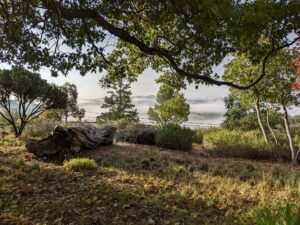
Note: this is a strong vote for doing research in person in the setting authors are writing about. I never would have known about that fog event if I hadn’t been sitting on the patio with my coffee that morning. And did I use the fog rise in A Poisonous Pour? Readers, I did.
Other kinds of in-person research included smelling the trees and wild brush, which are always too dry. Watching California quail with their goofy topknots running along the top of the fence and listening to the acorn woodpeckers drill destructive holes in wooden buildings. Learning how the gentrification of formerly sleepy, artsy Healdsburg is now pushing out blue collar and farm workers. Talking to valley residents about the danger of wildfires and their evacuation go-bags.
All those details add life to a story, and I loved including them.
Does all research have to be in person? Not at all. From the privacy of my home office in northeastern Massachusetts, I verified numerous details. I looked up the toxicity of castor beans and what the seed pods look like. I checked on wine preservatives and allergies to them. I researched the history of the local Native American tribes and of the nineteenth century Black settlers of the area, along with the valley’s earlier fame as an orange-growing region. And so much more.
I had to be careful not to get too lost in the research. A few real bits go a long way, and the most important thing is the story of the murder and how it gets solved. But I sure had fun disappearing down rabbit holes!
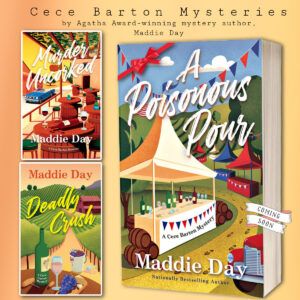
At the Memorial Day weekend classic car show and wine tasting, northern California wine bar owner Cece Barton witnesses heated discussions with local vintage car owners and overbearing association director Regan Greene. After Regan is later murdered, Cece once again enlists her twin, Allie, as her partner-in-sleuthing to clear the name of Cece’s elderly but muckraking neighbor. But they’ll have to act quickly to investigate various suspects in the case before the trail goes sour.
***

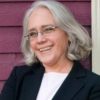
Maddie Day
Maddie Day writes the Cece Barton Mysteries and other gentle and historical mysteries; as Edith Maxwell, she writes Agatha-Award nominated short crime fiction. She’s a member of Mystery Writers of America and a proud lifetime member of Sisters in Crime. Originally a fourth-generation Californian, Maxwell/Day lives north of Boston with her beau and their cat Martin, where she writes, cooks, gardens, and wastes time on Facebook. Find her at edithmaxwell.com and at Mystery Lovers’ Kitchen.