
William Bernhardt on Comics, Superman, and the Legal Drama Behind an Icon's Creation
The author of The Superman Wars in conversation with L. Wayne Hicks
Keen-eyed readers of William Bernhardt’s last novel, Justice For All, might have noticed the dedication: to Jerry Siegel, Joe Shuster and Bill Finger, three legendary figures in the world of comic books. Published in 2024, Justice For All dives deep into the legal machinations a comic book artist must go through to win back the rights to his characters. The initial idea, that of art vs. commerce, served as a springboard for Bernhardt to explore the tragic tale of Siegel and Shuster.
Siegel, the writer, and Shuster, the artist, created Superman. The first superhero, Superman made millions and millions of dollars for its publishers but by comparison relatively little for the two.
Siegel dreamed up the character in 1933 and tried without success for years to find a publisher. The boys finally saw the debut of Superman in 1938, but in their eagerness to make that happen signed away the rights to the character for $130. The money they made after that came from what they received per page for their stories and artwork (and, decades later, pensions from the publisher).
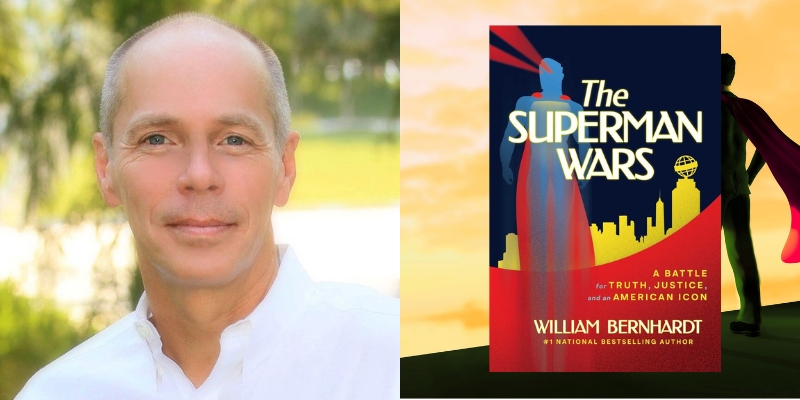
Bernhardt’s nonfiction tome, The Superman Wars, tells their story. An attorney as well as a writer, Bernhardt spent more than two years researching what Siegel and Shuster endured.
Their initial publisher found himself squeezed out by two men with mob connections—Harry Donenfield and Jack Liebowitz—who benefited from the Superman radio series, movie serials, television shows and merchandise sales. By the time George Reeves donned the familiar costume for the 1950s The Adventures of Superman television series, Siegel and Shuster were practically destitute—fired after having the nerve to sue the publisher in 1947.
The story of Siegel and Shuster has been told before—most notably in Brad Ricca’s 2013 book Super Boys: The Amazing Adventures of Jerry Siegel and Joe Shuster—the Creators of Superman. Bernhardt has updated the long-running legal battles the two men and their heirs endured over the rights to the character. The subtitle of his book is A Battle for Truth, Justice, and an American Icon.
Bernhardt is a longtime fan of comic books. A virtual interview from his home office in Oklahoma shows Bernhardt wearing both a sweatshirt and ballcap bearing the familiar Superman insignia. Behind him are shelves of his books. The Superman Wars is his sixty-seventh.
*
L. Wayne Hicks: What are people going to learn from your book that wasn’t in Brad Ricca’s book?
William Bernhardt: There are several things. And don’t think I’m putting down Brad’s book, because I like his book, and I like him. I thought he was a really generous guy when I interviewed him. The first thing I said was, “Are you thinking about doing a second edition or an update or anything?” He said no. I said, “Okay, I don’t want to step on your toes.”
But for one thing, his book’s about fifteen years old now, and we’ve discovered a lot since then. I’ve discovered some things since then, and others have as well. He couldn’t tell the end of the lawsuit, because that hadn’t happened yet. That didn’t happen until 2016, that it was all over. The Siegel family did not talk to him, at least not on the record, because there was pending litigation.
I did eventually get them to talk to me, which was a real treat. I dug up the bankruptcy papers and figured out what really went down, and so I’m able to explain that, and I think the other lawsuits as well, in a way that will make it more comprehensible. And at the same time, I tried to write those things so that you don’t have to go to law school to understand it. It’s going to be understandable to anybody.
LWH: The mob ties kind of threw me. I didn’t realize the publishers were connected.
WB: Harry used to brag about it. He wasn’t embarrassed in the slightest about that. He ended up getting a house on Long Island near Frank Costello. Harry did some rum running back in the day. He was indicted twice for pornography. That was another appeal of Superman for him – doing something that was clearly for children. It was not what those guys called a “Sing Sing job,” meaning it’ll end you up in prison.
LWH: Justice For All, which you dedicated to Jerry and Joe and to Bill Finger, did that start you thinking about writing The Superman Wars?
WB: Maybe not at first. I probably wouldn’t have dedicated the book to them if I realized the next book was going to be about them. I’m probably going to get some grief from people because I focused on Jerry Siegel. I really was not trying to cast any shade on Joe Shuster at all, but it was Jerry’s idea, and Jerry’s the writer. I like writers. I can relate to writers.
The whole history of comics might have been altered if Jerry Siegel had just had an agent or a lawyer, but he didn’t. He lost his father when he was seventeen, so he really had no one to advise him. Joe’s father was an elevator operator at a local hospital. Nobody had any business or legal experience. Nobody could teach them how to invest their money. That ended up hurting them in the long run.
LWH: How long did it take you to write The Superman Wars after finishing Justice For All?
WB: Around two years. I ended up traveling to eight different states to talk to people or look at library collections. I interviewed more than fifty people. I went through…I couldn’t even tell you how many books and periodicals. There’s a lot of good material and interviews with people who have long since passed in some of those old fanzines or magazines that focused on comic book collectors, but nobody had ever brought it together in one place before. That was valuable.
I wrote it in kind of a narrative nonfiction style, because I didn’t want it to just be here are the cold facts. And I wanted it to be not just what happened, but why. And to understand that you need to understand who Jerry Siegel was, so I started there and moved forward.
LWH: You said people are going to be upset that you did not focus as much on Joe Shuster. Is that partly because Jerry left a better historical record?
WB: Yeah, in a way. That’s true. But that’s because Jerry was always, in effect, their agent. He was the hustler. Joe was, by all accounts, a very gentle, mild-mannered, relaxed guy, but he never could have gotten anything published. Jerry was the guy who relentlessly sent the material out over and over again, and as you know from the book, we’ve got ten years of correspondence between him and Jack Leibowitz, where Jack is, in my view, absolutely abusive, insulting, infantilizing, constantly threatening them with being fired, despite the fact that they’ve supposedly got this five-, then ten-year employment agreement.
What is really immoral is their name was removed from their creation. I mean, sure, legally, you could say Jerry messed up. He shouldn’t have signed that document, but taking their name off the strip, that’s wrong. That is fundamentally wrong.
LWH: Which was the bigger problem: the boys being naive, or the publishing executives being crooked?
WB: I’m going to go with the latter. Because, you know, the Major (Malcolm Wheeler-Nicholson), the guy who founded the company, was perhaps not the world’s greatest businessman, but he was a writer. He understood that creatives deserve to be paid, and sometimes he was late, he didn’t pay that much, but his idea was that someday we’re going to have a breakthrough, and then I’m going to share it with everybody.
That’s what he says at the bankruptcy courts. He says, if you let this go through, these guys aren’t going to treat the creatives the way I did. And boy, was he right about that. This was such an unexpected windfall to Harry Donenfeld and Jack Liebowitz. This is what they did. They acquired other people’s companies by basically creating debt or finding people in debt, or both, and using it to take over their companies. They had no idea that just weeks, if not days, after they fully controlled the company, Superman would come out and be an immediate sensation.
Harry Donenfeld is a millionaire less than a year later. Jack is not far behind him. And they had no intention of letting go of anything. They didn’t have to. Jack’s attitude was always, “Anybody can write this stuff. If you don’t cooperate, we’ll get somebody else to do it.” To be fair, Jerry and Joe did make some real money, especially given that the Depression was going on and a lot of people weren’t making any money. They made good money in the early days. But it doesn’t last.
LWH: It seems as though Joe might have been willing to let things go and just keep working, but Jerry was more dedicated to fighting for the money and eventually the credit.
WB: I think that he wanted to control his own character, which I totally get. Although we all like money, I don’t even think that was the main thing. He wanted his name on it, and he wanted a seat at the table. Unfortunately, he took what he knew was a big swing when he filed that lawsuit in 1947.
LWH: How soon did Jerry realize he had made a big mistake in his deal for the publication of Superman?
WB: Almost immediately. Even before Action Comics No. 1 hit the stands, the McClure syndicate requested samples for a Superman newspaper strip, which was what Jerry had wanted all along. But he couldn’t negotiate the deal because he no longer controlled the rights. He had to settle for no control and a percentage of the profits, while Harry Donenfeld pocketed a $100,000 advance.
LWH: Why did the various legal fights over the rights to Superman last into the twenty-first century?
WB: Congress changed the Copyright Act in the 1970s allowing creators to recover their copyright fifty years after assignment in some situations. Jerry didn’t want to use it for another lawsuit because he was afraid of losing his pension, but after he died, his wife Joanne and his daughter Laura brought suit. This lasted for almost twenty years until finally, in 2016, a court enforced a settlement they’d reached fifteen years before.
LWH: What does Superman mean to you?
WB: I loved Superman when I was a kid. Part of that was when I started reading comics, the Batman comics were trying to imitate the Adam West series, the comedy series, so they were trying to be funny, not really very successfully. That didn’t appeal to me very much, but Superman stories were more science fiction, and that’s what I liked.
There were two main magazines, Superman and Action Comics. Superman, in my era, usually told the slugfest super villain stories, but Action Comics usually told science fiction stories. He’d go up in space and encounter a world where something’s different and I loved that stuff. In time, I came to realize that over and over again, Superman has been a symbol of hope, which I think is why he continues to be meaningful to people.
LWH: Did you ever wear a towel around your neck to imitate Superman when you were a kid?
WB: I don’t know that I ever did that, but I liked comic books. And here’s the nice thing: I took care of them, probably just because my mom raised me to take care of my stuff.
***


L. Wayne Hicks
L. Wayne Hicks is a freelance writer who covered real-life crimes for newspapers in Florida and Colorado, and has written profiles of many mystery writers including Sara Paretsky, Michael Connelly, John Dunning, Donald J. Sobol, and Stephen White.