
Death of the Co-Author: How Betrayal and Alienation Shaped The Last Movie
Mark Dzula on Dennis Hopper, Roland Barthes, and the Creation of a Polyphonic Failure
In 1968, Roland Barthes heralded “The Death of the Author,” arguing that all writing is polyphonic in nature. If we believe him, meaning making is inherently open: layered voices swirl to create neutered, other spaces for literature, obliterating authorial primacy. This polyphony annihilates the need to focus on the author to excavate meaning, purportedly preparing the birth of the reader.
But what happens when the author refuses to die, and snuffs out his collaborator in the process?
Dennis Hopper doesn’t just refuse to die in The Last Movie (1971). In a quixotic quest to make a wholly personal movie, he also murders his partnership with Stewart Stern, his original scriptwriting collaborator. Hopper grasps for status as an auteur and delivers a film that is equal parts chaos and catastrophe. Archival research of a deposition sealed until after both men’s deaths reveals the depth of Hopper’s betrayal.
As a result, The Last Movie churns, chasing alchemy and radiating polyphonic failure. Shards of what-could-have-been encircle every aspect of its tortured conception, development, filming, editing, and release. Thoroughly pocked with bad luck and self-inflicted wounds, one wonders whether The Last Movie’s humiliating denouement was always the point.
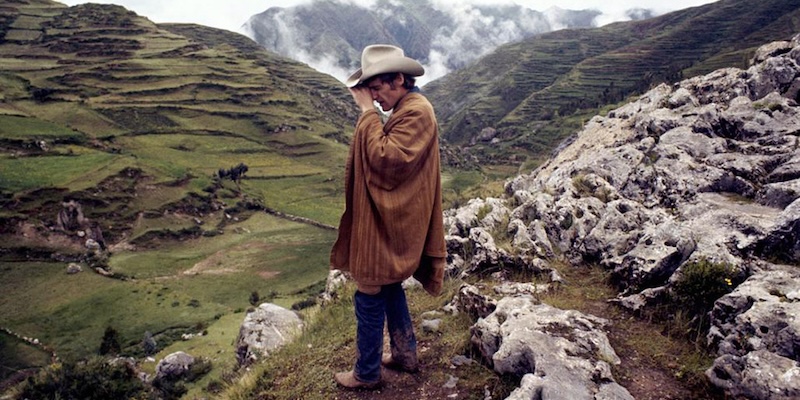
The film follows stuntman Kansas (Dennis Hopper) in Peru after a Hollywood shoot wraps. When crews don’t return, he flits from flush to bust as the locals enact a ritual “movie shoot” on defunct sets, using little more than wicker cameras. The violence is real, though.
Hopper conceives the premise in 1965 and enlists Stewart Stern, a friend since Rebel Without a Cause, to develop the screenplay as equal partners. Their friendship and working relationship is dead and buried by the time The Last Movie sees the light of day in 1971. What starts as an equal partnership under a letter of agreement, incessantly erodes until Dennis Hopper wrests full creative control of the project from Stern.
In Going Through Splat—The Life and Work of Stewart Stern, Dennis Hopper attests to this erosion: “Stewart wrote a wonderfully sensitive screenplay, I mean, really, really wonderful. And I changed a lot of that. It was more important for me to make a more personal film at that time than to make the film that Stewart and I wrote.”
A deposition sealed at the University of Iowa’s Special Collections until after both men’s deaths reveals their August 1965 agreement: equal collaboration, compensation, and creative control. But by early May, 1966, with Phil Spector interested in financing, Hopper sends a substitute letter stripping Stern of both equal pay and creative control.
Behind Stern’s back, Hopper makes his own negotiations, using Spector as a heavy to muscle Stern out. A meeting at Phil Spector’s house on May 18th plays out like an ambush. The cardboard “deal” leaves Stern with demonstrably less and is presented as a fait accompli: sign or kill the project. When Stern protests, “you and I are no longer equal,” Hopper plays dumb, “I didn’t know about that.” He clearly did.
Despite the betrayal, Stern nurtures his attachment to the project. This excitement brings him to Mexico as he continues to research, develop the script, and scout potential locations for shooting, even though the film would ultimately film in Peru. Prior to leaving, Spector and Hopper bully Stern to agree to the substitute letter of agreement by treating the trip as an urgent, nonnegotiable deadline.
Stern folds, and with the oral agreement in place, he does extensive work to smooth over Mexican censors’ major objections, drawing on his experience on The Ugly American. He understands the sensitivity of the censors’ objections to bias in the script and works to secure a reliable translator to help create a workable draft that evades the stonewall the project has hit.
The depth of Stern’s dedication shines in stark relief in the auteur’s sole credit Hopper takes in public accounts. Worse, even as Stern completes his end of the amended agreement, he still isn’t paid by Spector, not even by September. Throughout, Hopper and Spector keep Stern in limbo to get him to agree to increasingly unfavorable terms.
In this way, Spector and Hopper play a producer’s profits shell game, repeatedly lessening the actual amount Stern could hope to receive. This isn’t just bad business; it is authorial homicide. By systematically removing Stern from creative control while still exploiting his labor, Hopper orchestrates the death of his co-author. Stern continues to work, continues to write, but Hopper claims sole ownership of the vision. What Barthes theorized for meaning making, Hopper weaponized for ego.
With Stern out of the way, Hopper abandons Stern’s “wonderfully sensitive screenplay” to pursue “a more personal film.” This veering constitutes a major criticism of the resultant film, which relies heavily on improvised material. LIFE reported, “Did [Hopper] really intend to improvise a full-length feature film? All through the first day, he seemed to be improvising disaster.” Hopper claims this was deliberate:
The problem with The Last Movie, in my opinion, is a deliberate one, and that is that I alienated the audience, and I alienated the audience by saying, ‘Hey, you’re watching a movie. What’s your responsibility in this?’
Audiences and critics immediately agreed with Hopper’s sense of the problem. The film isn’t so much unfilmable as it strives to be unwatchable. Its scripted story is mercilessly twisted into an in media res structure, and shot out of a cannon, splattered onscreen in a barrage of alienating effects and sudden cuts.
While The Last Movie is alienating on purpose, it’s kind of shocking to see how much of the scripted material makes it into the film, even if it seems like the projectionist is running the reels through a blender. All characters and major plot points in the original script exist in the final movie. In fact, the middle stretch of the film is a very clear (if not slightly leaden) reproduction of the middle of the script. While The Last Movie is a far cry from the meticulously precise rendering of other New Hollywood scripts, like the razor-sharp Bonnie and Clyde, the spirit of the original story subsists.
Consider what Dennis Hopper kept, left out, and what he changed. He is being forthright when he talks about wanting to make a “more personal film.” Hopper’s garrulous control brings the film much closer to himself. In fact, as in the May 18th negotiation at Phil Spector’s house, much of Dennis Hopper’s life was spent playing “Dennis Hopper.”
According to the wounding June 1970 LIFE profile, “[Hopper’s] best performance,” a friend remarked, “is his portrayal of himself.” As an act of on-screen alienation, Hopper breaks the fourth wall by blurring the boundaries between his performances in and around the film, across media.
Little details, repeatedly developed in consistent overtures, hint at the method in Hopper’s madness. For example, in Stern’s expanded screen story, the stuntman is named Tex. However, in the film he is named Kansas. When Kansas accidentally interrupts a take of the Billy the Kid biopic twenty minutes into the actual film and moments from the extremely delayed reveal of the title card, “The Last Movie,” the Director yells, “Hey, hold it! Cut, cut, cut! What the goddamn hell’s the matter with you, Tex?”
Hopper responds, “My name’s Kansas. I’m sorry…I didn’t realize, man.” This correction is a small detail buried in a cacophonous opening, but it plays directly to Hopper’s biography, as well as to the way he plays “himself,” revealing Hopper’s larger gambit to pull the film closer and blur the line between self and fiction.
Hopper was born in Dodge City, Kansas. At a wrap party in the film, as Kansas the stuntman, he tells two actors “his” story about growing up in Dodge City, how his grandfather was a wheat farmer, and how his grandmother would sell eggs in the market and take him to the local cinema. This personal anecdote is innocuous on its own, but it reappears in the LIFE profile of Hopper as his own family history, almost verbatim to the content in The Last Movie:
Like, when I was little, I lived on a farm near Dodge City, Kansas. Wheat fields all around, as far as you could see. No neighbors, no other kids. Just a train that came through once a day. I used to spend hours wondering where it came from and where it went to.
Then when I was about five my grandmother put some eggs in her apron and we walked five miles to town and she sold the eggs and took me to my first movie. And right away it hit me—the places I was seeing on the screen were the places the train came from and went to! The world on the screen was the real world, and I felt as if my heart would explode I wanted so much to be a part of it. Being an actor was a way to be part of it. Being a director is a way to own it.
Placing himself in the center of The Last Movie, freezing Stern out, and exerting willful elisions allow Hopper to “own it” and claim the control of an auteur.
So, with his sidekick dead and buried, what actually happens when the author refuses to die? In a 1971 interview for The New Yorker, Dennis Hopper said, “I’m afraid it’s like what one of the Universal executives said to me—‘Art is only worth something if you’re dead. We’ll only make money on this picture if you die.’” In this way, Barthes and Universal are oddly aligned—in order for new value to be created, whether peddling commodities or vehicles for meaning-making, the only good author is an obliviated author.
As expected, Hopper’s refusal to die unfolds on multiple levels of The Last Movie. Killing Stern’s participation in the picture is just one example. On a metatextual level, this refusal to die rests in Hopper’s insistence on eclipsing the picture with his spectacular revolt, his irascible ego, his ongoing garish antagonism of anyone within earshot, especially his willful disregard of his collaborators, audience, studio, and authorities.
This contempt spills out of Peru over to Taos, captured in The American Dreamer, Lawrence Schiller and L.M. Kit Carson’s documentary, which exhibits Hopper’s shenanigans as he attempts to edit the forty-eight hours of footage he got on location for The Last Movie. This documentary was intended to be a companion piece to the film in an aborted university road show, but only received a few screenings, after Hopper reportedly blocked its release. It wouldn’t be officially released until 2016, years after Hopper’s death in 2010.
In The Last Movie itself, this refusal plays out in its seemingly botched ending. Kansas’ and Neville (Don Gordon), his war-vet prospecting drinking buddy return from a torturous trip to the desert, only to find that the gold that they found is worthless. Licking their wounds, they make a toast to failure, and Neville trudges out of the room.
As the camera zooms in on Kansas’s forlorn face, a shot blares out. Neville is dead. The rest of the movie follows Kansas as he becomes “El Muerto,” the object of the locals’ ritual, what they call the best part of “La Ultima Película.” In the script, this leads to Kansas’s ultimate demise. However, as the film seemingly comes apart at the seams and reverts to the opening’s frenetic cuts and random interruptions, we seemingly lose the thread of this plot. Shots that approximate outtakes and bloopers are even kept in.
At one point in the limp denouement, Kansas roughhouses with Thomas Mercado (Daniel Ades), the local “director,” and the priest. Kansas looks down at his bare chest and says, “Hey, now wait a second, fellas. I don’t even have my fucking scar on.” The actors drift away and the shot abruptly cuts.
Shortly after, the soundtrack plays its plaintive score, as John Buck Wilkin’s thin tenor intones, “Spaces between spaces/ and lines between lines.” Two children play in silhouette on a hilltop, seemingly unaware of the camera’s fixed then drifting gaze.
Cut to the village as Kansas runs, falls, and dies in a slow tracking shot. He lies on the ground for a while, then gets up and dusts himself off in slow motion. In front of the set church, he falls right in front of the camera. Another tracking shot chases him as he runs and falls, splayed out on the ground. Again, he gets up, dusts himself off, and walks toward the camera. Cut to Kansas lying in the foreground again, dead, as Hopper turns, looks directly into the camera, sticks his tongue out and gets up again.
As Hopper promised to Life, “The end is far-out.” He flailed finishing a final cut. In tracing the movie’s tortured development, its shattered narrative may seem a failure of craft, especially editing. The movie itself was eminently filmable; Hopper left Peru with 48 hours of raw footage.
However, he agonized while editing; he made an initial cut and destroyed it, then re-cut it after consultating with Alejandro Jodorowsky. He even called Stewart Stern to ask for help. “It took me two days just to look at the footage. Some of it was brilliant, and some was awful. But the end of the film was not there.” Stern wanted Hopper to go back and shoot the missing material, but Hopper refused.
Critically, it’s worth emphasizing what Hopper also refused to put in the picture. Stern’s screen story features a recurring motif: a runner running in the early morning sun, the sounds of running keeping time with a monument maker chiseling the visage of death. The incessant tapping of the runner’s feet hitting the ground and the clang of the monument maker’s chisel haunt the stuntman, Tex, multiple times throughout the movie. In the script, this brings Tex existential dread: what is the point of this runner’s effort?
The chisel makes it into the movie just after the long-delayed title card but the runner and the monument to death are cut. After two-plus minutes of unexplained clanging, it is revealed that the monument maker is indeed making a statue, but the stone skull in granite shroud in the screen story is also cut. Kansas walks through grave sites, but unlike Tex in the script, he doesn’t enter a tunnel with a legend above it that says: “Every moment wounds. The last one kills.” [emphasis original]
While the screen story hammers on the dooming inevitability of death, Hopper undercuts its gravity through alienation: by refusing to build a cohesive motif, by refusing denouement, by refusing to die, by sticking his tongue out directly into the camera, by getting up, dusting himself off, and walking away.
Significantly, The Last Movie is the kind of failure that only success could afford, the doomed labor of love that Hopper would not walk away from. He struggled for years to get backing for this film. In fact, he lost the possibility of Phil Spector as a producer in 1966, sending him spiraling. It wasn’t until he was riding high off of Easy Rider in 1969 that Hopper was able to get Universal Pictures to gamble and give him $850,000 to make the film.
The Last Movie is often compared to Jodorowsky’s work, especially for its aesthetic and his brush with editing the film. However, as a failure born out of success, and as a doomed labor of love made possible by legacy media taking financial risks on new, incorrigible talent, Van Dyke Parks’ 1967 album Song Cycle provides a compelling corollary, even for its inversion of Americana towards psychedelic and alienating ends. Parks famously worked with Brian Wilson on “Good Vibrations,” a pop hit that demonstrated the possible score to be had by allowing artists to go off the deep end.
While “Good Vibrations” topped the charts and was an absolute smash, Song Cycle was so odd, so impossible to promote, that Warner Brothers ran ads trumpeting: “How we lost $35,509.50 on ‘The Album of the Year’ (Dammit).”
Despite industry attempts at humiliation, artists like Parks and Hopper remain unbowed. “I have received that,” Parks says, “Crow tastes fine.”
Parks relates the way that contemporary independent-minded artists have received his work years later, and how they hold something in common. “They understand we have an urgency which is not cute to mute and we need to stay involved in our work and agitate the sensibilities through some way….So this is what I speak of when I speak of the authority of failure….My joy has been in doing it.”
Dennis Hopper expounds even further on this urge to create, beyond just the joy of doing it. “Making things is agony. I hate to make movies. But I’ve got to do it. It justifies my existence. If I couldn’t, I’d destroy myself.”
He destroys Stern, he sticks his tongue out at the camera, and he makes his personal movie: a box-office bomb, a pyrrhic victory that leads to his (second) extended banishment from Hollywood and resultant unraveling. Barthes might not have considered a creature like Hopper in his original formulation, but there was power in the focus on the author’s figurative death.
Tellingly, the Universal executives also spoke truth: it wasn’t until after Hopper’s actual death in 2010 that The Last Movie would be resurrected to receive a critical reevaluation.
***

Mark Dzula
Mark Dzula is an educator, artist, and scholar. Academically, he focuses on communications, technology, and education; his most recent research centers on digital participation in high school journalism. As an artist, he makes music with dzuls, his indie folk-rock project.