

The Brotherhood of Edgar Allan Poe, Shakespeare, and Sir Arthur Conan Doyle
Fiction Must Pay for Its Crimes
Under normal circumstances (say at a watering hole sipping something gin-forward, or in a bookshop café petting the reigning cat), I would not commence a casual chat with, “Poe, Shakespeare, and Doyle are all inextricably linked and I’ve the facts to prove it.”
And never would I announce something so easily misunderstood as, “Also, I’m in the same category.”
First off, I generally have my agenda packed with drooling on pretty hardcovers and buying new releases I do not in any sense “need.” Second, this theoretical hapless stranger is probably there for either a tome and a beverage, or else a tome and a beverage and a first date (bless these cheerily lit, beautifully shelved, latte-scented havens: the new backdrop of singles cruising). There’s no need here for my oddball brand of lit crit. But perhaps your interest is piqued—so what do the Father of Modern Crime Fiction, the Bard, and the Master (as Doyle is known to Sherlockians) have in common?
Answer: they were all hustling.
This trio was getting the bag.
These three lads were legit stacking as they chased bread with no days off on the grind.
Takes one to know one, boys.
While each of these authors is now revered by frillions, printed on everything from paper to nerdy socks to coffee mugs to specialty wall coverings, and taught in every one of our high schools, what they were after at the time was a paycheck. Art? Sure, what they made was also art (sometimes!). If they hadn’t been making art concurrently, their works wouldn’t still be the glorious inspo manna of half the Etsy small-batch crafts set.
Point being that they had to pay for housing and coal, bread and cheese, ink and paper.
All respect where respect is due to Lord Byron (hmm), but titles and estates did not fall on our trio’s hapless pates like Warner cartoon pianos. They were not seating themselves in damask-papered nooks as dappled dawn ascended, meditating on verse structure and the quality of the shadow cast by their carelessly heaped moneybags. Unlike Lord Byron, physical necessity imbued their fiction and poetry and letters and editorials and playwriting and journals with visceral vigor—not to mention teeming fecundity, aka massive output. And quite unlike Lord Byron, their acclaim was never wildly surpassed by that of their roommates (Mary Shelley’s Frankenstein churns out far more Barnes & Noble Classic reprintings than Childe Harold’s Pilgrimage, we can all concur).
It was (much of the time—not always) really, really good.
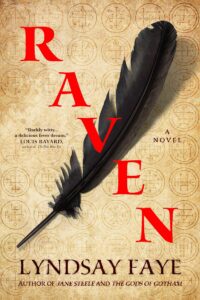
Whilst writing my forthcoming Edgar Allan Poe-inspired romantic thriller, Raven (my eighth novel), I was pretty publicly and absurdly poor. This is not a complaint: it is, however, a testimony. Let’s just say when I was wrenching my brain like a wet dishtowel over how the themes of madness and romance and penury and addiction and freedom should interact in my first-person narrative of young Raven Helen Allan, I was a Person of Immense Interest to the Internal Revenue Service. Did I enjoy it? About as much as I enjoy fire ants.
Did the fiscal woes inspire me? Not always (sometimes naturally I got so downhearted that I was pretty indistinguishable from the socks in my bureau drawer).
But lurking behind the itch of desperation remained the fundamental urge I feel to tell stories. The poverty of the writer is now so common as to be a trope; the difference between now and then being that the United States wasn’t printing fiction like it was Benjamins, with an increase in sales back in 2024 to a staggering $3.26 billion dollars. Artistic commoners with itchy pen fingers prior to mass commercialization were still whispering sweet nothings into the ears of patrons, sending urchins scurrying to printers with barely legible manuscripts, and scraping the cash together for their laudanum and tallow candles. Even in Bridgerton (hush, you know you’ve seen it), the scrivener is suffocating in taffeta. The Raven Helen Allan of my novel is an antebellum orphan well used to penury, who takes employment in a disintegrating Gothic manse as a paid companion to a pair of wildly attractive, flagrantly eccentric cousins. And let’s just say that in the wee hours, counting down the days till the mortgage was next due, I felt a certain camaraderie with get this right or else.
Since Raven’s journey is as much based on Poe’s biography as his body of work, I confess to a friendly snicker when I encountered in a postscript to one of his letters, “P. S. I am poor” (Letter to Messrs, J. P. and E. Buckingham including his story “Epimanes” for submission, May 4th, 1833). Prior to his soaring success as a playwright and thereafter his acquiring shares in the Globe, a percentage of ticket sales, and multiple properties, Shakespeare’s prospects were similarly muddy. His father was a glovemaker and the London theatre scene both viciously competitive and quite literally plague-ridden, houses often shutting down until the next crop of Black Death victims had expired. As for Doyle, he was an unsuccessful physician whose only sweeping commercial coup was thanks to a character he detested—to the point of tossing Sherlock Holmes off a waterfall in “The Final Problem” of 1893, only to un-dead the sleuth when the coffers called.
My favorite commonality between Poe, Shakespeare, and Doyle is not their working-class ethos, however—rather, it is the notable aspects of their fiction that tightly cinched belts evoked in their respective canons. Let us take, as perhaps the most obvious, their mutual attraction to the sort of lowest common denominator that likewise defines pulp fiction: their love of the spectacular and the grotesque.
Poe’s short stories are such a delight not because they are perfect in classical form (though many are), or even because they contain sympathetic characters (many don’t). Absolutely no one likes the abusive alcoholic who becomes obsessed with his cat to the point of mutilating it, then quietly hangs it from a tree, finds another puss, gets peeved again, attempts to slay New Kitty, opts to murder his wife with an axe instead, and finally walls up the bodies of the dead spouse and the all-too-alive cat in the basement. Is “The Black Cat” a glimpse into Poe’s own harrowing struggles with the bottle? Perhaps—Poe adored cats, so gouging one’s eye out was probably the most disgusting thing he could think of.
Was he writing the most disgusting thing he could think of in order to get a gloriously cheap, wickedly perverse thrill out of his readers?
Yes—yes, he was.
This deliberate (and in my opinion utterly fabulous) lack of subtlety was likewise gleefully exploited by both Shakespeare on behalf of his “groundlings” and by Doyle on behalf of his Strand magazine patrons. We deify these writers now for their ripples throughout the great ocean of English literature; but Shakespeare also never met a dick joke he didn’t like, and—while Sherlock Holmes himself abhors the notion of spirits—Doyle shoehorns the human “reasoning machine” into myriad scuffles with supposed vampires, ghosts, and hellhounds.
When we recall that “The Masque of the Red Death” is basically just about a spectral party guest showing up to a quarantined castle and slaughtering them wholesale, it’s entertaining to speculate about how Poe felt whenever Shakespeare decided to throw another set of twins into the mix, or invite a dead relation to show up, or to instruct an actor to exit pursued by a bear. Had Poe been able to read about Sherlock Holmes’s adventures, I posit he’d have gotten tremendous jollies out of them—even when the great detective in “The Creeping Man” is trying to solve the riddle of an elderly gent climbing sheer walls, and the answer ends up being “monkey serum” (because of course it was).
They can’t all be bangers.
I take sub-zero shame in admitting that I wallowed in melodrama writing Raven likewise, in the noblest tradition of trashy crowd-pleasing.
Did I try to pen some pretty sentences? Sure thing. Was I careful to adhere to a three-act structure, out of respect for my former career as a stage actress and my love of its elegance? Absolutely. Did I miss any opportunities for salacious Gothic debauchery? Of course I did, but it wasn’t for lack of trying. Raven starts her narrative from beyond the grave, she claims; her Aunt Berenice languishes in an opiate haze of self-harm; Raven’s exile to a grim and desolate manor would be a real bummer if she weren’t almost instantly enamored of its eerily sexy cousins, both male and female; and so on and so forth, including spectral lights and mysteriously deceased felines and madhouses and alchemy and all else that is delicious in a cobweb-strewn bodice-ripper.
Will I ever appear on a pair of novelty socks?
No. Maybe a coffee mug (specialty order amount: five), if a friend of mine happens to be tight with a screen printer.
But will I keep churning out new stories for readers of literary genre fiction by way of pop culture, whether they ask me to or not? Absolutely! Because I still have a mortgage to pay, and I still have stories to tell. And the one circumstance will keep informing the other, ad infinitum; I am nothing but honored and privileged to belong to the ignobility—we many, we shameless many!—of writers lacking patrons, and titles, and dare I say even trust funds, who put our faith instead in madness and in mayhem.
To sordid crime, promiscuous output, and healthy profits!
***

Lyndsay Faye
Lyndsay Faye is the internationally bestselling author of six critically acclaimed books: Dust and Shadow; The Gods of Gotham,Seven for a Secret; The Fatal Flame, the Edgar Award-nominated Jane Steele, and The Paragon Hotel. Faye, a true New Yorker in the sense that she was born elsewhere, lives in New York City.