The Sheep Detectives is the Ultimate Cozy Mystery
The new family-friendly whodunnit is a thoughtful, sweet love letter to the genre
Featured image credit: Amazon MGM Studios via Variety
In the new film The Sheep Detectives, the rules that govern murder mystery novels—specifically fair play whodunnits—are holy principles. They very clear, entirely foolproof, and apply to life as much as they do to fiction—commandments you can follow like a roadmap to find out what happened, should anyone you know die in suspicious circumstances.
The film’s protagonists do just that… they end up using tenets of detecting that they have gleaned from Agatha Christie-esque mystery stories to solve a real-life (or real-death, I should say) murder in their small town. It doesn’t matter that, in a real killing, there are countless factors to consider, or that there is greater unpredictability in life than in a carefully plotted puzzle—in The Sheep Detectives, the rules always apply, and they always get the correct results.
Personally, I appreciate when a film (or any work, really) has a reverence for formula—but more than this, I enjoy a film whose tone is genuine reverence for the conventions of its genre, and veneration for the landmark texts that came before. This is trend, lately. The mystery genre has always been meta, but lately, there have been numerous texts that practice this kind of deferential reflexivity towards their Golden Age ancestors. Rian Johnson’s third Benoit Blanc film, Wake Up Dead Man, does something similar—characters use locked room mystery guidelines listed John Dickson Carr’s The Three Coffins (called The Hollow Man abroad) to solve a locked-room mystery. The main (and most conspicuous) structural element to novels like Benjamin Stevenson’s Everyone in my Family Has Killed Someone and Louise Hagerty’s Fair Play are classic mystery solving rubrics. What Scream did for the horror genre, these texts are doing for whodunnits.
The Sheep Detectives follows suit. But it has more of a challenge, I think, than these other texts, because The Sheep Detectives is also intended to be a family-friendly movie. It has to appeal to children at the same time it appeals to their parents, or fans of the genre without extremely young people to entertain. But I’m pleased to say that the film works on multiple levels—not by telling one story for the kids and a more knotty, genre reflection for adults, but by building an entry-level, thoroughly user-friendly mystery framework that makes what’s fun about the genre accessible to everyone. What’s more impressive, though, is how it fills this framework with several thoughtful storylines, about love, pain, death, memory, inclusion, family, and justice.
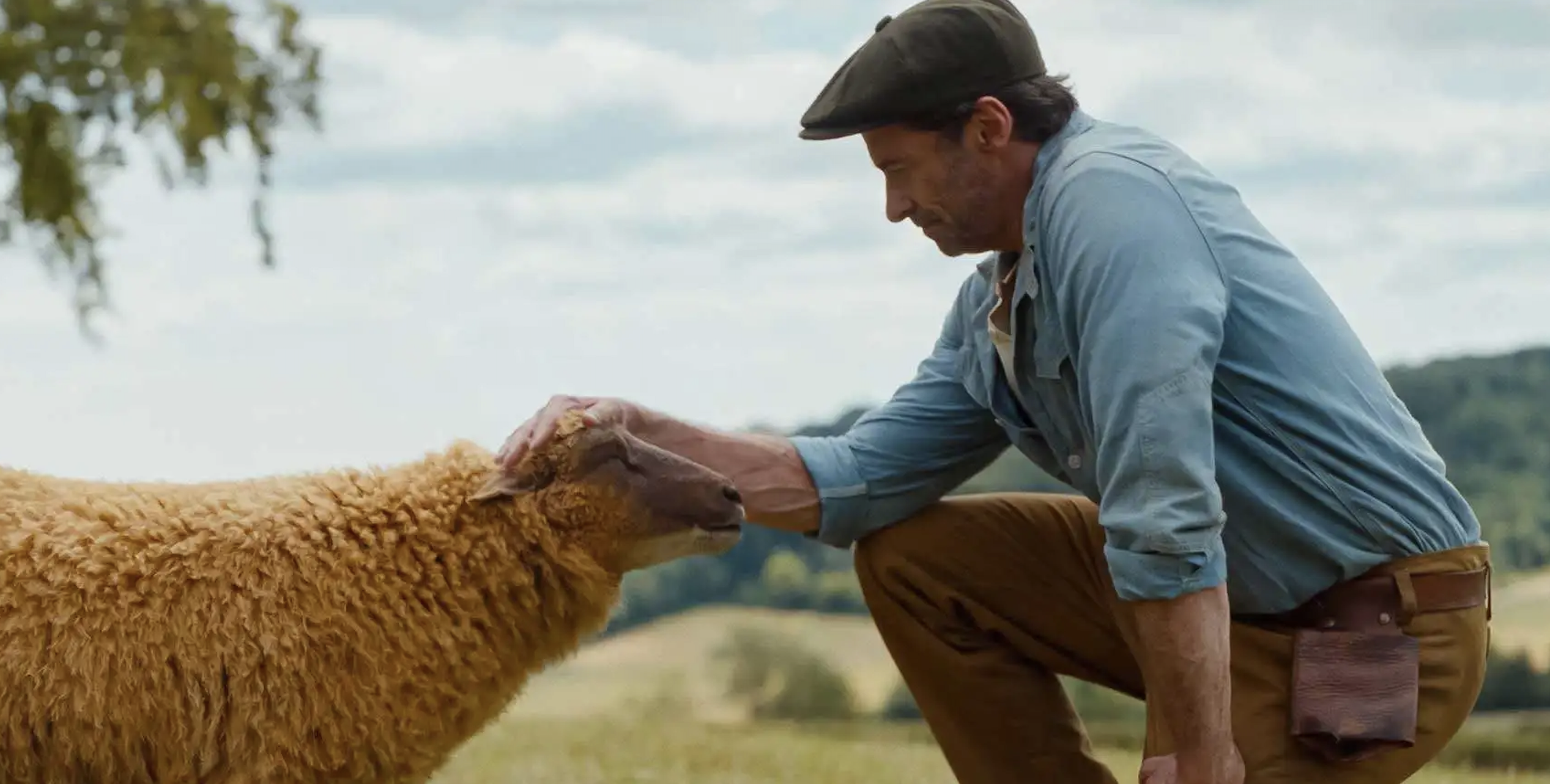
The film, which is directed by Kyle Balda and written by Craig Mazin, is based on the bestselling German novel Three Bags Full by Leonie Swann. The film is about a flock of sheep (no, the title is not a metaphor) who are lovingly tended to by their beloved shepherd, George (Hugh Jackman). He lives in a little airstream in a giant field somewhere in the English countryside, and spends his days feeding, grooming, shearing, cuddling with, playing with, and (in the evenings, before bed) reading aloud to his flock. He reads them his favorite books—detective stories. It’s an idyllic life.
The sheep can’t speak to humans, but they can understand them. And they love when George reads to them. One of the sheep, Lily (voiced by Julia Louis-Dreyfus), has even developed a talent for figuring out the identity of the murderers and how the murders were committed before the novel reveals those details. She is George’s smartest sheep, but he has a great many with different qualities. Among the herd are the lordly Sir Ritchfield (Patrick Stewart), the beautiful Cloud (Regina Hall), the always-bickering twins Ronnie and Reggie (both Brett Goldstein) he inquisitive Zora (Bella Ramsay), the clumsy Wool-Eyes (Rhys Darby), and the solitary Sebastian (Bryan Cranston). There’s also Mopple (Chris O’Dowd), who is the flock’s memory keeper. See, the sheep often choose to forget things that upset or confuse them—collectively and individually, they can order their minds to go blank. Except Mopple. He can’t forget anything. This makes him the wisest sheep, and an extremely important presence when painful and difficult things begin to happen.
The first painful thing is that George is found dead in the field, one morning. The village’s police officer (Nicholas Braun) concludes that the death is likely a heart attack, but the sheep begin to suspect foul play and decide to use the lessons from George’s mystery novels to solve the crime. There is a star-studded cast of human suspects and investigators alike (the ensemble includes Hong Chau, Molly Gordon, Nicholas Galitzine, Conleth Hill, Tosin Cole, Kobna Holdbrook-Smith, and Emma Thompson), and therefore, lots of feuds, motives, and friendships to go through.
But the best part of the film is how it gently nudges back against the most common convention of Golden Age mysteries: the very detached relationships they often have to the deaths at their centers. In The Sheep Detective‘s, George’s dead body isn’t a puzzle to be solved… it’s a tragedy. And the solving of his murder plays out as a kind of tribute to the life, an event that allows his true feelings and wishes to come to light, and a way to teach the sheep to grow and learn to live without him.
As such, it tells a story about the value of life, and not simply human life, either. The story is about appreciating the elements that make life beautiful: unspoiled nature, caring family and friend relationships, freedom and free will, safety and comfort. And it would like to extend these elements to all animals.

Olivia Rutigliano
Olivia Rutigliano is an Editor at Lit Hub and CrimeReads. Her other work appears in Vanity Fair, Vulture, Lapham's Quarterly, AirMail, the Los Angeles Review of Books, Public Books, The Baffler, Bright Wall/Dark Room, Politics/Letters, The Toast, Truly Adventurous, and elsewhere. She has a PhD from the departments of English/comparative literature and theatre at Columbia University, where she was the Marion E. Ponsford fellow. She hosts the podcasst "Culture Schlock" at Lit Hub Radio. She is on instagram at @oldebean, twitter at @oldrutigliano, and bluesky at @oliviarutigliano.bsky.social.