

Two Generations, One Shared Experience: On Incarceration, Redemption, and Family Love
Dr. Tonesa Welch, former first lady of the Black Mafia Family, and her son H. Corey Mills on finding trust again through co-writing a memoir
The following essay was co-written by Dr. Tonesa Welch and her son, H. Corey Mills, and told from the perspective of Corey.
*
Writing a memoir isn’t for the faint of heart. Doubly so when it is on behalf of someone else, especially when that story asks two voices to trust each other enough to become one.
That idea came back to me as I sat in bed, triple-tasking: writing, catching up on the last episode of “Your Neighbor and Friends” Season 1, and watching my Godbrother Adrian prepare two NY strips we had just picked up from Whole Foods. At first, I questioned why I needed to include that detail at all. Then I realized how closely the moments run parallel.
Between sips of my flat Coca-Cola, it occurred to me how rarely I allow anyone to cook for me. On the rare occasion I don’t find a good excuse to dine out, the only person I usually trust in the kitchen is my mother, Black Mafia Queen herself, Tonesa Welch. Lately, cooking has become more common for me because I find something soothing about the process. Yet today was new territory, and I was not entirely comfortable. Those strips weren’t cheap, and I like things how I like them. Sue me.
It was in that moment I recalled the writing process: write, stop, rewrite, then start again before the first few pages of Black Mafia Queen finally came together. The task was not only making sure the book sounded like my mother’s voice but doing it in a way that let her relax enough to give me the reins. That trust was not easy to give, and understandably so. This was not some pricey steak that could be overcooked, under-seasoned, or over-seasoned. This was a piece of her, an intimate look inside her life and mine, one that would be read and digested by friends, family, and strangers alike.
It felt like an undressing of who we were entirely: a bare-all of us, our beliefs, our thoughts, and the choices that brought us to this point. My first writing assignment would be judged by the person whose opinion I valued most, with the added weight that it was her life story I was helping tell. This would not be the easiest endeavor by any measure. It was not a paid writing gig that came with the luxury of detachment. It was visibly and verbally obvious that letting go was difficult.
Eventually, after hearing several unsolicited opinions and offers of assistance, I realized I had to do the same thing I was asking of her: let go of the reins and turn my attention to the more pressing issue in front of me—this article.
I like how you talk about Adrian cooking the steaks and your moment of introspection because it coincides with what’s included in the book, in a way I think about more often now than when I first mentioned it, my mother said over a phone call after I sent her the first few paragraphs.
We move around so fast that we rarely put much thought into what we’re doing, how it relates to who we are, or why we do the things we do.
Stop and smell the roses?
Exactly, yeah, she remarks.
Those few sentences sent me into a deeper exploration of how and why the book became what it is, and how I finished it at all. Truth be told, the book, released on February 24th, 2026, was at least four months behind and at risk of being shelved had I not hunkered down and finished. But it was not wholly my decision to sit down and complete it. Soon after my brother Jason’s funeral, I found myself in legal hot water in Los Angeles County because of my own issues with narcotics and a case of self-defense. Stubbornly, I refused to believe I had a problem, and I believed the D.A. had to see that I had been innocently minding my business. My conduct then, and mostly thereafter, proved that I could use help.
On July 10th, 2024, I entered my first inpatient program under the agreement I made with the court system. It was the one-year anniversary of my brother’s untimely death, and until then, it was the first day I truly considered how I would complete Black Mafia Queen. Coming down and sobering up, my emotions were erratic. I was constantly agitated by the rules and requirements, and I dealt with what felt like an insurmountable amount of imposter syndrome.
How did I—how did we—get an agent to believe in this story? And how was I now supposed to finish telling her testimony? It was not that I had to invent a tall tale or pull inspiration from someone I did not know. Still, it would take days that turned into months for me to understand and relate to some of the struggle my mother must have felt while incarcerated. It was a blessing disguised as a curse.
At first, I was not inclined to include chapters from my perspective or open the conversation to my experience before and throughout the story. It was the advice of a more experienced writer, and their intuition, that helped me see how including my story could make the book more impactful and help us find a publisher during the pitching stage. Still, I wondered what I had to add. How much could I bring to the table next to a woman whose life I silently stood in awe of?
I had never seen my mother at a low point or seen her cry. I never believed I could end up on the wrong side of the law either, but after 34 years of practically no real encounters with it, aside from a few speeding tickets, I faced five years in prison myself. I begrudged the law, the people I once believed supported me but who had now disappeared, and even God. What had I done to face so much adversity? How could I be on the brink of a career breakthrough and find myself on probation for what would be over two years, facing a one-strike felony and the requirements of three months’ inpatient treatment and three months’ intensive outpatient treatment? Possibly, it was to save my life.
Because of my predicament and my legal agreement, I was tasked with finishing the last half of the book while locked in a treatment center. No phones, no computers, and damn near no contact with the outside world besides a clock radio. It gave me plenty of time to concentrate, but it also meant I would have to write most of the work in a notebook. I set out to complete at least two pages a day until I could access an actual computer and transfer the work into a Word document.
Who is to say what the final chapters would have been without that experience? I would later be transferred and expelled from the program after failing to get my act together, still holding animosity and resentment toward the circumstances I found myself in.
I lost the first notebook, and it would be several programs later before I completed my first draft. After a little over a month of good behavior, I was given the chance to begin transferring my handwriting to my phone. Then I was offered the first shot at a new policy the program director was considering: “I can’t let you have a laptop, but we want to try giving clients the chance to spend an extended amount of time outside the program to visit family, friends, or handle whatever they need before returning to the streets.” Because of the seriousness of the work—and because of the support of my family and others calling in, including my writing partner and especially my mother—I was given the chance.
A light knock at the door brings me back to the present. Adrian sticks his head through the doorway and announces that dinner is ready. Simply put, the steaks look perfectly cooked.
It is easy to say what we hope the book will bring to readers, or how difficult the effort to finish and publish it truly was. It is harder to put into words what all that time, effort, and uncertainty felt like. Like cooking a steak, you do not really know the final product until you taste it. Until then, it is a guess—whether it will be edible, let alone good.
The lone ingredient is trust: trust in others, trust in the process, and, most importantly, trust in oneself. In 2013, there were hardly any reentry programs or serious public conversations about recidivism rates. Now, nearly thirteen years later, the total prison population has dropped from over 1.5 million to just over 1.2 million, with all fifty states adopting some form of rehabilitation-over-punishment programming. I would say the efforts were not for naught.
As I enjoy this New York strip, I would reason the same from our story: with trust, it can impact and change the lives of many who will help make this country a better place for all.
***
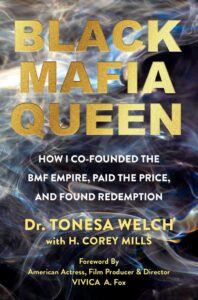

Dr. Tonesa Welch and H. Corey Mills
Dr. Tonesa Welch is a producer, mentor, activist, prison reformist, and brand influencer. As the former first lady of the Black Mafia Family (BMF), Toni was an inside witness to the crimes of one of America’s most notorious organized crime conglomerates. In 2006, Toni was convicted in the historic Operation Motor City Mafia bust and sentenced to nearly five years for money laundering. Following her release from federal prison in 2012, Toni and her youngest son, Corey, founded the non‑profit, Sylent Heart. Providing clothes and school resources for the children of incarcerated parents and other at‑risk youths, their organization has also assisted women ex‑convicts transition back into society via job placement, housing, life‑skills training, and transportation. The recipient of the “Spirit of Detroit” award for her service to the local community, Toni has hosted charity events for Los Angeles‑area schools as well as holiday events for children in need. She now lives in Los Angeles.
H. Corey Mills is the owner of Black Mafia Family LLC, a producer, writer, filmmaker, and author committed to telling bold, transformative stories rooted in truth, legacy, and personal experience. As the son of Dr. Tonesa Welch, The First Lady of BMF, Corey witnessed firsthand the impact of generational choices and the power of rewriting your own narrative. His journey has been one of evolution. From growing up inside one of America’s most talked-about legacies to carving his own lane as a creative and cultural voice, Corey continues to lead with vision and purpose.