
What Has Gabino Iglesias Been Reading in 2026?
Catch up on some of the year's best books so far with Gabino Iglesias as your guide.
“Hey, it’s July and you’re talking about January and February books?” Yeah, guilty as charged. March, April, and May, too. Oh, and I missed a bunch of columns–and books, which is the truly sad part–in the second half of 2025. Let’s just say that 2025 turned into a dark thing, yeah? Good news is, I’m out of that hole and doing a lot of the things that make me happy, and two of those things are reading crime fiction and talking to you about it. Let’s do that.
___________________________________
JANUARY
___________________________________
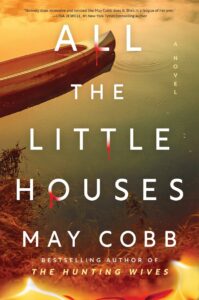
All the Little Houses by May Cobb
(Sourcebooks Landmark)
For a long time, May Cobb was the only author who could make me care about the lives of the rich and their little peccadilloes. A bit of that came from the healthy doses of chaos, sex, bad intentions, secret agendas, awful people, and murder that Cobb injects into every book, but it mostly has to do with the way Cobb spins a yarn and her ability to humanize even the most despicable people in order to explore humanity while everyone gets hammered. In any case, I said a shorter, probably far more eloquent version of that before and it became a blurb on one of her previous novels. This is all to say I expected to like All the Little Houses, but had no clue it would become one of my favorite Cobb novels.
All the Little Houses takes place in the 1980s in a small town in Texas. Small-town hell is real, and when you add families with a lot of money and huge egos, things only get worse. But not everyone has money. Charleigh Andersen, for example, has a great life now, but she came from nothing and, more importantly, remembers what that was like and doesn’t want to return to that. Unfortunately, Charleigh–and her spoiled daughter–suddenly face a najor threat to their status; a new family has moved to town, and they’re perfect. Or are they? This is a May Cobb novel, so of course they aren’t. Everyone has a secret agenda and a few dirty secrets here, and Cobb uses sex, weed, and booze like someone throwing gasoline on a campfire.
Wanna hear something funny? All the Little Houses also reads like a YA. It sort of is a YA. A very twisted, mature one, but a YA novel nonetheless. Most of the characters here are younger than usual for a Cobb novel and the violence, while still there, is more canoe hit to the head than shotgun to the chest.
Dark, tense, twisty, bloody, and entertaining to read, All the Little Houses is yet another banger from Cobb. Can’t wait to read the sequel.

Everybody Wants to Rule the World by Ace Atkins
(William Morrow)
Technically a December book, but I wrote things down wrong and picked up my galley in January, and that makes it a January book. Hah.
Can Ace Atkins write crime? Yes. Can he do violence? That’s another yes. Can he also be funny? Very much so. In fact, in Everybody Wants to Rule the World, his latest, he does all of it in almost every chapter, often in the same page or paragraph.
The year is 1985 and Peter Bennett, a fourteen-year-old, is convinced his mother, who has seen several men since Peter’s dad died, is now involved with a Russian agent who goes by Gary. The guy is weird, owns a gym, and seems a little too interested in the work his mother does at a government lab. So far, Gary seems to have everyone fooled, Peter’s mom included, but Peter is a fan of spy novels, so he comes up with a plan. Peter tracks down Dennis Hotchner, an author who hasn’t published anything in a while and is working at a local bookstore. Peter wants to hire Hotchner to look into Gary. The whole thing sounds silly, but Hotchner, with help from his good friend Jackie Demure–amazing drag performer now, but also former NFL player with the roughness to match–soon finds himself deep in a world of shady information, Russian defections, spies, double spies, and murder.
This is a hell of a fast-paced, multilayered romp. I could fill a few paragraphs telling you things you probably already know about Atkins; his dialogue is tight, his humor dark, his real, even when weird. But I won’t do that. Instead, I’ll tell you that Atkins had a blast writing this one and that makes it a fun read. The amount of detail and the number of characters here would probably scare or frustrate a less seasoned author, but Atkins is always in control, talking about people, places, sports, drag queens, politics, and love with the same energy and wit.
I’m a fan of Atkins’s work, but this novel surprised me. Everything I’ve come to expect from Atkins as an author was here in spades, but there’s something else going on here, and I think it’s love. No, hear me out. This story has decent amounts of love and loss, but that’s not what I’m talking about. What I’m talking about here is the author’s love for his characters, for dingy bars, for football, for the research that went into the novel, for the things from his past he is able to share with readers here. Movies and personalities and songs are sprinkled all over this novel with obvious love and care, and that adds a little something special to the reading experience. Anyway, go read this.
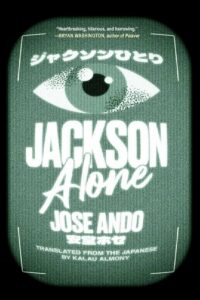
Jackson Alone by Jose Ando (trans. from the Japanese by Kalau Almony
(Soho Crime)
Jose Ando’s Jackson Alone follows a man by that name who works as a massage therapist at corporate gym, a place where people whisper about him. He’s a little weird. He might be gay. That kind of thing. Then there’s the violent porn clip making the rounds, which features a guy that looks a lot like Jackson. And he’s not alone. When Jackson meets three other mixed-raced guys who look like him and have also found themselves in a similar situation. Together they come up with a plan to find the culprit, but on the way there, they use their likeness to each other to exact a few smaller revenges.
This is a short, fast book that juggles big themes like race, discrimination, identity, and queerness in contemporary Japan. Ando has a few cutting lines here and shows he isn’t afraid to tackle big subjects with clarity and unflinching honesty. Sadly, the good elements here don’t add up to much, and I don’t say that in a bad way. Ando can write and he can certainly do dark humor and violence, for example, but there’s not a lot of that here because the story is over as soon as it gets going. Yeah, this is very short, and that translates to character development that feels weak, a fragmented plot short on connective tissue, scenes that are over too soon, and topics that are mentioned and then barely explored.
Jackson Alone promises much more than it delivers, but it delivers enough to make me curious about Ando’s next book in translation. For all its flaws, the book has heart and courage, going places other authors won’t dare. Oh, and it also contains lines that hit on different levels: “Do you want to know how the word Black sounds to us when someone who’s not Black says it?”
___________________________________
FEBRUARY
___________________________________
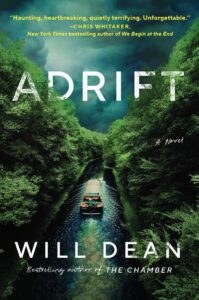
Adrift by Will Dean
(Atria/Emily Bestler Books)
I’m brutally honest, so I’ll tell you that I’m late to the Will Dean party, but Adrift, his latest, made me go looking for his back catalogue.
Peggy, her husband Drew, and her son Samson are living on a boat in an isolated canal and scraping by however they can. Drew is a writer who won an award a few years ago. He needs time and silence to work, but the way he goes about it is wrong. In many ways, Peggy and Samson live under constant verbal abuse. Peggy is also a writer, but she keeps her writing to herself so as not to bother Drew. However, Peggy receives an offer for a novel she wrote, edited, and submitted without telling her husband, and he, like with most things, doesn’t take it well. With Drew’s mood darkening by the hour, Peggy struggling to keep their lives together and protecting her son, and Samson dealing with constant bullying at school, the small family is on a slow, dark, dangerous trip as Drew pushes them further down the canal and away from the rest of the world.
Adrift is relentlessly dark, and I love it for it. The elements and characters are deceptively simple: small boat, middle of nowhere, family struggling financially, angry dad, mom who suffers in silence as she works and cooks and takes care of everyone else. However, Dean makes this story his and slowly makes everything worse in the best ways possible.
There are books (and movies, obviously) that make you want to jump in and talk to someone. Or, you know, stab someone. Dean pulls that off here. Drew is always bad, but as things get worse, so does he. There are many jokes about authors torturing their characters, and that’s exactly what Dean does for most of this novel. And it works. This novel is full of pain, grief, sadness, and abuse, but it’s also packed with love and hope. Oh, and stellar prose. Good enough, like I said, so send me to the bookstore looking for more. Looking forward to whatever Dean writes next.
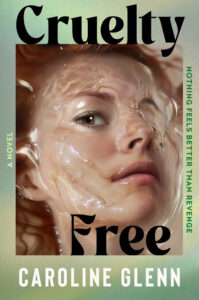
Cruelty Free by Caroline Glenn
(William Morrow)
I know there’s still more than half a year left in 2026, but I can already tell you I’ll be talking about Caroline Glenn’s Cruelty Free as one of the best debuts of the year. I loved it. The novel follows Lila Devlin, a famous actress who built an impressive career and a perfect family before losing it all in a single night when her baby daughter was knapped in the middle of night and, after the authorities repeatedly failed to negotiate her return, was never seen again. Devastated, Lila abandoned public life and left the country for a while as she went on a healing journey. Now, however, Lila is back LA and acting isn’t on her agenda. Instead, Lila dreams of starting a makeup company that’s actually honest, that does the right thing on every front and with the customers in mind instead of profit as the main goal. In short, Lila envisions a company that honors her lost daughter. The brand takes off, but Lila has experienced things that won’t let her be at rest. In fact, those experiences–that pain–has turned into a “grey thing” inside her. They say the best revenge is winning at life, but sometimes the best revenge is murder, and Lila knows it, and if said murders are also good for business, then it’s win-win.
Yeah, all synopses fall short unless you spend 1500 words on them, which I won’t do here. There’s much more going on here, including a solid “slow descent into madness” atmosphere mixed with the kind of vibes, actions, descriptions, and cold, psychotic dissociation that makes most people think of novels like Ellis’s American Psycho or CJ Leede’s Maeve Fly. Lila is a very interesting, very grey character, and Glenn handles her and every other character with the confidence of a seasoned voice, which makes this and even more impressive debut.
Listen, I know that sometimes my horror family reads my CrimeReads columns looking for stuff that might be for them. Well, this one is for you, horror folks. Yeah, those The Substance vibes you get from the cover and the synopsis? Those are definitely there. Also, this gets dark. Our kind of dark…and brutal and gory. Not much, mind you, but enough to make me go, “Hell yeah, Caroline! Go there!” In fact, when things got dark and creepy–physically, emotionally, and psychologically–at the end of the story, I thought, “Don’t you fucking pull back now, Caroline!” And she didn’t. This is bleak, weird, and violent in all the best ways possible. Oh, and there’s a twisted love story in there that I thought was going to fail and ended up being great, so yeah, go read this.
___________________________________
MARCH
___________________________________
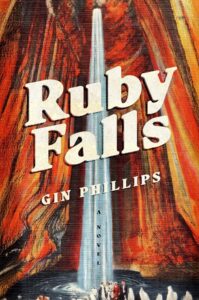
Ruby Falls by Gin Phillips
(Atlantic Crime)
Most of you already know Gin Phillips can spin a yarn, but this is one was hard to put down. Sure, I’m obsessed with caves and crime and this has both, but there’s more than that to love here, and Phillips’s wit would’ve made this great even without all the crawling in the dark and brutal murder.
Did I mention this is also a historical novel? Yeah, the year is 1928 and a man from Chattanooga who vanished into a hole in the ground has named the huge waterfall he discovered inside the cave Ruby Falls in honor of his wife. A few months later, folks can pay to get in and see the falls, although not all do. Ada Smith, for example, works there and sneaks in at night to enjoy the place, the quietness and freedom. Sadly, the Great Depression makes things rough for everyone, and that includes attractions like Ruby Falls. In order to get the business back on track, they come up with marketing plan to get a lot of attention from the media: letting a famous mind reader crawl around down there and find a hidden hatpin with no help other than his psychic abilities. Ada and a guide named Quinton are tasked with following the mind reader, his wife, his annoying manager, a journalist, a businessman, and their guide through the caverns to make sure everything goes well. Unfortunately, nothing goes well and they soon find themselves underground, short on time, and dealing with a body, a handful of weird, anxious people, and the reality of a killer down there with them.
Ruby Falls is a fun read. Phillips has a talent for action, and there’s a lot of that here–climbing, falling, arguing, hiding. However, it’s her wit and humor that make this one special. It takes a lot to stab someone in the face with a stalactite and still manage to make people laugh, but Phillips pulls it off here. Oh, and this was the second time this year that a crime novel included an entertaining love story that I thought wouldn’t work and then worked beautifully.
A unique historical whodunit full of humor, mud, blood, and lust in the dark. If you like your murders fun and your crime fiction full of blazing lines, this one’s for you.
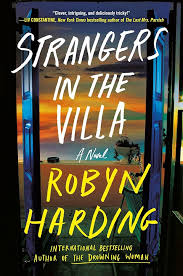
Strangers in the Villa by Robyn Harding
(Grand Central Publishing)
Remember when I said I don’t care much for stories about rich people? Well, you can add Robyn Harding to the short list of authors who can make me care.
Sydney had a good life in New York with her husband, Curtis. Then he confessed to an affair that meant nothing to him and everything came crashing down. Sydney and Curtis stay married and go to counseling, but the biggest part of the aftermath was that Curtis sold his part in a business for a song and they moved to a house on a hilltop near the Catalonian coast. The couple work on the property and plan on opening a little winery at some point as they work on fixing their relationship. Then their routine is interrupted by a cute Australian couple traveling through the area who have car trouble. The issue is bigger than expected, and Sydney, aching for human contact that’s not her husband, asks them to stay. The arrangement is okay for a while, but everyone in that house has dark secrets and agendas…
Listen, I know, this might sound like a light version of Speak No Evil, but it’s not. Harding makes both the “enemy inside the house” and “dark secret comes to haunt/torture you” tropes feel fresh. Also, no one here is “good” and I love that. Sure, Sydney is likeable, but not as much as you’d expect (something I also love). This is the kind of novel where bad people do bad things while thinking they’re doing the right thing and being good people. Morally grey characters aren’t easy, and Harding delivers four solid ones here. Oh, and in this one, every love story gets the kind of ending I like. Hah.
As someone who loves Spain, Barcelona, and the Costa Brava, I wish there had been more of a critique of the kind of people who do what Sydney and Curtis did and the way some folks move there with zero Spanish skills and then complain about it as if the country they moved to needs to adapt to them. Also, the ending is better if read fast and not questioning things too much, but by the time we get there, things are already so tense that none of it matters much. Top-notch domestic crime right here.
___________________________________
APRIL
___________________________________
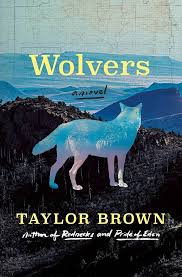
Wolvers by Taylor Brown
(St. Martin’s Press)
Trace Temple is angry at the government because they took his family’s New Mexico ranch just because they killed a wolf. And he’s not the only one. Many ranchers and farmers share the sentiment. That’s why when Trace is approached by a militia group with a job offer to hunt down a famous she-wolf–an offer that comes while he’s living in his car–he jumps at the opportunity. However, the she-wolf, known as One-Eleven, isn’t a legend for being dumb, so Trace has his work cut out for him, and to make things worse, there’s another predator out there…and he likes the wolves.
Talk about synopses that barely scratch the surface! Listen, obviously there’s much more here in terms of story and characters, but I wanted to get the fun part quick because this novel is fantastic. I was already a fan of Brown’s mix of lyricism and brutality and have read, loved, and reviewed some of his novels, with The River of Kings, Gods of Howl Mountain, and Rednecks as my favorites. Wolvers now sits at the top of that list. Why? Because everything Brown does right is here, but turned to eleven. Also, this novel works on several levels. I’ll stick to three for the sake of brevity.
First, the obvious: the violence, crime, guns, impeccable research, poetry about nature, and blood we’ve come to expect from Brown are all present here (the bloody stuff more than ever as we travel through the Gila Wilderness with a man dragging his destroyed lower leg in a massive, rigged trap he can’t open).
Second, Wolvers is the kind of novel in which every conceivable point of view is entertained but not defended, allowing facts to speak louder than words and letting readers come to their own conclusions. In this narrative, those who support the reintroduction and protection of wolves and those who want the polar opposite clash in more way than ones, and each clash increases the tension on a novel where tension is present from the opening page.
Lastly, Brown did something I wasn’t expecting and it turned into one of the best things about the novel. Chapters alternate between characters, but that includes One-Eleven. And no, there’s no cheap, easy anthropomorphism here. One-Eleven is a she-wolf, a mother, a predator, a protector, but always an animal, a resident of the Gila Wilderness. Instead of dialogue, the One-Eleven chapters are full images, sensory details, and things like sustenance and survival. Yeah, come read this one for the people, but stay for the wolves.
Oh, and the research. Yeah, won’t bore you with details, but the research takes this to a new level. This is tense, gripping, wild, ruthless, and gorgeously written. I’ve enjoyed all of Brown’s work, but this might be his best.
___________________________________
MAY
___________________________________
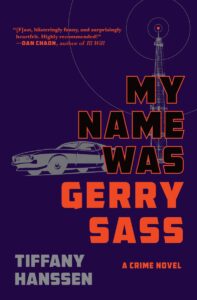
My Name Was Gerry Sass by Tiffany Hanssen
(Atlantic Crime)
Okay, so I dropped my wonderful editor here at CR, Dwyer Murphy (go read The House on Buzzards Bay!) a line about a week ago and we talked about this column. I said I’d send it right along. Then I started reading Tiffany Hanssen’s My Name Was Gerry Sass and had to hold on and include one May novel. Yeah, it’s that good.
Gerry Sass owns a little radio station right outside Mystic, Iowa. He doesn’t have many friends and his relationship with his adult daughter is strained. Oh, and he has mob connections, uses the radio station to launder money, and occasionally kills people when it has to be done. But live by the sword, die by the sword, right? On a regular morning in 1986, life catches up to Gerry and two men take him, walk him into the woods, and shoot him the back of the head…in front of Gerry’s closest friend, a local priest named Father Dan who sits out in a hunting blind nearby that Gerry let him set up.
One morning in 1986, his life of crime catches up to him when two men march him out into the woods and shoot him in the back of the head. Plunged into purgatory, he’s doomed to a painful examination of his life. Unbeknownst to the assassins, Gerry’s closest friend, a Catholic priest named Father Dan who has a tree stand out there that he uses for thinking instead of hunting. Scared frozen, Father Dan does nothing to stop Gerry’s murder, and that haunts him. Especially after he tells Early, Gerry’s daughter, who immediate sets out to avenge her father despite their strange relationship.
The novel alternates between Father Dan, Early, and Gerry, whose life and best/most important memories we see as his brain slowly fades out after his murder. Between the thirst for revenge, the mob connections, rumors that Gerry was killed because he was going to become a stool pigeon, and Early quickly learning that she inherited some dark talents from her father, this is a fast-paced thriller with the goods to satisfy most crime readers. That said, none of that is the best thing about this novel. There are plenty of stories out there featuring muscle cars and angry people dishing out righteous justice. No, what makes My Name Was Gerry Sass special is the metric fuck-ton of heart Hanssen injected into it. Early, Gerry, and Father Dan are all memorable characters. They’re all flawed, like we all are, but as the narrative moves forward, they step up, learn about themselves, and have to think a lot–and thus make us think a lot–about love in all its forms, the importance of friendship, and how there’s always time for redemption.
I was going to write a standard closing paragraph, but then realized I never mentioned this is a debut. Impressive indeed. Sign me up for whatever Hanssen does next.
Okay, just more one thing! Welcome to…
___________________________________
The Retro Corner
___________________________________
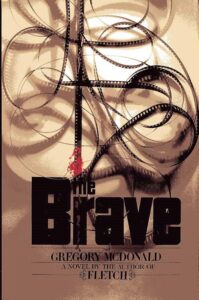
I know, it’s at the end, but The Retro Bottom sounds more like a joke than something about books. Anyway, story time! In late 2024, I was on a train in France talking books with Marie-Laure, the wonderful woman who serves as my translator/everything/French mother while I’m there. She had read The Devil Takes You Home, which they had just published in France, and said that, in her opinion, only one other novel had that mix of darkness, violence, and sadness: Gregory McDonald’s The Brave. I hadn’t read it, so I went looking for it. Published in 1991 and out of print. About $75 for a used copy. Nope. I asked online, got a friend to hook me up. I read it, wished I could write about it. Well, now that this is rolling again, I’d love to mention other books from time to time. You know, because a book that came out in earlier this year or in 2025 or in 2020 or in 1991 is still a new book to those who haven’t read it (and if they haven’ read it in a very long time, also kind of new to those who might revisit it). Anyway, if you can track it down, read The Brave, but I wanted to tell you about another novel…
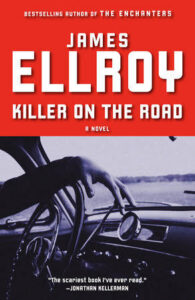
James Ellroy’s Killer on the Road. It’s back via Vintage as of December of last year. They also published new editions of classics like The Black Dahlia and L.A. Confidential, both part of his famous L.A. Quartet. In any case, this was one of those rare early Ellroy novels (the other ones being Clandestine and Suicide Hill) that I had no recollection of reading, so I read it.
Killer on the Road is pure Ellroy before he was Ellroy. His earlier novels have a more verbose, less telegrammatic prose than his most recent ones. Don’t get me wrong, you know it’s him the moment you start reading, but he was still polishing his style, developing that now classic Demon Dog voice and rhythm.
What can be said about a novel originally published in 1986 that hasn’t been said already? Don’t know, don’t care. I can tell you this: the way he talks about “brain-movies” that became part of crime fiction’s DNA. Also, for those interested in Charles Manson, the cameos here are a real treat, just like watching Ellroy toy with (b) romance while the bodies pile up and he takes up deeper and deeper into the mind of a serial killer. Anyway, thanks for putting up with my nerdy book shit. Much love. See you next month.

Gabino Iglesias
Gabino Iglesias is the author of the Shirley Jackson and Bram Stoker award-winning novel, The Devil Takes You Home, as well as author of the critically acclaimed and award-winning novels Zero Saints and Coyote Songs. He is a writer, journalist, professor, and literary critic living in Austin, Texas. He is the horror columnist for the New York Times Book Review.