What to Watch Now, International Edition: Z (1969)
A groundbreaking political thriller that still resonates today.
Story/Mood: More than half a century after it was made, Costa-Gavras’s Z is still considered one of the greatest political thrillers of all time. With no extra padding or layers of sentimentality, it unsparingly lays bare the mechanics of power—and how it is used to stifle political opposition. Z is based on the assassination of a Greek politician, Grigoris Lambrakis, but takes place in an unnamed city/country and opens with a scene in which a scientist talks about a rot that is overtaking plants and how to fight it. He’s followed by a member of the ruling military government who explains that a similar rot is overtaking society and that it too must be eradicated.
Shortly after that, we meet a group of opposition members who are preparing for the arrival of the “Doctor” the leader of their pro-democracy party who is scheduled to speak to a large audience. What follows is their attempt keep the Doctor safe from harm—and the aftermath of their failed efforts. Most of the characters remain unnamed—they’re the Doctor, the General, the Prosecutor and so on. For the most part (with the exception of the Doctor), we don’t get any glimpses of their home life but that doesn’t make them any less powerful as characters. I appreciated how the film didn’t get sidetracked into personal details—which seems like a default these days—to still create a situation in which I felt invested in the outcome.
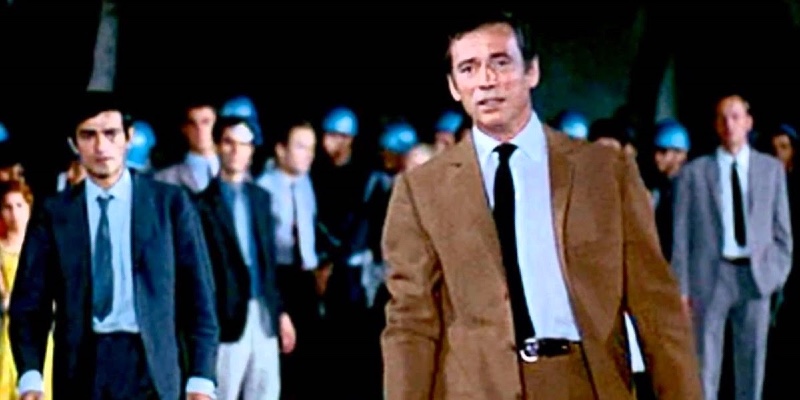
The Look: The movie forges ahead with the pace of a thriller but is filmed in a loose hand-held documentary style. Some of the crowd scenes are really menacing. I felt thrust in the midst of the protestors and counter protestors and wondered what I would do in that situation.
Memorable Moment: One of the early scenes in which the booking for a hall for the Doctor’s talk is canceled at the last moment, stuck with me. You immediately sense that things are not going to go well if civil society doesn’t have the courage to stand up to the military junta.
Crew: Greek-French film director Costa-Gavras said: “Thriller is a way to tell a story about society… Political is not whom you vote for, but rather your relationship with “polis”, which means “town” in Greek. I used to talk about political movies, and the distributor would say, don’t talk about “political”, but since then, everything is political.” A sentiment that is just as true today as it was in the late 60s.
Z was shot in Algeria with French actors because, Costa-Gavras said, it was impossible to film it in Greece at the time. Commenting on his decision not to use names, just functions, Costa-Gavras observed, “That made the film, you could say, more international. What was important was the idea of power, the power used by the main forces in society, the police, the army and the justice system, to do what they have done. That was the idea — that mechanism… What is permanent, I think, is how someone can use the police, the justice system and the army to have all the power. There’s still the possibility that a man, or a group of men, can control these three forces in a society and compel millions of people to obey you. That’s the whole system of a dictatorship.
Where to Watch: Streaming on multiple platforms.
Other notes: “Z” means “He lives” in Greek. With Jean-Louis Trintignant, Yves Montand, and Irene Papas. In a rare honor for a foreign film, it was nominated for multiple Oscars including Best Picture, Best Director, and Best Film Editing. 127 minutes. In French with English subtitles.

Radha Vatsal
Radha Vatsal is the Film/TV Columnist for CrimeReads. She is the author of No. 10 Doyers Street and the Kitty Weeks mysteries, and her essays have appeared in the The New York Times, The Atlantic, the Los Angeles Review of Books, and elsewhere. She holds a Ph.D. in Film History from Duke University. You can find her on Instagram or email: rvatsal@lithub.com