
Wole Talabi on the intersection of first contact stories and mysteries
The author of The Fist of Memoryexplores what alien stories, sci-fi, and and crime tales share
In 1985, just a few weeks after a bloodless coup during which Major-General Ibrahim Babangida overthrew the military government of Major General Muhammadu Buhari in Nigeria, American astronomer Carl Sagan published Contact. A novel in which humanity first encounters advanced extraterrestrial intelligence when a team of scientists at SETI (Search for Extraterrestrial Intelligence) detects a radio signal from the star system Vega, located twenty-six light years away containing a sequence of prime numbers.
As they investigate, they uncover an embedded video and instructions in binary for building a mysterious interstellar Machine. Nations unite to fund and construct the device and a small international crew travel through the machine to meet the alien intelligence near the center of the galaxy where the aliens reveal their grand cosmic plans. It’s a great story.
First Contact narratives like Contact are some of my favorite stories in all of science fiction. As a species, we’ve long wondered about our place in the universe: if we were alone in it and if not, what would it be like to encounter alien intelligence.
Ever since I was a boy growing up under military dictatorship in Nigeria, discussing current affairs, history and astronomy with my dad on the weekends, I have found it endlessly fascinating to imagine all the different ways that a first encounter between humans and extraterrestrial sapient life could go. So of course, I enjoyed reading Contact when I found it in my school library and especially loved watching the 1997 screen adaptation starring Jodie Foster.
Readers often think of First Contact stories like Contact, and the many others that came before and after, as being focused on scientific or philosophical discovery, but undergirding all the talk of orbital mechanics, biology, astronomy, communications protocols and alien artifacts are much simpler things: questions.
First Contact stories are about answering questions. That, I think, is exactly what makes most First Contact stories at their core, mystery stories. After all, what makes a mystery story? I would argue that the defining feature of a mystery story is a central puzzle (usually a crime, hence the typical bundling together in bookstores as “mystery/crime”) where the truth is hidden until the end. Mysteries rely on an investigator of some kind as a key protagonist, as well as misdirects, suspicions, clues, all of which let the reader follow along with the protagonist until a final reveal.
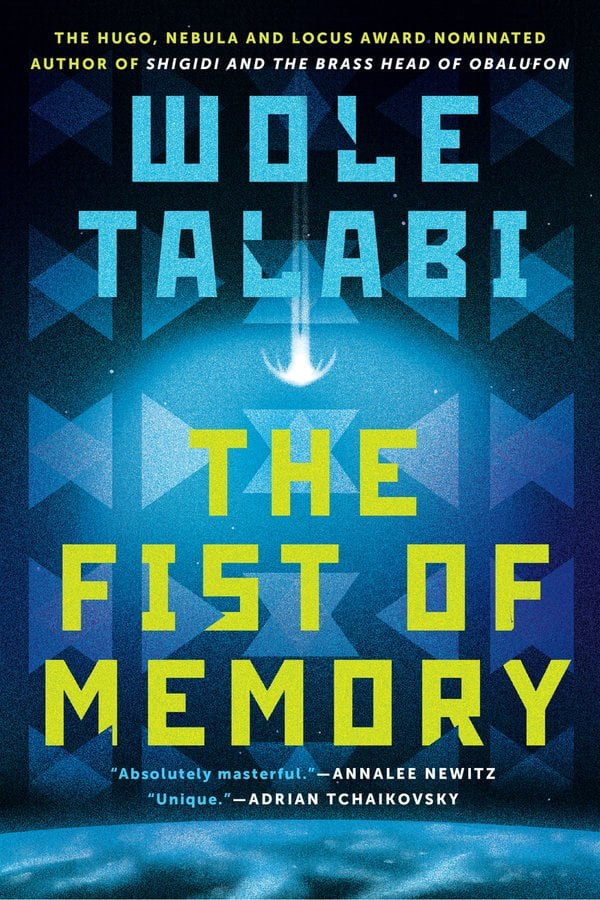
Given that, it’s easy to see how Contact, and many other First Contact novels like Rendezvous With Rama, The Three-Body Problem, Semiosis, Solaris, The Mountain In The Sea, and even my own new novel The Fist Of Memory, function on a significant level, as mystery stories. The puzzle may have shifted from a murder in a locked room to an alien signal/presence, but the narrative engine is the same: evidence appears, theories emerge, assumptions are challenged, and the truth slowly reveals itself.
That last bit is important. Both First contact stories and mystery fiction depend on information asymmetry and management to be effective. In both cases, truth emerges in fragments, until a final big reveal which should be both surprising and make complete sense in hindsight.
A mystery where the investigator reveals the solution too soon or without sufficient buildup can be unsatisfying. First Contact narratives are pretty much the same. They derive their emotional and philosophical power from a series of carefully managed revelations.
A perfect example is the movie Arrival (another one of my favorites) based on the novella “Story of Your Life” by Ted Chiang, in which a linguistics professor Dr. Louise Banks, is recruited by the military to try to communicate with twelve massive alien spacecraft that have landed across Earth to learn why before panicked world governments ignite a global war.
After several false starts and apparent failures, the film’s climax arrives (ha!) in a powerful revelatory moment when she finally comprehends the alien language and her perception of time shifts, as does the audience’s understanding of the film’s events. It’s so brilliantly done; I get chills just thinking about it.
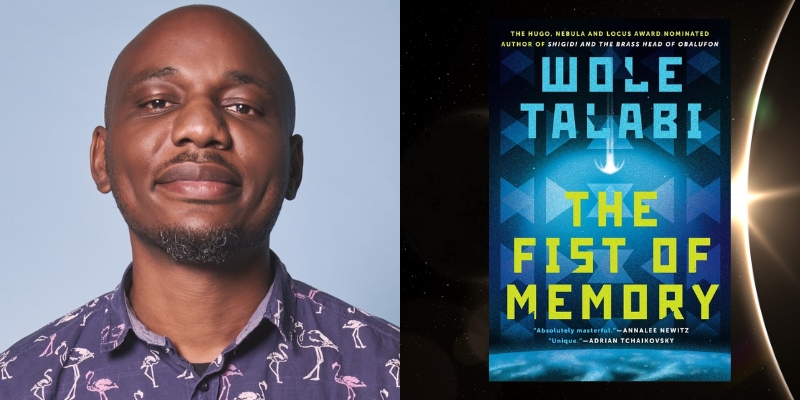
When I started writing my own First Contact SF thriller, The Fist Of Memory, I brought with me that imbibed spirit of mystery as an essential element and I wanted to give readers those familiar feelings. I open the book with a classic first-contact mystery premise, riffing on Rendezvous With Rama (yet another favorite of mine): an enormous alien spacecraft appears in the sky, approaching Earth. It’s uncommunicative and unresponsive to our signals.
My main character Tope is an assassin caught in the very Nigerian brand of political turmoil the alien craft’s arrival precipitates (inspired by my experience growing up under political instability). But once I had that opening as my setup, I knew I also needed a scientist as one of my protagonists. Because in First Contact, the scientists and explorers perform the same role that detectives perform in mystery and crime fiction: discover something previously unknown, gather evidence, analyze clues, formulate hypotheses, eliminate suspicions, search for patterns, solve the puzzle.
So, I created Itumeleng Sefako, an astronomer struggling to balance his scientific beliefs and his cultural traditions and connections. It’s through him that the mystery of aliens as well as their connection between humanity is investigated, analyzed and eventually revealed. Tope and Itumeleng become co-protagonists, performing a literary pas de deux, but without Itumeleng working through the core mystery, the book wouldn’t work.
That said, I think there is one thing that First Contact stories can do which traditional mysteries and detective fiction cannot (at least not without risking the ire of readers) and that’s this: leave the mystery unsolved (as is the case in Rendezvous With Rama). First Contact stories can do this because a truly alien intelligence may lie beyond our capacity for understanding. Or their worldview may be so radically different from ours that it’s essentially incomprehensible.
Think of all the meetings of separate human cultures/civilizations that were previously unaware of each other and just how many misunderstandings there were. Now increase that several orders of magnitude. Can we ever understand the motivations of, say, boron-based sentient crystals? Could we comprehend the morality of an inorganic mind that evolved in the magnetic poles of a neutron star? Sometimes, in First Contact, the closer we approach a solution, the more we discover the limits of our own perception.
Luckily, like in Contact, I chose not to lean into this too much in The Fist Of Memory. The mystery is resolved. At the end of the novel, there is an explanation of who/what the aliens are and a reveal that leaves all of humanity with a choice and a potential for change.
I felt this was important because in the end, while First Contact stories are ostensibly about humans meeting the other, they aren’t really about that. Not really. They’re about us. They’re a storytelling device through which we examine ourselves, attempting to think through the mystery of who we are and what our place in the universe might be.
Ultimately, First Contact stories are really mystery stories because they are driven by our own endless search for meaning and that, I think, is what makes them so appealing.
***

Wole Talabi
Wole Talabi is an engineer, writer, and editor from Nigeria. He is the author of the critically acclaimed Shigidi And The Brass Head Of Obalufon, which was named one of the best books of 2023 by The Washington Post, as well as The Fist of Memory. He has hopped around the planet quite a bit but right now lives in Australia. He has been a finalist for the Hugo, Nebula and Locus awards, the Caine Prize, and has won the Sidewise award for alternate history. Talabi's work has also been translated into 7 languages. His fiction has appeared in Asimov's, F&SF, Clarkesworld, and is collected in the books Incomplete Solutions (2019, Luna Press) and Convergence Problems (2024, DAW Books).