10 Books Where the Main Character Is, or May Be, a Psychopath
Hank Schwaeble breaks down a twisted and popular genre.
I think it’s safe to say a large swath of bibliophiles out there simply love reading about psychopaths. They love them when they serve as the core component of true crime, they love them in fiction, they love them wherever they appear (outside of real life). This isn’t a love of affection or approval, it’s a love of intellectual and emotional captivation for the morbid mental stimulation and dark entertainment they provide.
And who can blame them? Psychopaths make for fascinating characters. When they are the antagonists, we love matching wits with them, we love finding out how the protagonist is going to fare, wondering if he or she will even survive—how will he defeat this ruthless villain who lacks all restraint, how will she outwit this cunning foe who always seems two steps ahead? If well rendered, seeing the hero struggle against mounting odds and increasingly impossible circumstances to ultimately prevail and the unspeakably evil killer/stalker/terrorizer get his comeuppance makes for a great page-turner and scratches that itch that the brains of we thriller fans carry with us everywhere, and does so in a most satisfying way.
But what about when they’re not necessarily the antagonist? What about when they’re the point-of-view character, the main one, the one the story is really about? Novels spanning in breadth from the highest literature to the pulpiest horror have held readers in rapt engagement for the better part of two centuries by presenting character studies of protagonists displaying varying degrees of psychopathy; books ranging from overt and unmistakable psychopaths in the lead role to main characters whose reliability (and sometimes, sanity) is either unmistakably uncertain or which gradually becomes suspect. Some are characters who may be completely honest and expect you to accept who and what they are, others are ones who may be expending considerable effort in trying to fool you—or themselves. Like I said, works with such characters go way back and have held up remarkably well through numerous literary eras, with famous examples from the likes of Poe, such as in “The Cask of Amontillado” in the 19th century, to Highsmith with The Talented Mr. Ripley in the mid-20th, to the Dexter novels by Jeff Lindsay in the 21st, just to name a few.
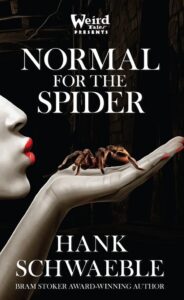
Personally, I find the alien mind of the psychopath an irresistible draw in a story. And not just as a reader. In my latest novel, Normal for the Spider, I take a magnifying glass to the character type, where I present not just a psychopathic protagonist, but an underground shadow society of such people, and a series of events where their plans to terrorize the country’s elites result in the hunters turning into the hunted.
Apropos of the above, for all you readers out there who, like me, have a soft spot for those characters whose minds work differently, for all of you who simply can’t resist the siren-call of a complex antisocial personality coming to life on the page—or of a protagonist you suspect may or may not be the good guy, after all—here’s a list of ten novels of varying stripes to feed that addiction.
American Psycho by Bret Easton Ellis
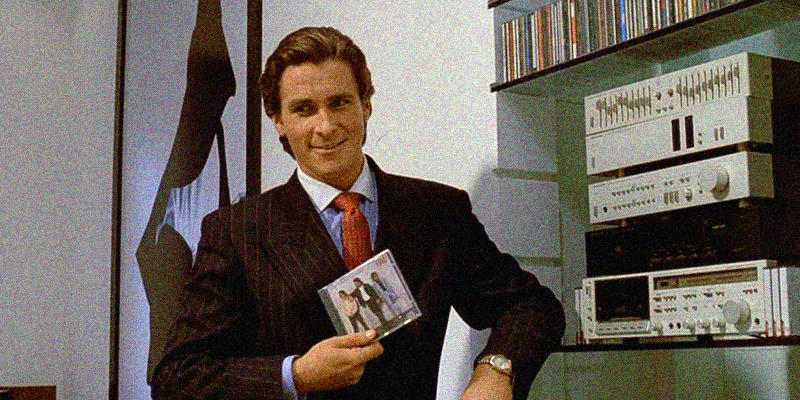
Few novels struck a nerve that seemed to run through the zeitgeist of an era the way Ellis did with American Psycho. His send-up of the self-centered, ego-driven and hyper-materialistic culture of yuppies in the 1980s, embodied in the monstrous persona of Patrick Bateman, triggered outraged condemnation from numerous corners for its unvarnished depictions of ruthless acts of depraved violence. But behind all that was an engrossing study of a psyche unconstrained by either morality or empathy, and whose accounts and perceptions can’t necessarily be trusted.
Gone Girl by Gillian Flynn
Flynn set the literary community on fire with the release of this novel about a man under investigation for the disappearance of his wife and who faces mounting and—to him—inexplicable evidence being uncovered pointing to his guilt. Flynn masterfully structures the novel partly in the voice of Nick, the husband, and partly in the voice of Amy, the wife who is missing, from her diary… until suddenly flipping the entire story on its head halfway through the book. This novel set a new standard when it came to keeping readers tearing through the pages for answers.
Crime & Punishment by Fyodor Dostoevsky
Remember how I said novels with a psychopath, or possible one, as the main character spanned the range of literature? It would be hard to name many books that have historically gotten more attention in literature programs than this Russian novel about a penurious former law student who decides that the only way to save his sister from an ill-advised marriage is to commit a murder. In Raskolnikov, Dostoevsky gave the world a captivating portrayal of a young man who compels himself to commit the ultimate sin and then desperately tries to grope his way out of the darkness. The psychopathy in this story is not the kind we’re used to seeing, being more temporary and circumstantial in nature, but the thought process and moral rationalizations involved open a window into the character’s soul that resonates to this day.
Fight Club by Chuck Palahniuk
This critically praised but relatively low-profile novel about a young man lost in the sea of malaise that is his life who has a life-changing encounter with a self-proclaimed cultural terrorist named Tyler Durden catapulted seemingly out of nowhere to take the literary community by storm in the late 90s when the movie of the same name came out starring Edward Norton, Brad Pitt and Helena Bonham Carter. It’s a book about manhood, maturity, responsibility, survival and the mental strain of living in a world where absent fathers are the norm and men hold contradictory and often dangerous ideas of what manhood means, and where pathologies of the mind run rampant.
Come Closer by Sara Gran
Sara Gran’s novel about a woman who finds herself slowly becoming possessed by a demon takes the reader on a disturbing journey through someone’s life as it steadily falls apart with increasing acceleration. As the breadth of an apparent conspiracy takes shape, questions about whether this is all in her head, something she’s questioned from the beginning, start to get answered. Or do they? Is she really being taken over by a female entity who appears in her dreams, or is she afflicted with a form of psychosis? Or is the answer even darker? Gran is an expert at manipulating the reader, and if you’re like me, you’ll find the climactic scene and ending will linger like a haunting, raising a number of questions that start to multiply more you think about them.
Lolita by Vladimir Nabokov
To say this novel was (and still is) controversial is like saying The Beatles were a popular rock-&-roll band: technically true, but such an understatement that it can hardly be considered accurate. Nabokov’s novel deals with a grown man’s sexual obsession with a twelve-year-old girl who eventually becomes his stepdaughter. Humbert Humbert’s unapologetic hebephilia, one he seems to nurture and rejoice in, makes him one of the most outrageous characters in all of literature. Often lost in all the furor is the fact the book presents a layered and riveting character study of a likely unreliable narrator who allows his entire identity to be shaped by the impact of a childhood loss to the point of embracing a destructive pathology as a joyful worldview, and who only belatedly begins to discover what a monster he truly is. The controversy surrounding it is well-deserved; it is an important novel, nonetheless.
Bunny by Mona Awad
It is a challenge to describe Bunny with any particularity in a way that won’t give away too many spoilers; suffice to say, the book may usefully be thought of as one part dark academia, one part magical realism, and one part what the hell did I just read. It’s a twisting—and twisted—account of a young woman’s invitation to join the Bunnies, a snobbish clique of popular ‘mean girls’ at an elite MFA program in Rhode Island. Once she discovers witchcraft is afoot, one might say all hell breaks loose. Unless, of course, one or more of those involved is simply crazy—or maybe a psychopath.
I’m Thinking of Ending Things by Iain Reid
This novel, told almost exclusively from the perspective of a woman struggling to decide whether to break up with her beau, lures the reader in through a deceptively simple premise that the author gradually suggests has a lot more going on than meets the eye. It’s a poignant and disturbing exploration of what makes a person who he or she is, and of the unreliable nature of belief and perception. The title, suggestive of the main character’s uncertainty regarding her relationship, carries with it the unmistakable hint of how the culmination of our thoughts and the actions we take as a result of them often lead to outcomes that were both avoidable in some ways, inevitable in others. Was the narrator a psychopath? Was the boyfriend? You be the judge.
Heartsick by Chelsea Cain
Okay, I cheated here—she’s not the protagonist of the novel, but Cain’s Gretchen Lowell is a compelling example of an enigmatic serial killer who all but steals the show, one who tortured the detective chasing her for ten days before letting him go and turning herself in. Those ten days changed him forever, and now she lives on not only in prison, but in his head, as a constant presence. Worst of all, although he’s unquestionably traumatized by what he went through, he also seems drawn to the memory of it, and her, like the proverbial moth to a flame, obsessed with the beautiful woman who carved a heart into his chest while possibly stealing his own (along with his spleen) in the process. This is a riveting tale of someone trying to catch another killer while still unable to get a handle on the feelings he has for the one who has scarred him for life in more ways than one. A tense and gritty look at the reflection one man sees when he looks into the abyss-like soul of someone who may understand him better than he does himself.
The Silence of the Lambs by Thomas Harris
No list of those who deserve credit (or bear responsibility) for the serial-killer craze that swept through bookstores and movie theaters in the 1980s can justifiably exclude Thomas Harris. He is, after all, the one who kicked off the decade with the ground-breaking novel, Red Dragon, where he introduced the soon-to-be-immortalized, iconic character of Hannibal Lecter, aka Hannibal the Cannibal, a highly refined and intellectual serial-killing psychiatrist. An important but secondary character in the book, Dr. Lecter reappeared in the sequel, The Silence of the Lambs, published in 1988. While most of the planet has an image of Lecter from the unforgettable portrayal of him by Anthony Hopkins in the Oscar-winning Silence of the Lambs film adaptation, Harris’s novel version remains an unforgettable entry into the annals of suspense literature. Is he the protagonist of this novel? No, I must confess, that billing goes to Clarice Starling, the plucky and determined FBI Academy cadet chosen to interview Lecter for his insights into the psyche of an at-large killer going around skinning young women. But you can’t keep a larger-than-life psychopath down forever, and Lecter garnered at least shared main-character status in the next book, Hannibal. All three novels are fantastic (not you, Hannibal Rising), but Silence is believed by many to be an almost perfect thriller, a gripping cat-and-mouse dance wrapped within the hunt for an active killer where the psychopathic Lecter bursts out of the prose in stereovision the way no such character had before—and few have ever since.
***

Hank Schwaeble
Hank Schwaeble is a two-time Bram Stoker Award-winning author of horror, suspense and thrillers. He lives in Texas with his wife, fellow novelist Rhodi Hawk. His latest novel, Normal for the Spider, comes out from Blackstone Publishing on September 15th.