Like many mystery-obsessed children, my first experience with child sleuths wasn’t Nancy Drew, Harriet the Spy, or the Hardy Boys, but with Donald J. Sobol’s boy detective, Encyclopedia Brown. My attachment to this series had little to do with Leroy Brown the character, or even his trusty sidekick Sally Kimball—although children who run their own detective agency for “25 cents per day plus expenses” are charming to be sure. What had me and others enthralled, of course, was that Sobol embedded clues in his stories for his young readers to gather and thereby solve the case. You might even say that the shocking twist of each story is that we were Encyclopedia Brown the whole time. The solutions typically hinged on some accessible bit of trivia, like the fact that humans and dinosaurs did not coexist, that polar bears and penguins live on opposite poles, or that electric clocks do not tick. If only being a detective in real life were so quaint.
That youthful itch to crack the case doesn’t subside just because one is grown up; one just has to seek out age-appropriate Leroy Browns, adult amateur detectives trying to make sense of a cryptic world, and, in the process, bringing us along for the ride. This list is designed to recreate that Encyclopedic thrill, to put the reader behind the gasoline can to disentangle codes, clues, and riddles. You’ll notice that many of these titles concern books and libraries. Where else does one have ciphered adventures but among books?
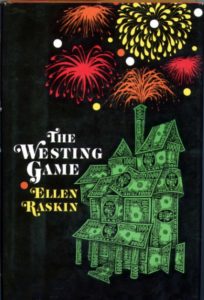
Ellen Raskin, The Westing Game
We’re still in the Encyclopedia Brown demographic here, but trust me when I say that Raskin’s Newberry Award–winning classic holds up under adult re-readings. The game of the title pits the late paper baron Sam Westing’s heirs against each other by dividing them into teams and dispensing each with a partial set of clues: “It’s not what you have, it’s what you don’t have that counts.” Through the book’s shifting points of view, the reader is left to gather evidence from each perspective—both clues on paper and those hidden within the sprawling cast of characters. Raskin’s genius wasn’t just her inclusion of the reader as contestant in Sam Westing’s mad game, but also in a larger thematic inclusiveness throughout her socially progressive novel. Add to that a knockout twist ending that blew my nine-year-old mind, an experience not to be replicated until I discovered Agatha Christie years later….

Agatha Christie, Postern of Fate
There aren’t an abundance of codes and ciphers to be had with Christie, but there are a few, among them the final novel of the author’s life. This frothy mystery can be oddly discursive and absent-minded (a bit like her aging protagonists), but I’m including it because of its preoccupation with books. The husband-and-wife team, Tommy and Tuppence, are no longer the dashing young sleuths of the early stories, but have since retired to an old house in the country. The house—and this story—is overstuffed with books: forgotten books, hidden books, books remembered and discarded, and rooms filled with more volumes than Tommy and Tuppence know what to do with. Enter a book code that sets off T&T’s final mystery. Was this preoccupation with musty collections the great writer grappling with her own legacy? One wants to tell her she needn’t have worried.
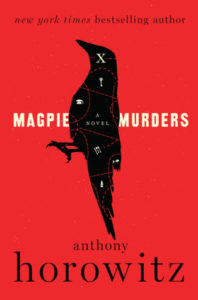
Anthony Horowitz, Magpie Murders
In addition to the numerous Agatha Christie screen adaptations of late, her resurgence can be found in mystery writers’ renewed appreciation for the Queen of Crime. The brilliance of Magpie Murders is that Horowitz has written not one, but two Christie-esque mysteries, folded into one another. You might expect that the mystery-within-a-mystery structure would result in one of the stories suffering as a result. But Horowitz shows just as much respect for his cozier meta-mystery as for his larger present-day story. Merging the two, he’s turned his book editor protagonist into a detective on the hunt among the pages of an unedited manuscript for answers to a novelist’s shocking death. The ingenious solution straddles the line between surprising and yet entirely solvable by the hypervigilant reader.
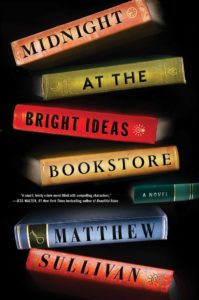
Matthew Sullivan, Midnight in the Bright Ideas Bookstore
When a young bookworm is found hanged among the stacks of an independent bookstore, a clerk must sift through piles of the deceased’s coded bibliomania to find out why. Sullivan imbues his literary world with such affectionate specificity (he dubs the lonely souls who haunt bookstores at all hours “book frogs”) that it’s no surprise the author was once a bookseller himself. The story’s principal book cipher, which we can decode along with our hero, Lydia, sets this charming mystery apart from similar novels in that the formatting and typeface of the pages incorporate the code, bringing this inventive whodunit and its solution into black-and-white relief.

Robin Sloan, Mr. Penumbra’s 24-Hour Bookstore
Robin Sloan may be a lover of paper books and brick-and-mortar stores, but he takes his love a step further by embracing the modern-day storehouse of information: Google. It makes sense then that when the bookseller narrator of Sloan’s story is faced with a distinctly bookish puzzle hiding among the stacks of the titular bookstore, the solution requires a bit of 21st century inspiration. Although wistful at first blush, Sloan’s novel turns itself inside out to become an optimistic merging of old and new; of nostalgia for the past and giddy hope for the future; of secret societies dedicated to decoding ancient texts to those of the sprawling campuses of Silicon Valley coding their own futures.

Charlie Lovett, The Lost Book of the Grail
In a Penumbra-like push and pull between analog and digital, Charlie Lovett’s third novel sets the love of paper things against the love of bald information. In other words, for our tweedy hero, Arthur Prescott, it all comes down to a battle between libraries and media centers. Lucky for Arthur (and us) his quest to track down the lost Book of Ewolda—a mysterious text he suspects will lead him to none other than the Holy Grail—largely requires escapades of the parchment and vellum variety, which means lots of time spent amid the forgotten manuscripts of the Barchester Cathedral library. Lovett’s trail of seductive clues includes obscure paintings, Latin texts, substitution ciphers, and a dash of coded mathematics, all leading to a very unexpected holy relic.
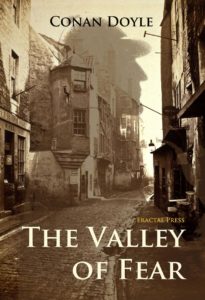
Sir Arthur Conan Doyle, The Valley of Fear
It’d be a stretch to suggest that even the most quick-witted mystery buff could keep pace with Sherlock Holmes. What, after all, is Dr. Watson there for if not as a stand-in for the reader? In his final novel, Doyle presents Holmes with a book cipher written by one of Professor Moriarty’s men. “But why,” bemoans Watson, “has he not indicated the book?” To which Holmes drolly points out the whole point of writing in code: “Your native shrewdness, my dear Watson, that innate cunning which is the delight of your friends, would surely prevent you from inclosing cipher and message in the same envelope.” Naturally, Holmes makes quick work of the cryptic message, but there is more coded mischief to come. Doyle’s stories being intricate puzzles in themselves, any might be at home on this list.
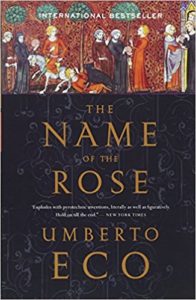
Umberto Eco, The Name of the Rose
Whether you believe Umberto Eco to be the original Dan Brown or the second coming of Sir Arthur Conan Doyle, there are codes and ciphers aplenty for the puzzle-hungry booklover. Eco, who was a famed semiotician, leaves much to unearth and decrypt here, hiding a ripping mystery beneath his scholarly illumination of 14th-century monastic life. Add to that codes written in invisible ink, substitution ciphers, forbidden books, a labyrinthine library (a riddle in itself), and serial deaths that align with the seven trumpets of the Apocalypse. One of Eco’s recurrent themes is the idea of merriment as a force for truth, or as our monk-detective, William of Baskerville, puts it: “laughter as a force for good, which can also have an instructive value: through witty riddles and unexpected metaphors, though it tells us things differently from the way they are, as if it were lying, it actually obliges us to examine them more closely, and it makes us say: Ah, this is just how things are and I didn’t know it.” And isn’t that what codes, ciphers, and puzzles ultimately are? Fact disguised as joke? Truth hiding in riddle?

Nova Jacobs
Nova Jacobs is the author of The Stars Turned Inside Out, now available from Atria Books. Jacobs is the author of the Edgar Award–nominated The Last Equation of Isaac Severy, a mystery set in the world of mathematics. Her latest novel, The Stars Turned Inside Out, imagines a murder investigation at the Swiss particle physics laboratory CERN. She lives in Los Angeles. Find out more at novajacobs.com.