
A Brief History of Occult Detectives
From gong’an to Carnacki to The Speculative Detective Agency, the occult has long haunted mystery fiction
When you conjure up the image of an occult detective in your mind, what do you see? Wrinkled trenchcoat—or trenchcloak? Smoke—tobacco laced with brimstone? Shadowy alleys, filled with unseen, whispering things?
The occult sleuth is, as you might expect, hazily defined. An individual with supernatural powers who solves mysteries? An individual without powers who encounters the supernatural while solving mysteries?
Once you start digging, you find hundreds of both kinds, ghost-seekers, monster hunters, magic detectives, sorcerer sleuths, people who see/talk/hear/shag dead people, etc., going way back in time. (Genre blending was a thing long before there were genres!) To list all these noircromancers, even just the ones named Harry, would require a tome Necronomicon-thick. Let’s stick to literary members of this curious cabal, resurrecting some old ones and shining a light on some of the newly risen.

Judge Bao
Called the “Chinese Sherlock Holmes” and based on a real person, Judge Bao starred in gong’an stories, or “crime-case fiction,” which date as far back as the 10th century CE. His cases often involve supernatural elements, with ghosts giving witness testimony in person, in dreams, or after having been transformed into pottery. Sometimes the judge even takes the investigation into the underworld. One of his most intriguing cases involves a young student who elopes with a beautiful woman—but she’s actually a white tiger demon who has been killing for tens of thousands of years. A Daoist priest warns the student about her, and soon the priest’s body is found ripped to shreds. Bao issues a warrant, which he brings to an altar, praying for intel. Soon, in a dream, he finds out how to subdue the demon (using dog’s blood, of course). She’s captured and beheaded, but the case ends with a final twist.
King Vikrama
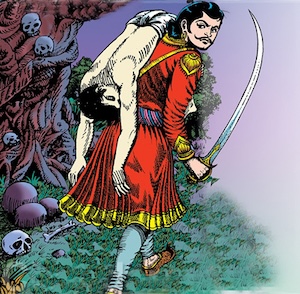
The Indian Sanskrit story cycle Vetālapañcaviṃśati has all the hallmarks of detective fiction. King Vikrama meets an ascetic/mendicant who tries to bribe him with precious jewels hidden in fruit. Vikrama asks, “What’s the rumpus?” But then the mendicant inveigles him into capturing a vetāla, a tricksy undead/spirit being named Betaal. The vetāla won’t surrender easily of course, and, in Scheherazadian fashion, teases the king with story riddles. After the king solves them all, Betaal, like a supernatural snitch, reveals the mendicant’s ulterior motives: to behead the king in order to gain supernatural powers. Then, just as in a buddy cop movie, the two work together to foil said plans.
Dr. Martin Hesselius
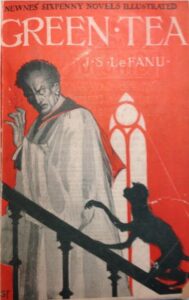
Over in the Global North, you’d think Enlightenment ideals of reason and science would have exorcised the supernatural from mystery fiction, but you’d be wrong. Physician/investigator Dr. Hesselius first appeared in Sheridan Le Fanu’s story “Green Tea” (1869), a sort of Sherlock versus Mr. Hyde tale, with the titular tea being blamed for the manifestation of a malevolent monkey. Hesselius was later used as the framing character for Le Fanu’s collection In a Glass Darkly (1872), which includes the exceptional female vampire story “Carmilla.” Other occult sleuths of the time include Abraham Van Helsing and Flaxman Low.
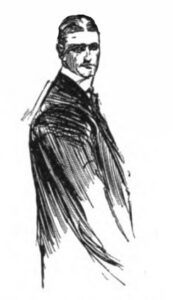
Thomas Carnacki, the Ghost-Finder
Created by William Hope Hodgson during the early days of pulp, Carnacki is an Edwardian-era bachelor/sleuth. The nine Carnacki stories are purple prosey and formulaic, and sometimes his adventures are no more than shaggy (or Scooby?) dog stories, ending with a mundane hoax. But sometimes there is a giant, evil hog spirit or a brick floor that turns into whistling lips. Published during an explosion of similar sleuths (e.g., John Silence, Aylmer Vance, Simon Iff, Professor Arnold Rhymer, Godfrey Usher, Semi Dual, Mesmer Milann, and Dr. Morris Klaw), Carnacki distinguishes himself by mixing the mystical with the mechanical, including a phonograph that reproduces sounds from dreams and an electric pentacle to ward off evil spirits.
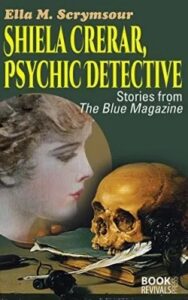
Shiela Crerar, Psychic Investigator
Orphaned, Crerar is taken in by her uncle, who in turn dies, leaving her broke. Realizing that she is psychic and can see ghosts, Crerar, coached by a spirit, decides to use her gifts to help others. A kind of ESPqualizer, she posts a notice in the paper to solicit clients: “Lady of gentle birth, Scottish, young, penniless, possessing strong psychic powers, will devote her services to the solving of uncanny mysteries or the ‘laying of ghosts’. Offer quite genuine.” Starting in 1920, the wonderfully named author Ella Scrymsour wrote six stories featuring Crerar, in which she battles ghosts, explores Celtic lore, and undoes family curses, but altogether the stories form the growth of a dynamic character.
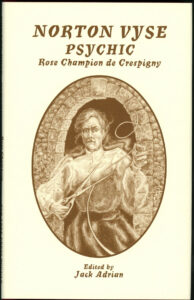
Norton Vyse
During the Golden Age of Crime Fiction, while there was some effort to bar the preternatural from mystery fiction (I’m looking at you Father Knox and S.S. Van Dine, metaphorically, of course, not through a crystal ball), it seems you can’t keep a good mystical snoop down. Already a popular writer of historical fiction, Rose Champion de Crespigny was a believer in the paranormal. She created the gentleman adventurer Vyse, who uses his “psychometric” ability to see the past and the future by touching a person or object. In the first Vyse story, “The Moving Finger” (not to be confused with Agatha Christie’s The Moving Finger), a worried mother consults Vyse because her daughter plans to marry a young man she distrusts. Vyse examines the man’s ring and through psychometry receives impressions of a wicked past. See also: Edward D. Hoch’s Simon Ark.
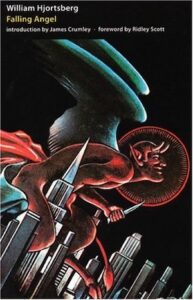
Harry Angel
William Hjortsberg’s Falling Angel (1978) is included here because it was made into the lurid film Angel Heart (1987), starring Mickey Rourke and Robert DeNiro, which has an, ahem, cult following. Mysterious client Louis Cyphre (get it?) hires stereotypical private eye Harry Angel (get it?!) to find missing musician Johnny Favorite. It’s downhill from there, and you may have guessed the twist ending from just that info. But the book garnered an Edgar Award nomination for Best First Novel and was turned into an opera, which honestly seems the best place for it. Stephen King described Falling Angel as “if Raymond Chandler had written The Exorcist.” A more modern critique comes from a reader on Goodreads: “If this book was a person, it would be Harvey Weinstein.”
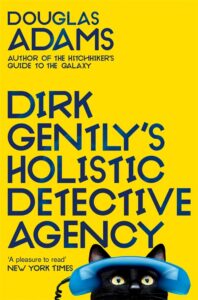
Dirk Gently
Written by Douglas Adams, Dirk Gently’s Holistic Detective Agency (1987) features eccentric private eye Dirk Gently, who while not psychic does have a “depressingly accurate knack for making wild assumptions.” He solves crimes by investigating the “fundamental interconnectedness of all things.” To say the plot involves murder, alien ghost possession, time travel, and Samuel Taylor Coleridge does it no justice whatsoever. The Times called the book “endearingly dotty.” Followed by two sequels, and Gently has been adapted many times in other media, including two television shows.
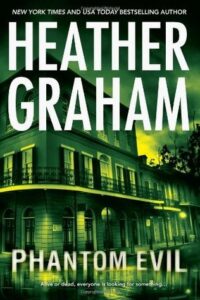
Krewe of Hunters
Heather Graham launched her Krewe of Hunters series in 2011 with Phantom Evil, in which skeptic Jackson Crowe leads a team of investigators, each with a different paranormal ability, when a Bayou State senator asks them to investigate his wife’s death in a haunted house. Angela, an ex-cop who can see the dead, quickly connects with the house’s ghosts, many of whom were victims of a serial killer in the years after the Civil War. The Krewe series is still going strong, with close to forty books as of this year, and following an effective, page-turning formula—new investigator, new murder, new ghost, new romance—that has clearly proven successful. Just visit any pharmacy or airport bookshelf.
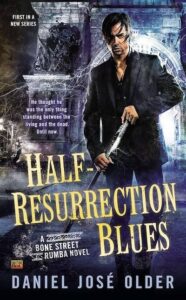
Carlos Delacruz
The protagonist of Daniel José Older’s Bone Street Rumba trilogy, Delacruz is an inbetweener, partially resurrected from death and, as a result, an amnesiac. Introduced in Half-Resurrection Blues, Delacruz investigates paranormal doings in Brooklyn as an agent for the Council of the Dead. In a solidly hard-boiled plot, he is ordered to kill Trevor, another inbetweener, but then he falls for Trevor’s sister Sasha and must hide the fact that he killed her brother. Publishers Weekly noted, “Older’s magical New York City is […] a gritty and genuine urban setting rife with strange forces.” What’s even cooler is Older’s thoughtful inclusion of LGBTQ characters.
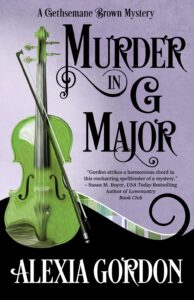
Gethsemane Brown
Murder in G Major, by Alexia Gordon, introduces classical musician Brown, who accepts a teaching position at boys’ school in Ireland only to find that her charming new cottage home comes complete with an incorporeal roommate: the ghost of one of her favorite composers, Eamon McCarthy. The two lonely souls bond as friends, and he insists he was falsely accused of murdering his wife and of committing suicide years earlier and convinces Brown to investigate. The spirit/human crime-solving duo went on to star in four more skillfully plotted cozies, and the series has been adapted by Hallmark as the Haunted Harmony Mysteries.
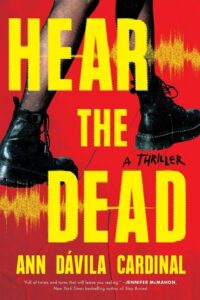
Elena Altieri
In Ann Dávila Cardinal’s brand-new mystery Hear the Dead, 66-year-old Elena “Lens” Altieri is an ex-punk rocker/photographer who turns amateur sleuth. Back in New York City for a retrospective of her photography, she realizes that beneath the buzz of her tinnitus, she can hear tortured screams of women in their final moments from back in the ’80s. She soon discovers that by touching objects connected to her past she can hear these women—one of them her best friend—who were thought to be victims of overdoses, but who were actually murdered. Cardinal spins a witty and heartfelt headbanger of a book, and, in a bit of meta magic, real-life actor Luis Guzman guest stars! IMAGE: hearthedeadcover.jpg
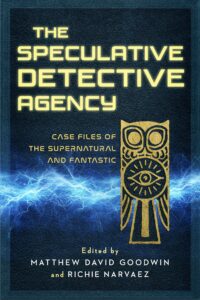
The Agents of The Speculative Detective Agency
The Speculative Detective Agency, an anthology I co-edited with Matthew David Goodwin, features sixteen short stories, each starring an occult detective working for a global organization that investigates cases that defy conventional logic: haunted environments; a cursed luchador; functional zombies. In my own story for the book, “A Haunting on South 4th Street,” newbie agent Carmen Ruiz is being trained by veteran agent Awilda “Cookie” Brunhilda Vasconcellos, a cigar smoking, tough-talking little person who may or may not have supernatural powers. Carmen is at first offended by but then fascinated by the unconventional methods Awilda uses to solve the mystery of a dark presence in a young girl’s room . . .
My sixth sense tells me that many of you will say this list is incomplete, so please feel free to name your own favorite occult sleuth in the comments.

Richie Narvaez
Richie Narvaez is the award-winning author of two novels and two short story collections. He teaches at Sarah Lawrence College and the Fashion Institute of Technology. His new anthology, The Speculative Detective Agency, is now available from Diversion Books.