
Rhys Bowen on writing real people and settings in historical fiction
The author of To Crown It All imagines the British royal family during fictive events
One of the aspects of the Royal Spyness series that readers like is that it involves the British royal family in the 1930s. The Prince of Wales, Mrs. Simpson the king and queen, the little princesses walk across the pages and are part of the plots. Other well-known real characters also are featured: Coco Chanel in a couple of books, Noel Coward in several and even Agatha Christie helps solve a mystery in From Cradle to Grave. My fictional heroine is supposedly related to the royals, a great granddaughter of Queen Victoria and thus a cousin first cousin once removed to the Prince of Wales.
Introducing real people to my plots is a bit of a risk, I suppose, but I am by no means unique. Shakespeare certainly wrote about plenty of real people but he retold their true lives. Taking a real person and putting them into a fictional plot is a little different. It is stretching truth and not everybody will be happy with that.
When I started the series I had to think how far I wanted to go from what we know of these characters and I decided I wanted to keep as close as possible to what I knew they said and felt. Queen Mary was a stickler for rules and passionate about antiques so in one plot I had her charge my heroine with reclaiming an antique that had been stolen from her.
I suppose the one person I took the most liberties with was Mrs. Simpson. Since I knew she had a sharp tongue and could be very cruel I enjoyed making her quite unpleasant for several books until she ends up helping my heroine.
Using real people and real settings requires a lot of research. I have to confess that I have poked into every corner of Buckingham Palace, and Kensington Palace, read all the biographies of Chanel and Noel Coward, the Prince of Wales and Mrs Simpson. To me it is important to recreate a real person as faithfully as possible.
In writing about real people each author has to decide how far they want to go and in what ways they might deviate from truth. Some writers have taken real people and made them sleuths. Stephanie Baron made Jane Austen (very successfully) into a sleuth. Karen Harper had Queen Elizabeth I solve crimes. Gyles Brandreth makes Oscar Wilde a detective.
Did any of these people really have time to do a little detecting on the side? And without being observed? Jane Austen clearly could have been a good sleuth with her powers of observation of the human condition, especially as she would have been overlooked, sitting in a corner as an unmarried woman. But Queen Elizabeth was accompanied every second of the day. Could she have found time and opportunity to sleuth a little?
So is the writer allowed to take real people and make them do things they didn’t do? Is there a chance of getting sued? Apparently not if they were a public figure. I could include Agatha Christie in my book, doing what she did best…solve a crime. But I don’t know about making them do something they would never have done: make them a murderer? I think the family would have cause to bring a lawsuit if a respectable person was defamed.
I don’t think I would be comfortable with making a real person do things I know they didn’t do. In fact it gives me great pleasure in having real characters say things I knew they really said. It’s like weaving reality and fiction together.
My favorite example is when Lady Georgie meets her cousins Princess Elizabeth and Princess Margaret. Margaret is three at the time. Georgie says “Hello Margaret,” and Margaret replies, “You have to say Princess Margaret because I’m a princess.” To this Georgie says, “Then you have to say Lady Georgie to me because I’m a lady.”
Margaret looks up at her governess and asks, “Is a lady better than a princess?” To which her governess replies, “One hopes a princess will grow up to be a lady.” True story!
For me the appeal of using real characters and putting my fictional heroine into a real world is that it immediately gives her credibility. It justifies her existence. She’s moving through a real society so we now believe she is real. We know all about Edward VIII and Mrs Simpson and we see Lady Georgie interacting with them. So we accept Lady Georgie as real. Very satisfying.
As well as involving real people in my stories I have introduced real events. We were at Sandringham for the last days of King George V. We were with Mrs Simpson when the king decided to abdicate.
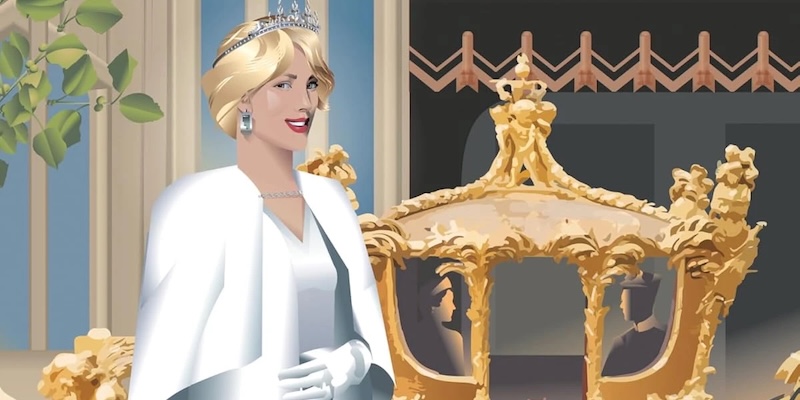
In this latest book in the Royal Spyness series, To Crown It All (book twenty!) the whole story centers around a real event: the coronation of King George and Queen Elizabeth in 1937. This was a well-documented event, It was even filmed. So I made sure I kept every element completely accurate (except for a minor detail of a plot nobody knew about…which might have happened).
I reasoned that my heroine, Lady Georgie, who is the king’s cousin, would be invited to the Abbey and be involved in the coronation, but I didn’t expect her to get so very involved!
I find it very satisfying to recreate real history, to take readers back to a real time and place, but with the slight addition of my fictional sleuth.
***


Rhys Bowen
Rhys Bowen is the New York Times bestselling author of more than sixty novels, including Mrs. Endicott’s Splendid Adventure, The Rose Arbor, The Paris Assignment, Where the Sky Begins, The Venice Sketchbook, Above the Bay of Angels, The Victory Garden, The Tuscan Child, and In Farleigh Field, the winner of the Lefty Award for Best Historical Mystery Novel and the Agatha Award for Best Historical Novel. Bowen’s work has won sixteen honors to date, including multiple Agatha, Anthony, and Macavity Awards. Her books have been translated into many languages, and she has fans around the world, including more than seventy thousand Facebook followers. A transplanted Brit, Bowen divides her time between California and Arizona. For more information, visit www.rhysbowen.com.