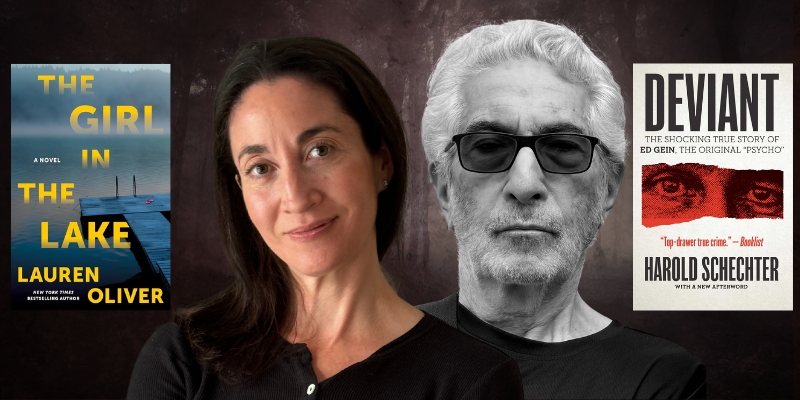
A Father and Daughter Discuss Their Shared Crime Obsessions
For Father's Day, authors Harold Schechter and Lauren Oliver are talking writing, crime, and the darkest corners of the human psyche.
For Father’s Day, we asked authors Lauren Oliver and Harold Schechter, who happen to be daughter and father, to have a wide-ranging conversation about writing and crime. Happy reading!
Lauren Oliver: It’s rare for a father and daughter to share a professional obsession with the darkest corners of the human psyche. I’d love to start with how you first found your way into writing about murder and crime.
Harold Schechter: I’ve been asked that many times, and the answer always goes back to my childhood fascination with monsters.
As a baby boomer, I grew up in a culture saturated with them. I spent my Friday evenings watching our local Creature Features TV programs that showed the classic Universal monster movies like Frankenstein, Dracula, and The Wolfman. I went to Saturday matinees of Grade-B horror films like Creature from the Black Lagoon and The Incredible Shrinking Man. I pored over comics like Tales from the Crypt and magazines like Famous Monsters of Filmland. My imagination was shaped—if not warped—by those stories.
As I grew older, I became fascinated by the psychological and sociological function these stories serve—why do we need tales about monsters from childhood on? At a certain age, you stop believing in werewolves, but you never outgrow the need for a substitute. For me, that need was fulfilled by real-world murders who seemed like fairy-tale ogres come to life.
LO: Like Ed Gein?
HS: Exactly. While researching a book on movie special effects, I realized that The Texas Chain Saw Massacre and Psycho, my all-time favorites horror films, were both inspired by the midwestern “ghoul,” Ed Gein. Looking into his case—which most people, me included, were unfamiliar with at the time—I was struck by the fact that it was a kind of nightmarish folktale come to life.
It’s a universal experience: every community has a story about the “creepy character” living off the beaten track—the Boo Radley types. Those figures invariably turn out to be harmless eccentrics. In the Bronx apartment building I grew up in, there was an old woman on the sixth floor we whispered was a cannibal witch. Of course, she turned out to be nothing but a lonely old cat lady.
But in Gein’s case, the stories about his “haunted house” were actually true. When I wrote my early books, I didn’t even think of them as true crime. I felt I was inventing a new genre: “true horror.”
LO: It’s interesting you say that, because I grew up in a house saturated with those real-life monsters. When I started writing my first thriller, it felt like a homecoming. I’ve always been interested in the “shadow”—the Jungian idea that these monsters are just the embodiment of dark impulses that are present, in a refracted way, in regular people.
HS: Precisely. Monsters are the incarnations of our forbidden, antisocial impulses. They’re manifestations of what Jung called the shadow archetype.
LO: But there was a weird duality for me. Our home was filled with stories of gruesome killers, yet it was also incredibly cozy. Those two things are blended in my mind. I don’t experience reading about killers as “dark” because that darkness was always an intellectual part of our household. Speaking of which–did it surprise you that you ended up writing about murder, too?
HS: Far from surprising me, it felt somehow inevitable. And it doesn’t surprise me that you turned out to be a writer—you were winning awards at a very young age. I always expected you or your sister, Lizzie, to find a path into this world.
LO: It is a family affair. Lizzie studies the brain to answer fundamental questions about the “self”. I think all writers are trying to answer those same questions, but for me, the answer runs out at the “edges”—those horrible acts people commit against each other. Our sense of being in control, our sense of the knowable ego, peters out at those extremes.
HS: Well, writing is a form of self-exploration. To write successfully about someone like Albert Fish, I had to take a painful journey into the darkest recesses of my own mind to find some sliver of empathy. As Jung said, the meeting with oneself is at first the meeting with one’s own shadow. You have to confront the things you’d prefer not to know about yourself.
LO: Do you think that’s why people read these books? As a way to ventilate those same feelings?
HS: To some extent, yes. It’s a way to process taboo fantasies and impulses that people aren’t even consciously aware of. Plato said, “The virtuous man dreams what the wicked man does”. Reading true crime stories allows people to live those fantasies out in a vicarious way—it’s like releasing steam.
LO: There’s also something uniquely satisfying about the narrative structure of murder. You have clear antagonists and protagonists, and a puzzle element where order is eventually restored. My latest book, The Girl in the Lake, lives on that edge between the psychological and the supernatural. It required immense research into a real place to anchor the fiction. You do the opposite: you take “dry” documentary material—court records and police reports—and shape it with the structure of a novel.
HS: Truman Capote pioneered that approach with In Cold Blood, which he called a “nonfiction novel,” meaning that he was applying novelistic techniques to the telling a true-life crime. Today, people sometimes use the term “creative nonfiction.” When I wrote Deviant, I was constantly thinking about point of view, cliffhangers, and how I would “edit” the material as if it were a suspense movie or pulp thriller. Fiction and non-fiction both require the same imaginative skills for story construction.
LO: The challenge in fiction is educating the reader about that research without being didactic or slowing the narrative down. I know you read everything, but what’s on your nightstand right now?
HS: I don’t actually read or watch much true crime—I spend all day thinking about it, so I need a break. Like many people my age, I’ve migrated toward non-fiction. I just finished a biography of Mark Rothko and a book about the “New Hollywood” directors of the 1970s—Coppola, Lucas, Spielberg, Scorsese, et al. But I still enjoy a good novel. I just finished Larry McMurtry’s Horseman, Pass By and have started on Elizabeth Strout’s The Things We Never Say.
LO: I’m in a “golden era” of literary mysteries. I’m obsessed with authors like Tana French, Kate Atkinson, and Liz Moore’s The God of the Woods. They write at that perfect intersection of literary depth and commercial pull.
HS: My sister just finished the new Tana French. As for more heavy-duty fiction, I spent forty-two years as a professor of American literature, so I feel I’ve paid my dues there.
LO: Given those forty-two years and the nature of your work, does the material ever get to you? Does it become too heavy?
HS: Because of the unspeakable things he did to children, my book on Albert Fish, Deranged, was the hardest to write, partly because you and your sister were so young at the time. I’m not inured to the material I write about; I’m still capable of getting upset over a particularly atrocious crime.
But I don’t find it quite as disturbing as I used to. I compare the situation to a medical student’s first cadaver dissection—at first, you’re running out of the room trying not to throw up, but before long, you’re eating lunch while you’re slicing open the body. Nothing really shocks me anymore regarding the outer limits of human behavior.
At the same time, I don’t choose my subjects because they involve especially gruesome murders. People are killed in horrific ways every day. I look for cases that have the elements of any strong narrative—compelling characters, a clear arc of how the person was caught, and the larger impact it produces. To some degree, I see my work as a form of sociology. You learn a lot about society by looking at the crimes it becomes obsessed with at a given time.
Lauren: It’s strange to think about when “normal” kids learn that murder exists. For me, it was just the background context of my life. It makes it easier to go there imaginatively, even though I still find the reality of it—the idea of solving a problem with murder—totally shocking. We grew up understanding the difference between the “serial” monsters and the much more mundane, everyday tragedies visited upon friends and families.
Harold: Kids are exposed to “murder” from a very early age. Just look at the horrors that run through Grimms’ fairy tales or the kind of gratuitous cartoon violence satirized in the Simpsons’ “Itchy and Scratchy.” Plenty of characters die violent deaths in Harry Potter. Still, it’s true that those are different from the real-life horrors you were exposed to.
Lauren: Exactly. It made going there imaginatively feel natural, even if the fact of it remains shocking. It was just the constellation of the world as I understood it.
Harold: Well, I think the main point you need to stress with this interview is that basically you and your sister owe everything to me.
Lauren: I knew you were going to end there.
Lauren Oliver
Lauren Oliver is an author, screenwriter, and media entrepreneur. Her previous works include multiple New York Times bestselling novels for teens, including Before I Fall (which spent seventeen weeks on the list and was adapted into a feature film released by Open Road), the Delirium trilogy (a two-million-copy-selling dystopian series translated into thirty-five languages), and Panic, which she later adapted into the streaming TV show on Amazon Prime of the same name, for which she wrote every episode and served as Executive Producer. Along the way, Lauren founded the IP company StoryGiants as well as its technology offshoot, DubFrog Technologies, and helped to package and edit nearly one hundred other novels. Raised in Westchester, New York, Lauren attended the University of Chicago and got her MFA from NYU. She now divides her time between Maryland and Los Angeles.