
Bobcats, "Twin Peaks," deer: What influenced Gabrielle Lucille Fuentes' new novel
A list of what led to Clear Water, inspired by Adrienne Kennedy's memoir
I love and often teach the memoir People Who Led to My Plays by Adrienne Kennedy. In the book, Kennedy lists all the diverse people, objects, works of art, images, songs, and events that shaped her as an artist. The result is a portrait of a singular artist, a time period, and a manual for becoming an artist.
I have borrowed her form here to explore some of my influences.
*
Bobcat
Many years ago, my parents sent me a video of a female bobcat being released in the woods outside their home in Northern Wisconsin. It was deep winter, the snow several feet high. An acquaintance of theirs had trapped the bobcat to stop it from terrorizing his neighbor’s chickens and he felt my parents’ woods was a safe place to release her. This news alone would have been interesting enough, but the specifics of the video fascinated me.
The bobcat snarled in the cage, her fluffy winter coat standing on edge, looking both surprisingly small and terrifyingly dangerous. Her captor placed a frozen duck carcass on the snow outside the cage, opened the door, and quickly backed away. But the bobcat didn’t move. She stayed in the cage. The door was open, yet she stayed.
That image captivated me and I started building a story and characters around it.
Twin Peaks
In my twenties, everyone in my friend group loved Twin Peaks. But I hated it. It frightened me, on many levels, and I hated the way Laura Palmer’s dead and aestheticized body was used to create a story around, a story she had no say in. I wanted to examine this trope of the “beautiful dead girl”: to see if I could write about the real danger women and girls face without making them a spectacle, to see if there was a way to give them agency in a culture that took so much from them.
Gina Abelkop: Her Poem “Fuck Twin Peaks“
“—But I love/ life/ I get to be/ in it/ From somewhere else/ in the world/ I am living….”
Top of the Lake, Season One
I consumed all seven episodes ravenously and in quick succession, in the days when I could stay up all night watching TV, letting the images soak into my mind in the thin, vulnerable hours of early morning. I loved the misty forests and the character of the deep, dark lake, the isolation and strangeness. Though the story takes place in New Zealand, the setting felt very similar to places I’d known in Wisconsin. And the missing girl takes action, shapes the story, has a life after the crime that incites the series.
Ciguapa
I’d heard and read this folktale, of a mysterious woman completely covered in hair who haunts the jungles of the Caribbean. Her backwards feet confuse those who’d try to track her and her name means “so beautiful” despite or in spite of her sometimes-vengeful nature and her unabashed wildness.
When I saw paintings of her by Firelei Baez—her hair intricately painted fur, her body melding with palms and fauna, her backward feet sprouting kitten heels—the ciguapa began haunting me, stalking in and around my novel.
Sacklers
My family, like countless others, has been irrevocably shaped by the opioid crisis. I carried, and still carry, rage against the Sackler family and others whose criminal and greedy actions caused so much pain and suffering. I wanted to punish them. I wanted to indict them. But I write novels and I didn’t want to write a novel about them. Instead, Clear Water was a way of transforming that rage, of telling the stories of the victims and survivors of this crisis.
Deer
In Wisconsin, deer are everywhere. They are full of contradictions: both sustenance and a nuisance—carrying disease, eating flowers and vegetables, totaling cars. They can be both prey and cause destruction. They can seem almost tame, yet are dangerous to approach. They are common and graceful. These contradictions became an intricate part of my book—deer acting as both symbols and forces of their own in the narrative.
Ledfeather
Stephen Graham Jones has written many fabulous books since Ledfeather in 2008, but I read this novel at a pivotal moment in the writing of Clear Water. The way Jones interweaves different timelines, the way history shapes the present, and the relationships between humans and animals served as a North Star for my own writing.
Tracy Chapman
I listened to her early albums on repeat while writing Clear Water. Her songs look without faltering at the pain of poverty, violence, and loss yet remain so tender, so full of love and hope.
Oak, Pine, Birch
The forests and lakes of Wisconsin are both the setting of Clear Water and forces that shape the story and the characters. Oaks drop acorns that messages could be carved on. Pines are the only green visible for months in the winter. Birch roots hold the land together. Leaves and pinecones and acorns drop into the lakes, dyeing the water a deep brown tinged with orange.
Even shallow water is opaque. Many beings seek refuge there. Anything could hide there.
***
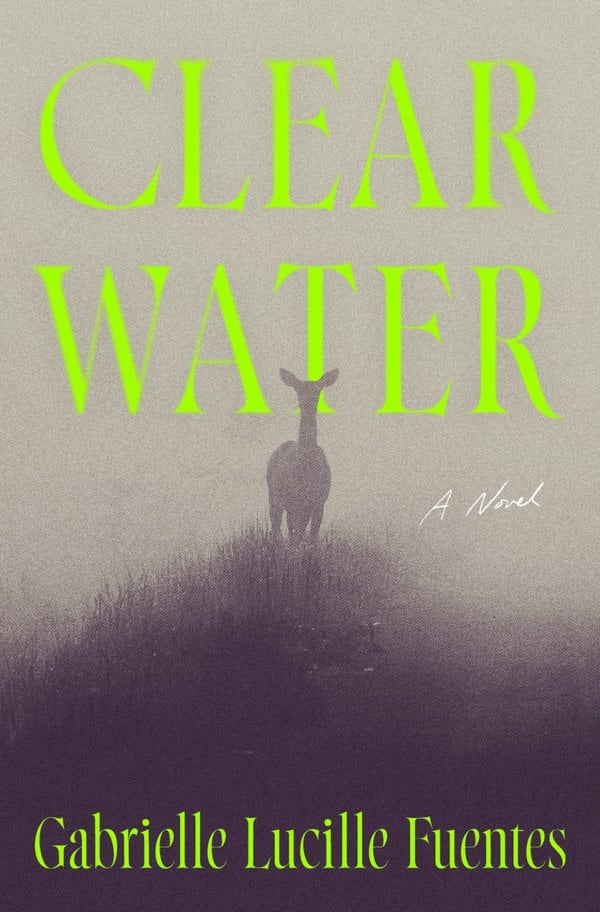

Gabrielle Lucille Fuentes
Gabrielle Lucille Fuentes is the author of The Sleeping World, Clear Water, and Are We Ever Our Own. She has received fellowships from Hedgebrook, Willapa Bay Artists in Residency, Yaddo, the Millay Colony, Lighthouse Works, and the Blue Mountain Center. She holds a BA from Brown University, an MFA from the University of Colorado, Boulder, and a PhD from the University of Georgia. She is an associate professor at the University of Maryland. She lives in Maryland with her family.