

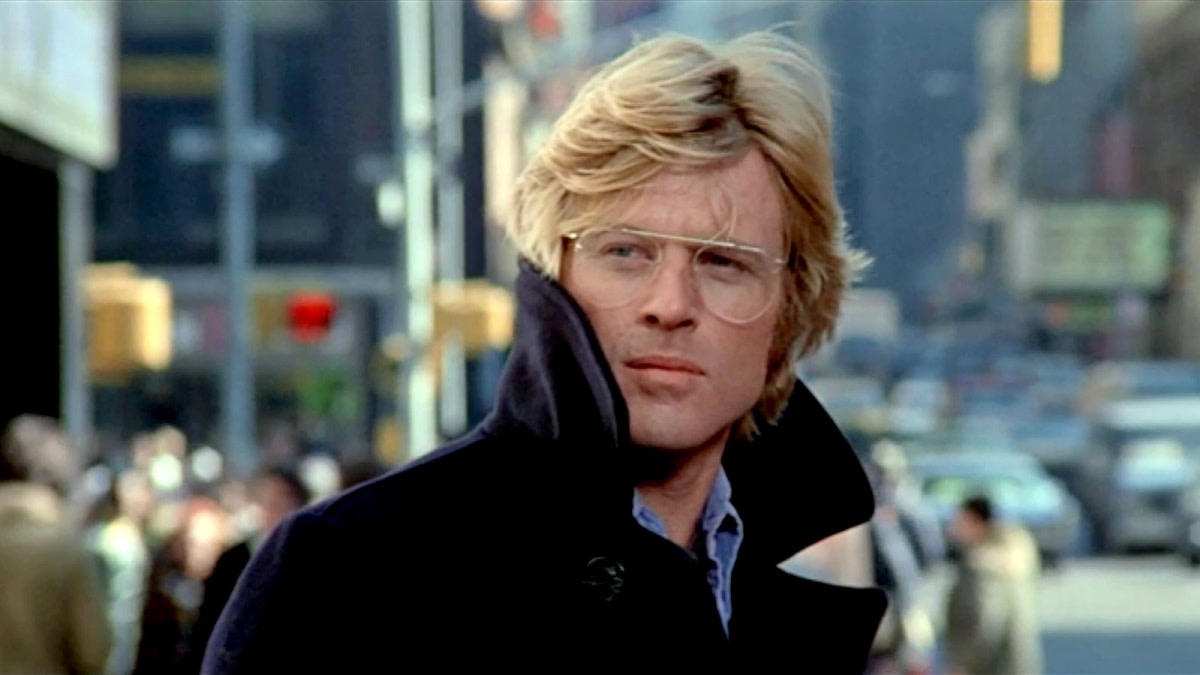
The U.S. Navy is retiring the peacoat—the kind that Robert Redford wore in
Three Days of the Condor
Today, in "crimes against fashion."
Welcome to The Fashion Police, a column where we spotlight some of the best fashion in crime film and TV.
It’s true. The United States navy is retiring a its signature peacoat. Yes, its signature peacoat! “The double-breasted, hip-length wool peacoat that is synonymous with the romance of the sea.” They’re retiring an iconic garment, a staple not only of military fashion, but also of fashion in general.
They are replacing it with a black, synthetic, all-weather parka. Why are they doing this? A statement from the Navy’s Uniform Board said that it was due to the Navy’s “commitment to eliminating unnecessary costs while ensuring sailors have the cold-weather protection they need to accomplish their missions.” The U.S. Naval Institute News revealed that it was chosen was chosen for its “modern appearance,” and “its versatility in being able to be worn with service and dress uniforms and civilian clothing.” But it has NO personality. This is like tearing down a historic 18th century townhouse to put up a glass and steel high rise.
In her piece on this landmark decision, Vanessa Friedman at The New York Times noted the history and symbolic associations of the garment, writing
First designed for Dutch sailors in the 18th century, the pijakker was particularly well-suited for life at sea: roomy enough to accommodate warm inner layers but streamlined enough not to get caught in a ship’s rigging. Its collar could be turned up to shield the face against wind, and side pockets kept the coat closer to the body in cold weather.
Adopted by the Royal Navy in 1857, the peacoat made the leap to the U.S. Navy shortly thereafter, becoming standard issue in 1886. And though small details may have been tweaked, the general style has remained the same.
In 1962, Friedman notes, Yves Saint-Laurent included a peacoat in his womenswear Rive-Gauche show, launching the coat as as style staple for women. According to the brand,
The simple shape of this practical garment sculpted the silhouette. The fact that it was not fitted and covered the hips made it ideal for women who did not yet feel daring enough to wear pants, which accentuated the female form.
Saint Laurent’s 1962 fashion show opened with the pea coat, which was the first piece he presented under his own name. The model wore it with white shantung pants and mules. This ensemble paved the way for Yves Saint Laurent’s signature style, which borrowed from menswear in order to make women feel comfortable and confident.
But, for our purposes, the most iconic use of the peacoat is Robert Redford’s look in Three Days of the Condor, Sydney Pollack’s 1975 political espionage thriller, based on James Grady’s novel Six Days of the Condor). Redford plays a low-level CIA employee in New York City who is the sole survivor of an attack on his small office branch, and then goes on the run, attempting to untangle what appears to be an enormous intra-bureau conspiracy. The peacoat is a nice choice for this character; as Valerie Steele, the director of the Museum at the Fashion Institute of Technology told The New York Times, “the peacoat doesn’t have the associations with violence and warfare often attached to camouflage and Army greatcoats. Rather, the peacoat more often represents bravery against the elements and the romance of voyages to places unknown.”

Olivia Rutigliano
Olivia Rutigliano is an Editor at Lit Hub and CrimeReads. Her other work appears in Vanity Fair, Vulture, Lapham's Quarterly, AirMail, the Los Angeles Review of Books, Public Books, The Baffler, Bright Wall/Dark Room, Politics/Letters, The Toast, Truly Adventurous, and elsewhere. She has a PhD from the departments of English/comparative literature and theatre at Columbia University, where she was the Marion E. Ponsford fellow. She hosts the podcasst "Culture Schlock" at Lit Hub Radio. She is on instagram at @oldebean, twitter at @oldrutigliano, and bluesky at @oliviarutigliano.bsky.social.