A Conversation About 'The Kidnapping of Arabella,' An Italian Road Movie from Writer-Director Carolina Cavalli
The new movie features two misfits and Chris Pine speaking in Italian.
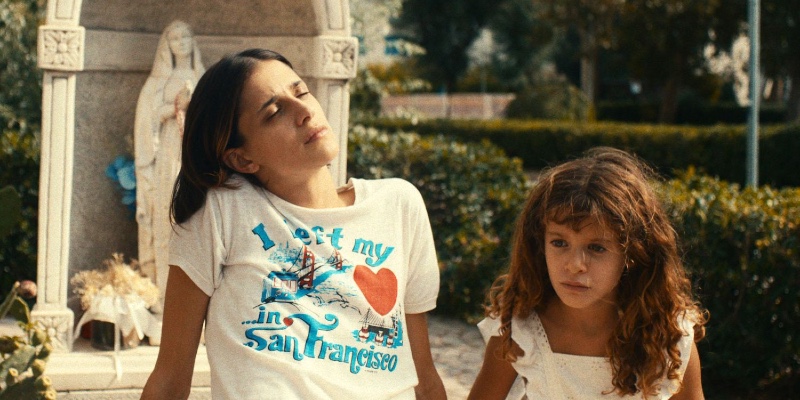
What do Jonathan Franzen, Chris Pine, a little girl, and a disgruntled former ice-skating-rink attendant have in common? They’re all part of Italian writer-director Carolina Cavalli’s off-beat and winning new film, The Kidnapping of Arabella (2025). The little girl (Lucrezia Guglielmino) is hot-headed Arabella, who loudly accuses her novelist father (Chris Pine, speaking in Italian!) of not paying his taxes and being jealous of Jonathan Franzen at an award ceremony in his honor. The former ice-skating attendant is Holly (Benedetta Porcaroli) who kidnaps Arabella from the parking lot of Taco King, believing she’s a younger version of herself because Arabella is faking a limp, just as Holly did when she was young.
What follows is a road movie in which the two misfits—one in her twenties, the other very much a child—embark on an unlikely adventure while being pursued by a dogged policeman. However, at several moments in the narrative, it feels as though Arabella is the one speeding into adulthood while Holly is the child who never grew up.
Kidnapping premiered at the Venice Film Festival where Porcaroli won the Orizzonti Best Actress Award. The film is Cavalli’s second feature, after Amanda (2022), which also features Porcaroli in the lead role.
I met Carolina Cavalli at the Film at Lincoln Center in New York where Kidnapping screened at this year’s Open Roads: New Italian Cinema. Our conversation has been edited for length and clarity. The Kidnapping of Arabella is currently in theaters.
Radha Vatsal: I saw Amanda about two years ago when it was streaming on Criterion Channel. And I loved it because the lead character, Amanda, is so unusual, and so idiosyncratic, but the film doesn’t ever punish her for being that way, and it doesn’t pathologize her. Then I came to see The Kidnapping of Arabella, and I didn’t know who the director was, and within twenty minutes, I thought—it has to be the same person.
Carolina Cavalli: Oh, you made me so happy.
RV: Afterwards, I realized it’s the same actress too, but again, the characters are still idiosyncratic and difficult. So I was wondering with these unusual female characters, whom we don’t really see portrayed very often on the screen—do you have any inspirations or particular thoughts behind writing them?
CC: I never put my own life in writing, because it’s not that interesting, but, of course, inner life, or whatever you go through, comes from yourself. And so there are certain things in these women that I am, or I wish I was, and I put it in these characters. And I never try to, as you said, to pathologize. That is not the theme of the film. It’s just a condition or an aspect of the personality of the character.
And I would say that [Amanda and Holly] are two very different characters. Of course, the actress is the same, but they’re very two different characters. And I realized after I shot [Kidnapping], that there are, for sure, some points in common. And I love this kind of female character who is not immediately lovable or desirable. I think even in life, the women I admire are not necessarily desirable for our system as it is now.
RV: I’m curious as to why you decided to work with Benedetta [Porcaroli], who’s the same lead actress [as in Amanda]?
CC: Before Amanda, we didn’t know each other. But it was also my first film, so I realized how much of a relationship you can create through this job. You have to open up, and show yourself very much, and have a real connection. And, so, while I was writing the second film, I was trying not to think about an actress, but Benedetta came in my mind very often. She has a big talent for putting a lot of heart in everything she does. It’s like really embracing the character as if it was the most important thing for her. And that has a lot of value.
RV: And again, in terms of casting, there’s the little girl who plays Arabella… I read she’s just six years old?
CC: Si.
RV: Unbelievable. She reminds me of—have you seen Tatum O’Neal in Paper Moon?
Si.
RV: She reminds me of her.
CC: I’m gonna tell her. She’s gonna see it. She’s gonna watch it for sure.
RV: I was curious about how you cast her, what qualities you were looking for, and then also how you directed her, because some of her lines feel much older than her years.
CC: It was my first time casting children, so I thought there is this necessity, first of all, of being sure that she wants to do it, and she’s not pushed to do it. And I think she really showed—she had cut her hair herself for the audition—she really wanted to do it. And then [we needed] someone who is young but understands that she’s going to play a character. That is another important thing. Because, of course, it could be a comedy, but it’s a dark comedy.
And it was so natural for her to be the character—and at the same time, really believing in it while she was doing it. Maybe children are used to playing and feel, you know, that this play has a dimension of realism?
RV: Had she acted before?
CC: No. No. It was her first time. And, in terms of directing, I’m very anxious generally when I go on set, because it’s a very adrenalinic environment, and I prefer to make decisions when I’m calm, and on set you have to make decisions while you’re on the go.
And so I like to prepare and control things as much as possible. And with a child, you cannot do it. So I think I learned a lot from this experience, because of her spontaneity and changing things all the time.
RV: Can you talk about what you were thinking when you were writing her character?
CC: I think sometimes I have very good memories of childhood. Sometimes I think that I make them up a little bit, so I’m never sure. But I also love reading books in which children are the main characters, or even children’s books, especially lately. All children’s books and films, in the end I think they are for everyone. There is this [movie] called The Hedgehog In the Fog. And in the hedgehog, there’s so much humanity, and so much desire and curiosity, but also so much fear. We took a lot from that character and put it in this film.
And so, yes, even for Amanda, I started from children’s books, like Matilda, Pippi Longstocking. I was thinking, I love these little girls, and I was thinking—how would they be at my age? Did they become as boring as me, or did they keep being these most amazing heroines?
RV: That’s a great point. Your adult characters retain some of the prickliness that girls have before they become teenagers and the edges get sanded off… The opening scene of the film is fantastic. The way Arabella taunts her father and accuses him of not paying his taxes and being jealous of Jonathan Franzen at a literary event in his honor.
CC: There was always this thing of shouting the name of the writer her dad was jealous or felt that he would never be and wanted to be. And when Chris [Pine] said he wanted to take the part [of Arabella’s father], I immediately taught about Jonathan Franzen because there are some things in common between the character [Chris Pine] plays and Jonathan Franzen. And Franzen, I think he’s a writer you can be jealous of. First of all, he’s alive. He’s very successful. In my opinion, he’s handsome. And very good at talking and interviews.
RV: And what led you to cast Chris Pine? Does he have some connection with Italian cinema? Does he speak Italian? While I was watching the movie, I kept thinking, it can’t be him.
CC: He loves Italian cinema. He speaks Italian, he’s studying Italian and French, and he really wanted to act in Italian. I wasn’t sure he wanted to act in a small film, in a part that is not the main character, but I think this was an adventure for him, and something different. And he was very focused on it, and it was very beautiful to work together. Also, all the actors and actresses from this film come from very different backgrounds, some of them are not even actresses or actors. And when you’re on set, you kind of forget where you’re from or where you’re going, right?
RV: The format of the film seems like a road movie with two women. And the most famous example of that, for me, is Thelma and Louise, and it ends up badly for them. What made you decide on the road movie format?
CC: Maybe there was an idea of going on a trip to look for something, and finding something completely different–as it always happens when you go on a trip. And maybe you find what you needed, instead of what you were looking for.
But at the same time, this idea of going back and going forward was something that felt really close to the format of the road trip for me. It’s a movement, and it’s going somewhere, but it never gets there. And from the beginning that was my idea. And sometimes I do ask myself if I really wanted to make a road trip, because it’s so iconic, and there are certain very iconic memories about films like, as you said, Thelma and Louise.
RV: How long was the shoot for the film?
CC: 33 days. For me, it was quite good. Now films have shorter and shorter times on set, and so 33 was, let’s say, we managed to get all the material. We were not very lucky with the weather. So that was a bit complex, but that was the only complexity on set. You have to learn to see these problems as opportunities to make more creative choices.
RV: Do you feel it’s still difficult as a woman filmmaker to get your films made—with women in the lead, and these unusual women in the lead?
CC: It’s probably getting better, but I think we should—I mean, we shouldn’t do anything—but I pay attention to not take every small victory as a systemic change. It’s something to be happy about and proud of, but there’s a way seeing women filmmakers that, in my opinion, still has to shift. At least in my country.
In my country, I feel it’s hard. Filmmaking is sight. And sight is power. And it’s very hard to give this kind of power to a woman, for a patriarchal society to see a woman having this power. And especially with not very desirable characters. What I hope for me and for my colleagues is not working to try to be desirable for a patriarchal system, but just try to work to be free and authentic.
RV: Yes, because so much of it is in our own minds as well.
CC: I grew up in the ’90s in Italy. It’s really hard to detach yourself from this point of view—of being watched and not to watch. It’s something that, for me, came a bit too late. I wish it came before. It came after being a teenager, in my early 20s. But still, in my teenage period I wasn’t aware of this possibility for me.
RV: And do you feel that in your films you’re consciously trying to provide an alternate perspective?
CC: I really try to be as free as possible. And every time I find myself thinking in a way that doesn’t belong to me, but belongs to a system of beliefs that I impose on myself, and that doesn’t make me feel truly free or authentic—that I consciously try to avoid. But other than that, I just try to feel comfortable in writing, and–it’s also easy to feel comfortable writing, because you’re alone. When the film comes out, I feel less comfortable. But in that moment, it’s the moment in which I feel that I have power and I love it.

Radha Vatsal
Radha Vatsal is the Film/TV Columnist for CrimeReads. She is the author of No. 10 Doyers Street and the Kitty Weeks mysteries, and her essays have appeared in the The New York Times, The Atlantic, the Los Angeles Review of Books, and elsewhere. She holds a Ph.D. in Film History from Duke University. You can find her on Instagram or email: rvatsal@lithub.com