Christopher Golden's Secrets to Creating Dread and Writing Great Horror Thrillers
The author of Carry Me to My Grave shares advice on pacing, atmospherics, and more
I’ve been a keynote speaker at conferences and book festivals. I’ve taught classes and seminars. Yet, somehow, every time I’m asked for writing advice, or to explain how I approach writing a novel, I want to go hide under my bed. My process has become so reliant on instinct that I don’t like to examine it too closely. When I try to put it into words, I end up chasing tangents in hopes that comparing the process to some other life experience will illustrate my feelings better than any true inspection.
Lately, however, I’ve found myself providing feedback and editorial insight to other writers often enough that I realize my advice can be boiled down to two words: dread, and momentum. There’s more to writing an effective horror thriller, of course. It’s vital that you take the time to create characters worth turning the pages for. Give your readers characters they can truly care about, and then make it hurt to care. But that advice can apply to all kinds of books. In the horror thriller, it comes down to those two words. Dread, and momentum.
We’ve all sat in a theater watching a horror film. Far too often, movies rely on the jump scare, but the art of a great jump scare is in the buildup to it. A great filmmaker can inspire such dread in the audience that the moment of a jump scare is almost a relief, but the filmmaker has tools that a novelist lacks—music, lighting, cinematography.
You can’t control the environment in which your readers will be experiencing your story. My winter-set novels are often read on the beach, for instance, when certainly a howling blizzard outside would be more effective. Without those other tools, an author can only rely on words, and maybe a little bit of magic.
I want to say “creating dread on the page” but that would be inaccurate, because you’re never creating dread on the page—you’re creating it in your reader. I begin with a judicious selection of details. Too much detail, or too little, and the effect is significantly diluted.
Set the mood early in your story, even if it requires an opening scene that flashes back or forward, to let the reader know there is truly something to fear. I prefer supernatural horror, so for me, it isn’t just a suggestion of danger, but the presence of malicious evil. This way, when the reader begins to get to know your characters, they’re already anxious about what’s to come.
This isn’t to say the reader should know everything. An important element in creating an atmosphere of dread comes from the things the reader doesn’t know, but it’s possible to layer different levels of dread into the story:
(1) Things the character doesn’t know, but the reader does, can build dread and even horror.
(2) Things the reader doesn’t yet know, but the character does, can create real mystery and suspense.
(3) Things neither the reader nor the character knows may be the most insidious way to build dread, and the terror of the unknown. As with every element of writing, it’s about how you layer these elements.
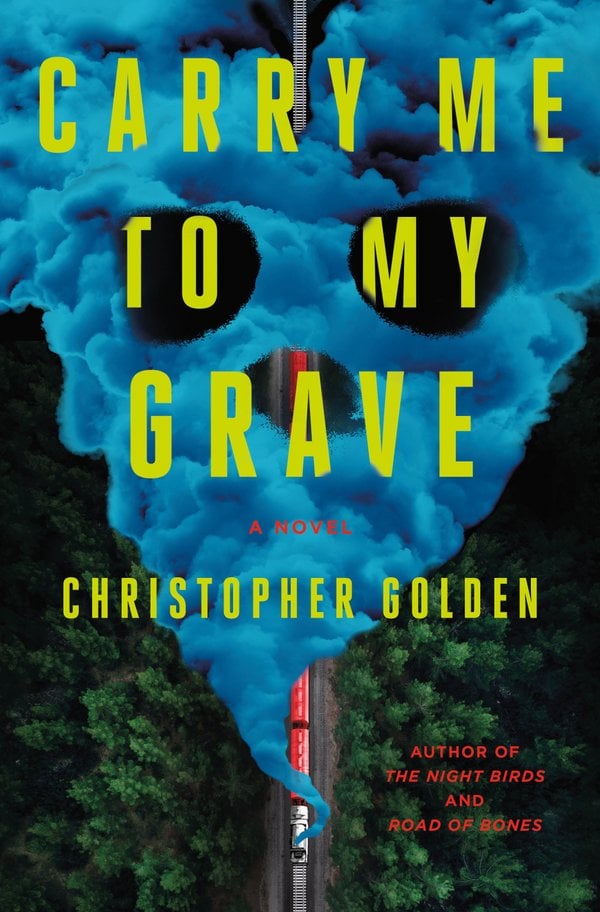
In my new novel, Carry Me to My Grave, Malcolm Wise has agreed to his mother’s final request, to transport her body from their home in Indiana to her birthplace in Maine, and to bury her there. Before she died, she made him swear to do this by the second sunrise. It’s 1956, and he sets off on this journey by train, along with his sister-in-law, Violet. They’re forced to travel in the baggage car, because he’s also promised to remain with her body until they reach their destination.
Around the country, things begin to dig their way up out of the ground and to hurry toward this moving train, desperate to stop Malcolm and Violet from completing their task. There are so many layers of mystery here, but I’ll tell you a secret—my favorite one is not one of the top layers.
It starts as a small detail. Sitting beside the crate that holds his mother’s remains, Malcolm occasionally hears soft piano notes coming from inside the crate. This is impossible, of course, but we’ve already learned that while he was growing up, local children would chant a rhyme about his mother, and the rumors that she was a witch.
That little bit of music, those piano notes from his mother’s favorite song, are unsettling, and they tell us there are questions to be answered that go beyond the novel’s set-up. We know it’s going to lead to something, but it feels more like mystery than dread—at first.
Weird, ominous moments, a change in the air, motion in the dark, all combine with the more grounded dread of danger the reader knows is there, even if the author hasn’t fully revealed its nature. But the breathless nature of a horror thriller has two facets. Dread may make you hold your breath, but momentum keeps you out of breath. Just as with the judicious selection of detail mentioned earlier, momentum is carefully crafted in word choice, paragraph length, and spreading character examination across the breadth of the story instead of frontloading.
This isn’t to say that every scene must be about forward motion, but even if the characters are standing still, the sense of urgency must remain. Carry Me to My Grave includes a ticking clock—characters must achieve their goal by a deadline, or the result will be catastrophic. Scenes and chapters can be pared back to avoid creating a drag on momentum. Scenes can be split up, something more urgent placed between them. A sinister presence, an emotional revelation, an abrupt twist of fate, a sudden act of violence, a surrender to desire—all of these things can keep the story hurtling forward.
As a writer, I can feel when this is working. Sometimes I’ll even feel a bit breathless myself while writing such scenes. I feel that urgency. When I don’t have that sensation, I know the scene needs reworking, that through action, setting, plot, the characters’ awareness, and the reader’s awareness of imminent threats unknown to the characters, I need to increase the story’s velocity.
I don’t picture the work I need to do as giving the scene or novel a push from behind. Instead, in my imagination, I’m adding pressure from all directions to make the story burst forward until it’s careening in a way that feels out-of-control.
And that’s the secret. Using dread and momentum, the author has to make the story feel out of control, while remaining in complete control. I’m a terrible dancer, but I do imagine it’s a bit like dancing. If you feel like taking a bow at the end, you’ve probably done something right.
***

Christopher Golden
Christopher Golden is the New York Times bestselling, Bram Stoker Award-winning author of such novels as Road of Bones, Ararat, Snowblind, and Red Hands. With Mike Mignola, he is the co-creator of the Outerverse comic book universe, including such series as Baltimore, Joe Golem: Occult Detective, and Lady Baltimore. As an editor, he has worked on the short story anthologies Seize the Night, Dark Cities, and The New Dead, among others, and he has also written and co-written comic books, video games, screenplays, and a network television pilot. In 2015 he founded the popular Merrimack Valley Halloween Book Festival. He was born and raised in Massachusetts, where he still lives with his family. His work has been nominated for the British Fantasy Award, the Eisner Award, and multiple Shirley Jackson Awards. For the Bram Stoker Awards, Golden has been nominated ten times in eight different categories, and won twice. His original novels have been published in more than fifteen languages in countries around the world.