The Men Who Sold the Long-Lost Treasures of Cambodia's Khmer Empire
From the foreword to The Man Who Stole the Gods by Matthew Campbell
Toek Tik’s work was a kind best done by night.
As an adolescent in rural northwest Cambodia, he had been a foot soldier in a military force whose very name was a byword for terror: the Khmer Rouge, the radical communists whose rule had left perhaps two million people dead before they were driven from power. Now, twenty years later, hardened by the long internal conflict that followed, Toek Tik was a leader of men. The members of this group served no ideology, however. Their only purpose was to survive.
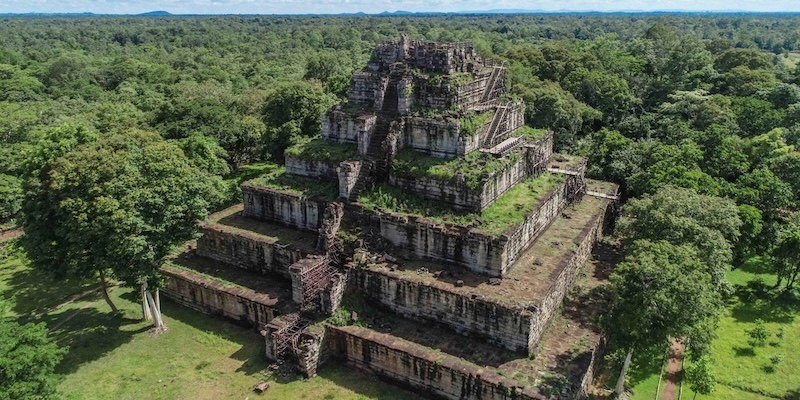
Toek Tik’s mission for them, on this evening in 1997, was to reach the base of a towering square chamber deep inside the Cambodian jungle. Built from an iron-rich material called laterite, its rough-hewn blocks had shifted with age, time sanding down their edges.
But the chamber remained solid, seemingly as robust as the day it had been built a millennium before, forming one of the central structures of a temple called Prasat Thom. The temple, in turn, sat at the center of a city called Koh Ker, about seventy miles from Cambodia’s best-known archaeological site, Angkor Wat.
For a brief period in the tenth century AD, Koh Ker was the capital of the Khmer Empire, which would come to dominate all of Cambodia, as well as much of modern-day Thailand and Vietnam, making it one of the most powerful polities of the medieval world. Enriched by trade, agriculture, and slaves, its rulers were wealthy beyond imagining; a later chronicler would describe a Khmer king who wore “some three pounds of great pearls” around his neck and traveled on an elephant with tusks sheathed in gold.
At Koh Ker, Angkor, and other temple-cities, they left buildings so imposing that European explorers speculated the edifices had been constructed by a wandering Jewish tribe, or perhaps by Alexander the Great—certainly not by the Cambodians, who, the visitors assumed with the prejudices of their era, never could have accomplished such a feat.
But by the time Toek Tik and his men approached Prasat Thom, carrying shovels and spools of rope, the dominance of the Khmer Empire was a distant memory. Their lives had been shaped, instead, by modern ideologies and the superpowers that espoused them, clashing in Cambodia to devastating effect.
Every one of the men knew that in their battles for territory, the combatants of the civil war—the Chinese-backed Khmer Rouge and proxy forces supported by the United States and the Soviet Union—had littered the country-side with land mines. On another expedition, some had watched a wandering cow get blown up.
So they walked carefully, measuring each step as they made their way to the center of the laterite chamber, which was surrounded by dense stands of trees. A thick trunk extended into its depths; undisturbed by humans, its roots had penetrated the walls, becoming one with the structure.
The treasures that Toek Tik sought were also underground, buried under layers of sediment. Soon the crew began digging down, attentive to the jolt of a shovel hitting stone instead of dirt. With each discarded clod of earth, they came closer to exposing the objects that would allow them to keep hunger and desperation at bay a while longer—works of otherworldly beauty, created by hands as skilled as any in human history.
The artifacts were three nearly life-size stone statues, standing in a row on a rectangular pedestal. Two were divine female figures, with full lips and high breasts, carved with such vivid precision that it was possible to imagine them coming to life and embracing the right visitor. The third was a powerfully built male, likely a representation of Shiva, the Hindu god of destruction, which seemed to contain, in its muscular torso and taut, determined face, some spark of the power of that awesome deity.
Toek Tik and his band were the first to see the statues in centuries. Cambodians were raised to revere such objects, viewing them at once as embodiments of the souls of their ancestors, and as avatars of the gods. To stand before them was to gaze into the eternal, and in another context, the men might have kneeled to their bases and begun to pray, or left offerings of lotus flowers and incense.
But the customers who sustained Toek Tik’s livelihood in a war-shattered nation made no allowance for their spiritual role, and he had work to do. It took hours to excavate the statues, and then days to move them by oxcart and truck to Cambodia’s border with Thailand. There, brokers were standing by to transport them to Bangkok, mainland Southeast Asia’s portal to the world.
At this point, Toek Tik’s role in the process was over. He and the others would receive a modest payment—enough to live on for a time, but a tiny fraction of the sums that the works were about to fetch on the international art market, where demand for pieces like them was booming.
From the Thai capital, they went in three separate directions. The male figure would ultimately be purchased by an American billionaire to decorate his home in Palm Beach, Florida, a short distance from Donald Trump’s Mar-a-Lago. One of the females would be sold by a London dealer called Spink & Son and then disappear into an anonymous private collection.
The other female statue took a more rarefied path. By 1998, it was in the possession of Doris Wiener, a prominent dealer with a gallery on New York’s Upper East Side. Not long afterward, it made the short journey to one of the most prestigious addresses in Manhattan: 1000 Fifth Avenue.
Barely five years after being ripped from its pedestal by a former child soldier of the Khmer Rouge, in the last days of one of the twentieth century’s bloodiest conflicts, it had entered the collection of the Metropolitan Museum of Art. And it would be far from alone.
***


Matthew Campbell
Matthew Campbell is an award-winning reporter for Bloomberg Businessweek and the author of The Man Who Stole the Gods: A True Story of War, Obsession, and a Global Art Conspiracy. His previous book, Dead in the Water—co-authored with Kit Chellel—was selected as a Book of the Year by The Economist, The Financial Times, and The Times. Matt has reported from more than twenty-five countries on crime, corruption, terrorism, economics, and the environment. His work has earned some of journalism’s highest honors, including awards from the Gerald Loeb Foundation, the Overseas Press Club, the National Press Club, SOPA, and SABEW for both feature and investigative reporting. A 2025 Jonathan Logan Family Foundation Fellow at New America, Matt lives in Singapore with his family.