

Counting Down the Greatest Crime Films of All-Time: #41
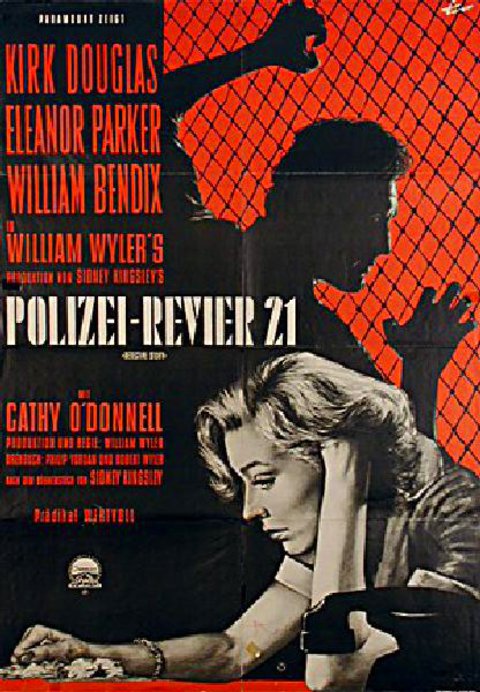
Detective Story (1951)
Otto Penzler ranks, analyzes, & celebrates the 106 greatest crime films of all-time. Catch up on the series and find new installments daily here.
__________________________________
Detective Story (1951)
__________________________________
TYPE OF FILM: Police
STUDIO: Paramount
PRODUCER: William Wyler
DIRECTOR: William Wyler
SCREENWRITERS: Philp Yordan and Robert Wyler
SOURCE: Detective Story, play by Sidney Kingsley
RUNNING TIME: 103 minutes
PRINCIPAL PLAYERS:
Kirk Douglas…………………………………………………………….…Detective Jim McLeod
Eleanor Parker……………………………………………………………………….Mary McLeod
Horace McMahon……………………………………………………………Lieutenant Monaghan
William Bendix……………………………………………………………….Detective Lou Brady
Cathy O’Donnell………………………………………………………….……..Susan Carmichael
George Macready…………………………………………………………..…..Dr. Karl Schneider
Gladys George………………………………………………………………………….Miss Hatch
Joseph Wiseman……………………………………………….Charles Gennini, the burglar
Lee Grant………………………………………………………………………………….Shoplifter
Gerald Mohr………………………………………………………………………Tami Giacoppetti
__________________________________
DID YOU KNOW?
__________________________________
By 1951, the great detective fiction writer Dashiell Hammett had just about lost his touch. Years of alcoholism and frail health were exacerbated by the House Un-American Activities Committee, which investigated his political activities. Although he wasn’t broke, his early books providing him with serious Hollywood money and royalties (his five novels have never been out of print since their original publications), he was offered work in the movie industry on a regular basis, partly for his talent and partly out of sympathy for his difficulties. Producer/director William Wyler offered Hammett $10,000 to do a simple adaptation of Sidney Kingsley’s play, Detective Story, which he accepted. Wyler flew him to California from Martha’s Vineyard in Massachusetts, got him a suite of rooms at the lush Beverly Wilshire hotel, and dropped by every few days to see how things were going. He and Hammett had friendly visits, but Hammett was evasive when conversation turned to specifics about the script. Finally, after three weeks, Hammett handed Wyler a check for the full amount he had been paid. “I just can’t do it anymore,” he said.
__________________________________
THE STORY
__________________________________
This is the story of a single day in the life of New York’s Twenty-First Precinct and the policemen who come to work everyday, particularly Detective Jim McLeod. McLeod is rigid and moralistic, becoming more vicious because of the pressure of the job and the heavy influence of his father, a criminal. “A one-man army against crime” is how he is described by his boss, Lt. Monaghan. He treats suspects roughly, especially an abortionist, Dr. Karl Schneider, whom he brutally beats during an arrest and interrogation.
Schneider’s lawyer reveals that Mary, McLeod’s wife, had a brief affair during the war, got pregnant, and went to Schneider, claiming a miscarriage but obviously for an abortion. McLeod’s inflexible moral code turns him against her, calling her a tramp and effectively dooming their marriage. Although they both work at keeping it together, it is clear to her that he has made the same intolerant judgment of her that he does of criminals who have become his whole life. McLeod, more and more despondent and aware that he is incapable of change, deliberately steps into the line of fire when a criminal tries to escape from the precinct house and is killed.
***
Detective Story was a hugely successful Broadway play that opened in March of 1940 and ran for nearly two years. Among its all-star cast were Ralph Bellamy (as McLeod), Lee Grant, Joseph Wiseman, Horace McMahon, Alexander Scourby, Maureen Stapleton, and Robert Strauss, some of whom went on to reprise their roles on the screen.
The motion picture, too, was both successful and influential. For the first time, the members of a police department were portrayed as fully fleshed-out characters, with lives outside of the precinct: families, fears, weaknesses, problems, and a range of personalities. Later cop pictures would reflect this new, penetrating look at the way the job affected, even tortured, members of the police force, and the influence extended to other media, like the Eighty-Seventh precinct novels of Ed McBain and such television programs as Hill Street Blues and NYPD Blue.
Academy award nominations went to William Wyler for Best Director, Eleanor Parker for Best Actress, Lee Grant for Best Supporting Actress, and Philp Yordan and Robert Wyler for Best Screenplay. Grant recreated her role from the stage production in this, her first film, after which she was blacklisted.
__________________________________
BEST LINE
__________________________________
Jim McLeod, becoming more despondent as the job wears him down: “If I went home to an empty flat, I wouldn’t dare take my gun with me.”

Otto Penzler
Otto Penzler is the founder of The Mysterious Press and The Mysterious Bookshop. He has written and edited several award-winning books and is regarded as the world's foremost authority on crime, mystery and suspense fiction.