
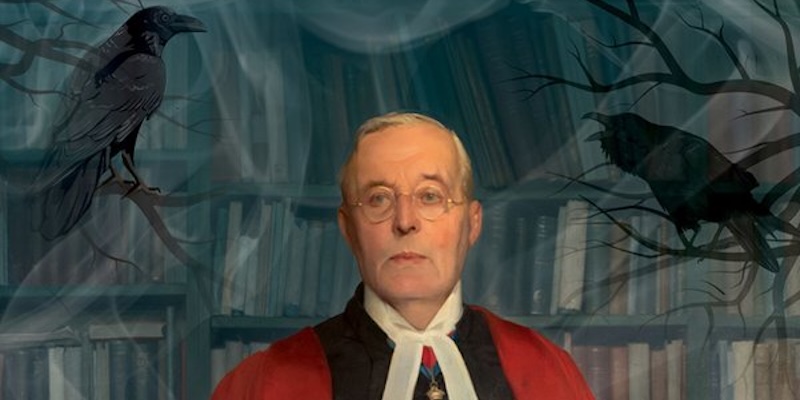
Darryl Jones on Discovering the Remarkable Ghost Stories of M.R. James
The author of For the Dead Remember reflects on the life and literary influence of a Cambridge scholar
I didn’t know this until years later, but I first encountered Montague Rhodes James on Saturday 28 June 1980 at 10.30pm. The BBC did my generation the lasting service of showing horror double bills from the mid-70s to the mid-80s. I watched many of them, but one in particular stays in my mind. That night (I was twelve years old), the BBC broadcast Jacques Tourneur’s 1957 masterpiece Night of the Demon, followed by The Ghoul, a Freddie Francis sub-Hammer from 1973.
It was the first film, Night of the Demon, that captivated me. The actual Demon, a sixty-foot smoking monster from Hell Itself, was terrifying enough, but what really got me was the film’s atmosphere of dread and impending doom. The protagonist has been given a piece of parchment on which are written Satanic runes; if he doesn’t pass it on to someone else by the allotted time, then he has an appointment that he really does not want to keep, and he’ll never have another one.
My adolescent self wouldn’t have put it this way, exactly, but the thing that spoke to me was the film’s air of civilized menace. Something in me really loved the film’s world of impeccably well-mannered, tweed-clad gents who go about their sinister business against a backdrop of steam trains, ancient libraries, country houses, and grand hotels. A whisky and soda is never far away, and, while you may worship Satan, you also always dress for dinner.
Night of the Demon is an adaptation of M. R. James’s 1911 classic short story “Casting the Runes.” James was an academic prodigy, who spent many years as Provost (in American college terms, President) of King’s College, Cambridge, an ancient college of enormous distinction, the alma mater down the years of everyone from E. M. Forster to John Maynard Keynes to Alan Turing, and home to the grandest and most beautiful College Chapel anywhere in the world.
By day, he was the foremost manuscript scholar of his time, the man who knew seemingly all there was to know about medieval manuscripts, ecclesiastical stained glass, Biblical apocrypha, and the occult. By night, he put his scholarship to darker use, using it as the fuel for a series of phenomenally learned, austere, terrifying ghost stories.
At least, he did this on certain nights. Like a Satanic ritual, or a Black Mass, every Christmas Eve, at around midnight, after carols in the Chapel and dinner in the Hall, the Provost would read his latest ghost story to a select group of friends, colleagues, and students—all men, of course—who had gathered together in his rooms.
He was by all accounts a superb actor (a leading man in student drama, and a wonderful mimic) with a flair for the theatrical, and so he would retreat to his bedroom to finish writing the story, and emerge, the ink still wet on the pages, not long before midnight. He would pour himself a whisky and soda, blow out every candle but one, settle down in an armchair near the fire, and begin to read: “It was, as far as I can ascertain, in September of the year 1811 that a post-chaise drew up before the door of Aswarby Hall, in the heart of Lincolnshire….”
In a typical James story, a lonely scholar of solitary habits comes upon a mysterious artifact (a manuscript, an engraving, a whistle, a pair of binoculars, a crown) in a remote church, country house, or library. When he reads, or blows, or looks at or through, or touches, something is released, implacable, unappeasable, utterly inhuman. James’ entities (we call them ghosts, but things are rarely that straightforward) are glimpsed, or sometimes felt: spidery, hairy, damp, dry.
In “Casting the Runes,” the protagonist wakes up in the middle of the night, in bed in the pitch dark, gropes under his pillow for the box of matches he keeps there to light his lamp, and finds, not a box of matches, but “a mouth, with teeth, and with hair about it, and, he declares, not the mouth of a human being.” This combination of vulnerability, intimacy, and a strong dash of sexual panic, is very characteristic of James.
As some readers will have surmised from my choice of Forster, Keynes, and Turing as representative graduates, King’s College, Cambridge had, in the words of its foremost historian, L. P. Wilkinson, “a reputation for homosexuality” right up to the 1970s, when it finally admitted women.
In fairness, King’s was one of the first all-male Cambridge Colleges to go co-ed, and across the twentieth century had gained a reputation as one of the University’s great bastions of liberalism. James was no liberal (in fact, he was a lifelong opponent of women’s education, and of any other progressive cause that came his way), but he was a repressed, very closeted, completely celibate gay man.
The novelist and diarist A. C. Benson, the man who wrote Land of Hope and Glory, was James’s oldest and closest friend, and lived what was in many ways a parallel life. The pair had been at Eton together, and then at King’s, and both ended up as the heads of Cambridge Colleges. Arthur Benson, too, was an accomplished writer of ghost stories (if you were very lucky, as you would have been on Christmas Eve 1903, you might have got a ghost story from both of them).
Throughout his adult life, Benson was tormented to the point of serious, debilitating mental illness by the nature of his desires, which he never really understood and could never really speak openly about, other than in his millions of words of diary. He was often stunned by his friend Monty’s apparent total lack of anguish about his sexuality.
If you want to find that anguish, open his ghost stories. M. R. James is the most frightening writer I have ever read. Read one of his stories alone, late on a winter night, in an armchair in front of an open fire, with a glass of whisky at your side. Slowly, gradually, you will come to understand that you are not, in fact, alone…
***
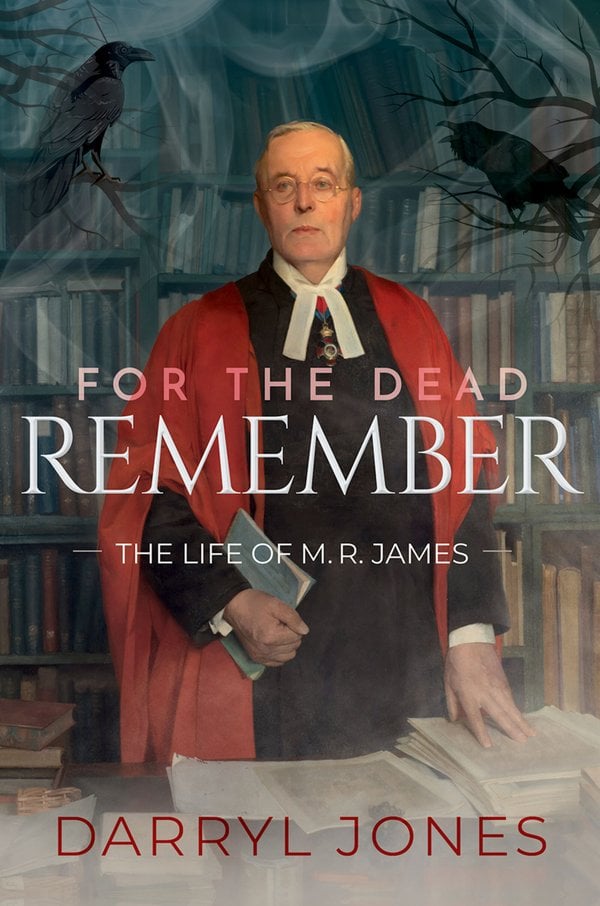

Darryl Jones
Darryl Jones is Professor of English and Dean of the Faculty of Arts, Humanities, and Social Sciences at Trinity College Dublin, where he teaches nineteenth-century literature and popular fiction. His books include Horror: A Thematic History in Fiction and Film, the Oxford World's Classics editions of M. R. James's Collected Ghost Stories, and Horror Stories: Classic Tales from Hoffman to Hodgson. He has also written numerous articles on nineteenth-century fiction and supernatural literature. His latest book is Sleeping With the Lights On, now out from Oxford University Press.