
Eriq LaSalle on Storytelling, TV Scripts, and Shifting the Focus of His New Novel
John B. Valeri profiles the author of Laws of Solomon, the latest Martyr Maker story
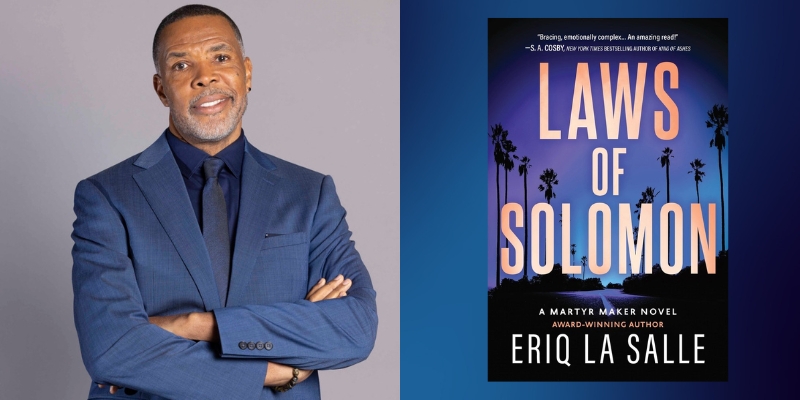
Eriq La Salle has many titles: Actor. Director. Producer. Novelist. But perhaps the one word that encapsulates them all is…storyteller.
“As an actor and a director, you are handed a script. You are handed a world,” he says. “The difference as an author, of course, is that you are completely creating every aspect of the world—the tone of the world, the beauty of the world, the ugliness of the world, the inhabitants of the world.”
While La Salle may be best known for his work in television—on camera for his award-winning role as Dr. Peter Benton in ER and behind the camera for shows including Law & Order, Chicago P.D., CIA, and On Call—he has been writing books for more than a decade now. His first novel, Laws of Depravity, was self-published in 2012; Poisoned Pen Press later reissued that title in a revised edition along with two sequels, Laws of Wrath and Laws of Annihilation.
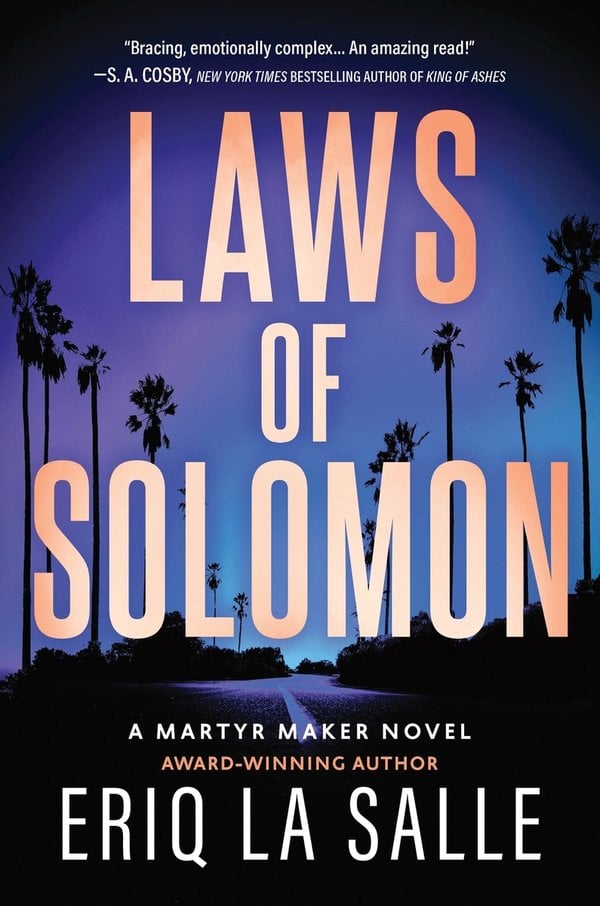
The Martyr Maker series continues with Laws of Solomon (Poisoned Pen Press; September 8, 2026), in which the titular character—Solomon Nangobi, a child soldier and mercenary-turned-hit man—progresses from the periphery of the saga to its primary focal point.
“One of the things I really love about Solomon—and there are many—is that he never apologizes,” La Salle says. “He never once apologizes for what he’s done, who he is. He’s very clear about that…and all he wants is for everyone around him to accept that.”
But what Solomon—a generational landman of Ugandan decent who witnessed unspeakable atrocities as a child—sees as black and white others view in more forgiving shades of grey.
“You have those that learn to love him, that see more,” the author says. “That’s the only difference—he doesn’t see all of his value. He doesn’t see all of his potential as a human being. The few people that are allowed to love him … it’s because they see the things he cannot see.”
It’s a perspective that also extends to readers, who learn of Solomon’s backstory—at times heartbreaking, harrowing, and even heroic—as the narrative alternates between past and present events. But Solomon’s journey isn’t simply a literal one; it’s also metaphoric and allegorical—even biblical.
“There’s a bit of mysticism and spirituality and otherworldliness that’s subtly woven into the story,” La Salle explains; indeed, the subtext extends to everything from names and placed to meanings and morals. “I wanted to explore that.”
Hoping to live out his final days in service of the land, Solomon—who has found refuge working in a botanical garden near the northern tip of Malibu after escaping New York City’s underworld—instead becomes the unlikely savior of eight-year-old Gaby, an orphaned child who is nearly killed in an explosion of gunfire.
Wanting to eschew any responsibility for the child, Solomon instead finds himself drawn to Gaby, who possesses a wisdom and resolve that belies his young age.
“Gaby fits into this world [by] capturing and representing the innocence that Solomon lost at around the same age. So, it’s very strategic that the universe put these two together at this time,” La Salle says.
Having assumed care of the boy, Solomon soon learns that Gaby is being hunted by a cartel, whose ruthless leader, Cesar Quintero, will stop at nothing and nobody to get his hands on the boy. Like Solomon, he is haunted by a loss that feeds his bloodlust.
“I wanted to show Cesar’s origin as well, in the sense of what made him turn into the type of man he is currently,” La Salle says of his antagonist, who is not without some degree of sympathy.
Unlike Solomon, Quintero wields the kind of power and prosperity that suggests protection. And yet such privilege has failed to insulate him from the cruelties of fate, which can’t be bought off or bargained with.
“For completely polarizing purposes, I wanted to show darkness versus light converging at the same point. And that point is Gaby,” La Salle says. “What does Gaby represent to somebody seeking light? And what does he represent to somebody seeking darkness?”
With one killer seeking redemption and the other vengeance, Gaby’s future will be determined in a face-off between good and evil.
This conflict is in keeping with the tone and themes of the earlier Martyr Maker books, in which NYPD detectives Quincy Cavanaugh and Phee Freeman, along with FBI agent Janet Maclin, investigate high-profile crimes that are often motivated by moral indignation over the failure of societal/religious figures and institutions to uphold their appointed duties.
The series’ elasticity allowed Solomon to step forward in an origin story that both tightens and enlarges the books’ collective breadth.
“[Solomon] was always conceived as a secondary character…but he just kept growing,” La Salle says, noting that he only appeared in one chapter of the first book, with a single reference to his murky past in the second. “These characters fight for their right to live, to flourish, to multiply, to expand. Solomon fought for the right to have his own book.”
While this might come as a surprise to readers who’ve been expecting a final showdown between the series’ central characters, it seemed a natural—and perhaps even necessary—deviation for the author.
“I thought for the penultimate book, it would be interesting to take a slight breather,” says La Salle.
And so he borrowed another page from his actor/director/producer handbook.
“As a director and producer, we sometimes have what we call ‘bottle episodes,'” La Salle says. “You have an ensemble, but this one episode is just about two characters … And if you pull it off correctly, it makes people have more investment in the characters and the story.”
Laws of Solomon is a calculated risk, then, but one that holds the promise of reward—both in terms of appealing to a wider audience and in achieving a new level of artistic freedom for its author.
“It’s a standalone, so you can just jump in…without being overwhelmed,” La Salle says. “It’s still in the same universe, but we take it out of New York….Now, our main protagonists only have one chapter in Laws of Solomon and that one chapter is to tease the big showdown, which is coming in the final book.”
Early response has been enthusiastic, with many new readers stating their intent to go back and begin the series from the very first book. The experience also proved surprising to La Salle, who found the shift refreshing.
“The beauty of it is that it was a slight departure that I didn’t know I needed,” he says.
La Salle—who returns as a director for Law & Order’s twenty-sixth season after having limited his television commitments to focus on novels—has nearly completed the series’ fifth and final installment, which will deliver the conclusion readers have been waiting for.
In coming full circle, La Salle stands in testament to the fact that in serving the self, one is also serving the story and its audience.
“Being an actor made me a better director. Being a director made me a better producer. And being an actor and director and producer made me a better author,” La Salle says. “The different aspects of storytelling, the variations, are the connective tissue. They all feed each other.”
This synergy marks the culmination of a decades’ long journey for La Salle, who finds sustenance in all the expressive outlets he has pursued—but particularly in writing, which provides a showcase for his singular voice and vision.
“I’m happy for the moment that’s happening,” Eriq La Salle affirms, “and all the good that seems to be coming to this book and to my writing career.”
***

John B. Valeri
John B. Valeri is a book reviewer, author, and host of the web series “Central Booking.” He has contributed to The Big Thrill, CrimeReads, Crimespree Magazine, Criminal Element, Mystery Scene Magazine, The New York Journal of Books, The Strand Magazine, and Suspense Magazine. Visit him online and watch past episodes of “Central Booking” at JohnBValeri.com.