How Jane Austen Influenced Modern Detective Fiction
Lucy Andrews explores the history of detective tropes in Emma and retells it as a cozy
At first glance, a Jane Austen cozy crime retelling may seem like a strange, hybrid monster, but look around and you’ll find plenty of examples. From Amelia Blackwell’s time-travelling Miss Georgiana Darcy to Tirzah Price’s wannabe-lawyer Elizabeth Bennet, the Austen detective has become well established in the past decade.
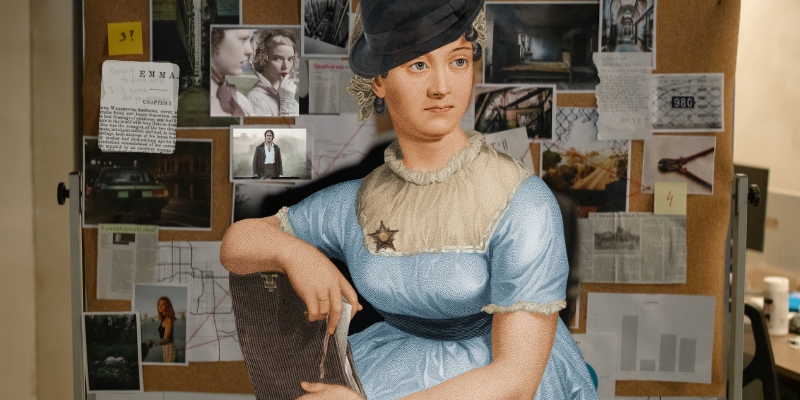
So, in creating a cozy crime retelling of Austen’s Emma from the perspective of con-woman-turned-detective Harriet Smith, I’m writing into a tradition that has become firmly established in the twenty-first century. But Austen’s mystery credentials go back much further than this.
While Austen’s novels predate the origins of detective fiction, which many crime fiction scholars attribute to Edgar Allan Poe’s “The Murders in the Rue Morgue” in 1841 (although there are some worthy candidates for this plaudit in the 1830s’ British literary journals), Austen’s own work carries many of the hallmarks of detective fiction.
Her novels are set in enclosed environments where gossip is currency and people present a public identity to their neighbors that is designed to conceal their private selves. There is no murder in Austen’s work (with the exception of her Juvenilia—the outlandish and, sometimes, bloodthirsty scribblings of her youth), but there are plenty of secrets, scandals and mysteries. And the root of them all? The marriage market.
In the marriage mystery, rather than a dead body appearing in the opening chapters to disrupt the peace of the usually quiet, closed community, it’s the arrival of a living gentleman that causes chaos. With a corpse, the mystery that needs solving is “who murdered him?” With the eligible bachelor, it’s “who will marry him?”
Austen creates female pseudo-detectives to solve these marriage mysteries. Elizabeth Bennet, for example, must identify the true characters of the menfolk around her to find a suitable match for herself and her sisters. For the single woman not in possession of a good fortune, the stakes are as high as in any murder mystery.
For me, Emma was the obvious choice for a cozy crime retelling. I’m certainly not the first person to describe it as a proto-detective novel. Crime writer P. D. James, who wrote her own Austen detective retelling, Death Comes to Pemberley, in 2011, gave a talk to the Jane Austen Society UK in 1998 entitled “Emma Considered as a Detective Story” in which she enumerated the sheer volume of mysteries and clues to their solution throughout the novel.
What really makes Emma work so well as a mystery novel is the fact that Emma Woodhouse herself is such an abysmal detective. She willfully misreads or overlooks clues as to what is really going on in Highbury, manipulating the evidence to fit her own narrative. In doing so, the novel invites readers to solve the mysteries which Emma cannot.
This is the exact pleasure of the Golden-Age detective fiction of authors such as Agatha Christie, Dorothy L. Sayers, Margery Allingham and Ngaio Marsh, which was so popular in the interwar period. While the early Holmesian tradition saw the genius detective drawing extraordinary conclusions from improbable or obscure evidence, Golden-Age detective fiction showed its working, giving readers a chance to solve the mystery alongside or, even, before the detective. And that’s exactly what Austen does in Emma.
In fact, Austen utilized several narrative techniques in Emma which later became staples of Golden-Age detective fiction. One of her most effective techniques is to create an unreliable narrator of sorts by switching between omniscient narration – the reportage of the godlike narrator who knows everything—and free indirect discourse—where the thoughts and feelings of specific characters are incorporated into the third-person narration. These two narrative techniques are blended together so that the reader has to decode which is which and whose head we are in.
As the protagonist, it’s actually Emma’s views that most frequently color the narrative and they are almost always erroneous. There are lots of passages where Emma’s opinion slides into the omniscient narration as apparent fact and, if you read carefully, you can detect, and reject, Emma’s misreadings of the situation.
Another ploy that Austen uses in Emma is tricking readers and characters alike into overlooking clues by putting them into the mouths and mundane monologues of characters to whom we pay very little attention. This is where Miss Bates, Jane Fairfax’s garrulous aunt, comes in very useful.
As readers, we don’t expect to hear anything of note from Miss Bates and so, like many of the characters in the novel, we might be forgiven for switching off during her extensive monologues. But, if you interrogate her ramblings, you’ll discover that Miss Bates knows a lot more about what’s going on in Highbury than we give her credit for.
Austen is also a master of misdirection. A great example of this is Frank Churchill’s trip to London for a haircut. The scenario causes such an uproar, as Frank is charged with being selfish, foppish and extravagant for going all the way to London for a haircut, that nobody sees the connection between Frank’s visit to London and the arrival the next day of a pianoforte from Broadwood’s music shop in London for Jane Fairfax from a mystery benefactor.
Frank Churchill, of course, sent the pianoforte; his presence in London the day before makes this obvious, but the haircut drama means that none of the characters (and probably not many first-time readers) make the connection.
So, Austen and crime is not such a bizarre combination, after all. In fact, one of Austen’s descendants, her brother James’s great-granddaughter, Lois Austen-Leigh, was herself a Golden-Age crime writer, producing four mystery novels in the 1930s which draw on some of the techniques and tropes of her famous ancestor.
And, since Golden-Age crime fiction has a clear affinity with the recent cozy crimewave, I suspect that, if Jane Austen was around today, she’d probably be writing cozy crime!
***


Lucy Andrews
Lucy Andrew is a crime writer and crime fiction scholar who has an unhealthy fixation with Jane Austen. She has a PhD in English Literature from Cardiff University and was a Senior Lecturer in English Literature before leaving academia to concentrate on her writing. Andrew was shortlisted for the Penguin Michael Joseph Undiscovered Writers’ Prize and was a finalist at Bloody Scotland’s Pitch Perfect. She is a member of the Jane Austen Society and lives in Wolverhampton, UK, with her husband and septuagenarian tortoise. She is the author of A Very Vexing Murder.