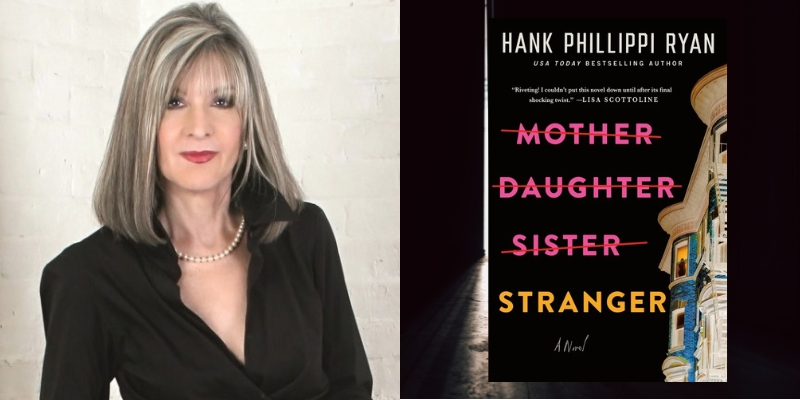
Hank Phillippi Ryan on Endings, Generational Scars, and Secrets in Mysteries
John B. Valeri chats with the author of Mother, Daughter, Sister, Stranger
Secrets are her trade and truth is her destiny.
Whether writing fictional crime stories or solving real ones, bestselling author Hank Phillippi Ryan—who has thirty-seven Emmys and fourteen Edward R. Murrow Awards in addition to her numerous accolades in publishing—recognizes one commonality above all others. She finds sympathetic people (i.e. characters) who are beleaguered by problems and then discovers the truths that, when revealed, will bring about hard-won happy endings.
It’s as true of her forty-year career in broadcast journalism (for which she was an on-air investigative reporter in Boston) as it is of her novels, which now number seventeen (and counting!) since the publication of 2007’s Prime Time. Whether writing series (Charlotte McNally, Jane Ryland) or standalone, the same rule applies: exposing secrets begets salvation.
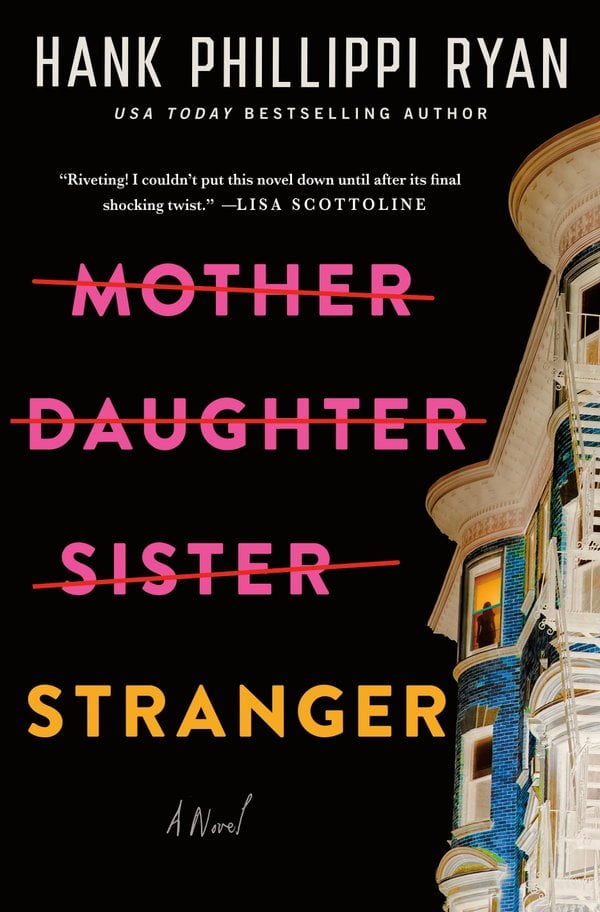
In Ryan’s newest, Mother, Daughter, Sister, Stranger (September 1, 2026; Minotaur Books), twenty-something Eliza Ramsey is a book agent in the making who specializes in romance novels with happy endings because she believes that’s the only place such things are guaranteed. Having survived a plane crash along with her sister Bea that killed their parents eleven years ago, Eliza’s world is once again rocked when Bea—a high-profile fashion influencer in the midst of a marital separation—fails to show for their annual Remembrance Day. Moreover, she appears to have abandoned her precocious pre-teen daughter, Piper, to Eliza’s care.
With little to go on but her suspicions that something is very, very wrong, Eliza—now a de facto mother herself by virtue of Bea’s disappearance—must reconcile the mysteries of her past with the those of the present. And doing so means leaving the familiarity of ever-buzzing Boston (where her apartment has just been broken into) for the relative solitude of the Berkshires, where she and her family used to summer before that fateful day it all came crashing down.
But the discoveries she makes there causes her to question everything, and everyone, she thought she knew. Will putting the pieces of her broken history together heal old wounds—or will it visit them on the next generation?
Now, Hank Phillippi Ryan discusses how endeavoring to answer those questions stymied her—and, ultimately, set her free….
*
John B. Valeri: Mother Daughter Sister Stranger is a title that strikes as sinister in nature yet also subjective in its connotations. In what ways does the book’s heading set up the BIG questions at the heart of the story while also reflecting the larger context of people in Eliza’s orbit (and ours)?
Hank Phillippi Ryan: I grew up with three sisters and a brother, and I am the oldest. And know best. As I remind them at every turn.
But back when I was in college, I created a game called Familial Pursuits. It was all questions about our family’s history. Like: “Who dented mom’s new car? And how did it happen?” And “Who was home when the barn burned down?” Let me tell you, we all had different answers to those questions. And we were all absolutely convinced our answers were right.
How did we all remember the same thing so differently? And what did we all assume about each other? In Mother Daughter Sister Stranger, family memories, family legacies—and some terrifying murders—are the center of the mystery.
It also struck me that every reader will be at least one of those nouns, right? Some of us will be all of them, and we all know how we change our behavior to fit whichever role we’re playing. And, it occurred to me so powerfully, some of our own mothers, daughters, and sisters might actually turn out to be strangers, hiding dark and sinister secrets.
At one point I thought about how often I’d lied to my mother when I was a teenager. And then I wondered, what if she was lying to me, too?
As it says on the cover: Every family has its legacy, and this one’s deadly. And the way the mother daughter sister stranger relationship puzzle pieces turn out to fit together becomes the beating heart of the story. And, as you say, of our own stories, too.
JBV: Eliza and Bea survived a plane crash that killed their parents eleven years ago. How did that event shape both the dynamics of their relationship and the people they’d go on to become as adults? In what ways is generational trauma and the idea of legacy interwoven throughout the story?
HPR: The main character, Eliza Ramsey, is an up-and-coming book agent. She specializes in romance novels, because, as she says, it is the only place she can rely on a happy ending. After the horrible tragedy that killed her parents and left Eliza and her sister the sole survivors, Eliza has never believed in real-life happy endings. As she says, “I took psychology 101, I know what I’m really doing is looking for a happy ending of my own.” Eliza thinks fiction is as close as she’s ever going to get.
Generational trauma and legacy are the undercurrents of this entire book—and more I cannot say! Because we are only in Eliza’s point of view, we can only know what she knows. But what she doesn’t know is about to change her life.
I am fascinated by the secrets our families keep from us, and how powerful our own personal systems of belief can be. As Eliza also says, she sees pictures from her childhood, and thinks she remembers what really happened—but comes to understand that her past is only a story she has been telling herself.
I was looking through my own family albums as I was writing the book, and realized there were photos of people I had no idea who were—and that there was no one alive to tell me. It was deeply unsettling, and I wondered what secrets were buried in those yellowing photographs.
JBV: In Bea’s absence, Eliza becomes a motherlike figure to her niece, Piper. In what ways does this render her both vulnerable and strong/emboldened at once? How does this unexpected responsibility of care cause Eliza to rethink her relationship with Bea (and what it could be going forward, assuming they are reunited)?
HPR: Oh, this is one of my favorite parts of the book! I love Piper, she’s so feisty and so smart, and such a cool 11-year-old. But her mother is missing! And how devastating would that be to a little kid? Her father has just walked out on the family, and now, it appears, bewilderingly, that her mother is gone too.
As an author, the relationship between an adult and a child is always so much fun to write. Because the behavior of the adult toward the child is incredibly revealing about what kind of a person they really are.
Eliza adores her niece Piper, but Eliza is a hard-working professional woman who is focused on her career and does not have children of her own. When her sister Bea inexplicably disappears, Eliza is left with a powerful responsibility. This vulnerable child is now in her charge, and relies on her for absolutely everything. Eliza must juggle everything she does and everything she says—how much do you share with a child about the dreadful possibilities that may have befallen her own mother?
Plus, Eliza is desperate to find Bea, her beloved sister. But now, every decision she makes, every step she takes, every risky move she considers—she’s got a preteen in tow. Who can she trust? How much danger can she face? How can she best protect little Piper, and herself?
Because Bea vanished on the exact eleventh anniversary of the plane crash, does that mean Eliza and Piper are next?
Eliza must learn what it means to be a mom, a friend, and a sister. And at that point, the title comes into play again. Eliza, the sister and the daughter, is now additionally a mother. Not in actual relationship, but by unavoidable responsibility.
JBV: The book plays out against two very distinct Massachusetts backdrops: Brookline/Boston and the Berkshires. How does each serve the tone and theme(s) of the story – and in what ways does their familiarity give way to fear as Eliza and Piper find themselves in the crosshairs of enemies unknown?
HPR: Oh gosh, I adore the Berkshires in western Massachusetts. My husband and I go every summer to take peaceful walks in the woods, and go to art museums, and try wonderful new restaurants, see every play we can, pay homage to Edith Wharton at The Mount, and enjoy the glorious music of the Boston Symphony at Tanglewood. The rolling hills and gorgeous scenery are absolutely immersive, there’s a peace and a calm in the Berkshires that is like nowhere else.
However. It’s also a place where many people go just for the summer, and the dynamic between the summer people and the people who live there year-round can be full of simmering conflict. As Eliza admires the graceful and magical geese flying in a vee overhead, another character sneers at her, and says: if you had to clean up golf courses after those geese depart, you would not be so in love with them.
Plus, it takes the main character away from the busy bustling environment she loves—to an isolated remote rural place she only thought she knew.
Two different worlds. Beautiful on the outside, but sometimes festering on the inside. And that’s what shapes the story.
JBV: Eliza is a junior book agent—and is apprenticed, essentially, to one of the most literary successful agents in the country. Why did you make Eliza’s understanding of the agent-editor-author relationship important to this novel?
HPR: I’m going to dance around this a little bit, because I don’t want to give anything away, but one of the things that I have realized over my many years of writing is that the communication between author and editor and agent—the notes in the manuscript that no reader will ever see—are sort of a secret conversation that shapes the book. What are the author’s true goals, what important things have they left out, what motivations are unclear, and why are they writing what they’re writing? This is a discussion that only happens in the margins, and one someone on the outside will never be able to read. Might the author and the editor be having a clandestine and multi-layered conversation? I will leave the rest of that idea to you. And to the book.
JBV: You discover the endings of your books through writing them. Tell us about the anxiety and exhilaration of your process as a “pantser.” What is that moment of discovery like, when it comes—and how do you think your own surprise at the revelation(s) might be indicative of the readers’ own?
HPR: Let me put it this way. I have no idea what’s going to happen next until I write the next word or the next sentence or the next paragraph or the next scene. So every twist and turn, every reveal, well, it’s a surprise to me too. Sometimes sitting here at this very computer, I gasp at something a character decides. You’re going to do that? I think.
So talk about twists and surprise endings, I always surprise myself! Sometimes readers ask how did you figure out that twist? How does it all fit together so perfectly? And I honestly have to say: I don’t know.
Sue Grafton used to call that the magic; that the writer’s mind, and their creative imagination, can somehow explode into something that never existed before. It’s fascinating to me, too, because you cannot force that moment to happen. You just have to be open to it.
So every day I sit down to write and I think I cannot wait to find out what’s going to happen next! And I know the only way I can find out is by writing it myself.
I absolutely did not know the ending to Mother Daughter Sister Stanger until the last day before it was due. And, coincidentally or ironically, my husband and I were driving back from a weekend in the Berkshires! We were on the Mass Pike, (the very highway Eliza drives so terrifyingly in the book), and I said, “Sweetheart, I’ve created a crime that I cannot solve!”
And Jonathan said “Honey, you say that every time. And you always figure it out.”
True. But I was so worried! Then, about fifteen minutes later—bingo. I thought of it. I knew it was right. And it is exactly the ending that’s in the book’s final version. And at that moment in the car, I will confess to you, I burst into applause.
JBV: You are a highly decorated investigative reporter. In what ways does that background lend itself to an understanding of the nuances of crime and human behavior? In general terms, how do factual realities inform your fiction—and how do you weigh creative license with realism for the sake of story?
HPR: I’ve been a television reporter for forty-three years, and my entire life has been covering true crime, and solving crimes others couldn’t. And in doing that, every day I have found a character I care about, with a terrible problem that needs to be solved. I track down clues and follow leads. I’ve confronted corrupt politicians, chased down criminals, wired myself with hidden cameras, and gone undercover and in disguise. And in the end, the good guys win and the bad guys get what’s coming to them, and we get justice and I get to change the world a little bit.
Every one of those thirty-seven Emmys on my bookshelves represents a secret that someone didn’t want me to tell. And that is exactly the same thing I do in my crime fiction.
We talked earlier about not knowing the endings of my stories—I don’t know the endings of my news stories either, obviously, because then they would not be news. So every day I am out in search of the story.
And writing crime fiction, I’m doing exactly the same thing—I am out in search of the story. But instead of researching the real world, I’m researching my own imagination.
But as for the nuances of crime and human behavior—my entire writer ethic is to make my stories as realistic as possible. My books are potential real life on the page. They unfold like real life: the motivations are realistic, the rules are realistic, the laws are realistic, and the outcomes are realistic.
The only thing I change sometimes, just the tiniest bit, is geography. Obviously there is no Greylock Killer who lurked in the Berkshires (that I know of, at least), and my darling (but sinister) Mallard Cove in the book is actually a real place, but I have created a fictional Mallard Cove for my own nefarious purposes.
JBV: You are proof that writing doesn’t have to be your first, or only, career. What advice would you give to others who may believe their creative dreams come with an expiration date? How has becoming a novelist enhanced your (already rich) life?
HPR: I didn’t start writing until I was fifty-five years old, and now I am writing book eighteen. I began writing because one day, I simply had a good idea for a novel! And I deeply knew it was a good idea. But instead of saying oh, it’s too late at this point to try something new, I’ll just keep doing what I’ve always done, I thought Hooray!
I’ve always thought about writing a book, and I’ve always wanted a good idea, and now one has just dropped into my lap! And that became Prime Time, which won the Agatha for Best First Novel, and was the beginning of my career in crime fiction.
I am truly the poster child for following your dreams in midlife. I’m supremely lucky, since as a reporter I’d written thousands of stories, and I understand the structure of a terrific one. I know what’s entertaining and what’s enlightening and what’s important and what’s compelling and what’s propulsive. I also learned, as a reporter, how important it is to decide what to leave out! I don’t want you to change the channel when my stories are on TV, and I hope that you miss your stop on the subway because you are so glued to my books!
I love my work as a journalist; I know I’ve changed laws and changed lives and that is so important to me. But I still feel like the luckiest person in the world, to be able to use my imagination now to create stories that no one has ever heard before, to raise the bar on myself every day, and to understand that our possibilities are boundless. Plus, now, as a novelist, I can get up in the morning, and read the papers, and have a cup of coffee, and have the glorious freedom to have my own schedule. (Except for those pesky deadlines!) But even with that, journalism taught me well.
So right now, I feel like I am exactly where I am supposed to be—working so hard, telling a good story, and enjoying the ride. And that is as much as any of us can ever hope for.
***

John B. Valeri
John B. Valeri is a book reviewer, author, and host of the web series “Central Booking.” He has contributed to The Big Thrill, CrimeReads, Crimespree Magazine, Criminal Element, Mystery Scene Magazine, The New York Journal of Books, The Strand Magazine, and Suspense Magazine. Visit him online and watch past episodes of “Central Booking” at JohnBValeri.com.