
Liv Constantine on Marriage Thrillers and Crafting Dangerous Relationships in Art
The author of Promise Me Never explores the allure of threatened couples in film, folktales, and fiction
We’ve all heard the phrase “It’s always the husband” but in crime fiction it could just as easily be the wife.
Dangerous marriages have long been fertile ground for thriller writers. Why? Because almost everyone can relate to domestic life in one way or another, making it easy to empathize with characters when the danger comes from inside the house. The motives are endless: greed, lust, jealousy, revenge, resentment. As Paul Simon put it, there are fifty ways to leave your lover and crime writers have found even more.
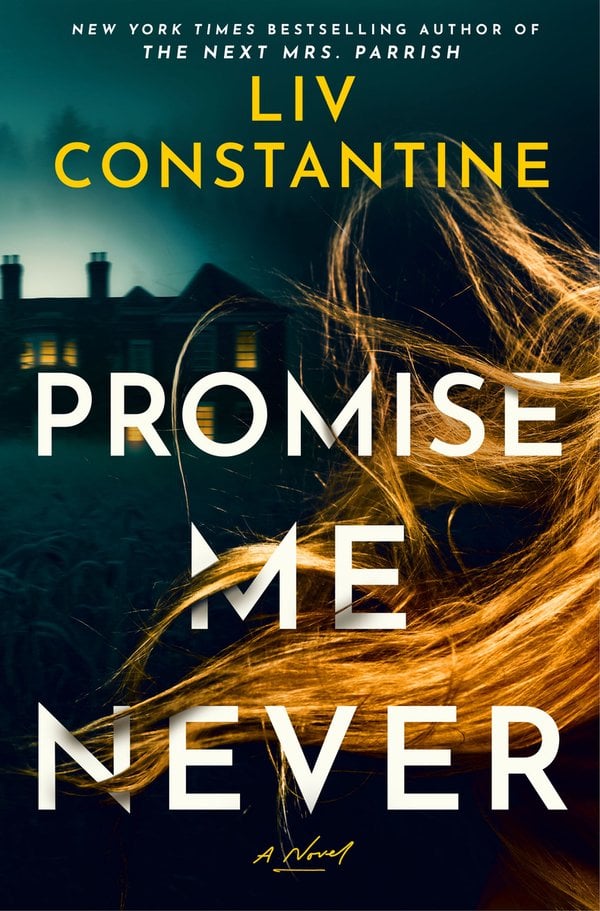
Like most brides, Savannah, in Promise Me Never, believes that her I do is the beginning of her happily ever after. She’s snagged the famous author: rich, good-looking, influential, attentive. A man who’s going to help her achieve her own dreams of becoming a best-selling novelist.
Red flags? She brushes them aside. So what if his last wife drowned under suspicious circumstances? And what’s wrong with a locked office that she’s forbidden to enter? And surely he only discourages her from leaving the house because he’s worried about her safety. But when a stranger warns her during her daily walk that other women have disappeared, Savannah worries that she may have married a man far more dangerous than she ever imagined.
Marriage has long been rich territory for crime fiction because the threat is deeply personal. Instead of lurking in dark alleys or abandoned warehouse, it waits in kitchens, bedrooms, and living rooms. In the places we’re supposed to feel safest, and with the person we most trust.
Even the Greeks understood that marriage could be a battleground. Greek mythology is rife with toxic relationships. Hades violently abducts Persephone and tricks her into eating pomegranate seeds thus binding her to the underworld as his wife. Over time she grows to accept him and rule beside him as queen of the underworld. Was this one of literature’s earliest examples of Stockholm syndrome? Or simply the first marriage made in hell?
Then there are Hera and Zeus. Zeus is an unrepentant serial philanderer who often changes his appearance to trick other goddesses into sleeping with him. Hera, the goddess of marriage, is devoted to the institution but trapped in an impossible union. Unable to punish her all-powerful husband, she turns her fury on his lovers and their children instead. Throughout Greek mythology, infidelity, jealously, revenge, and betrayal run rampant in divine marriages.
By the late seventeenth century, Charles Perralut’s Bluebeard (La Barbe bleue) gave us one of literature’s most terrifying husbands. A wealthy nobleman who murders wife after wife for disobeying him, only to be undone by the curiosity of his latest bride.
Shakespeare’s marriages are often no less perilous. In Macbeth, husband and wife become willing partners in murder as ambition consumes them both. As Macbeth grows more paranoid and tyrannical, Lady Macbeth eventually descends into guild-ridden madness. In Othello a loving marriage is destroyed by jealousy after Iago convinces Othello that his faithful wife, Desdemona, has betrayed him with another man. Believing the lie, Othello murders the innocent woman he loves.
James M. Cain’s Double Indemnity, adapted into the classic 1944 film, features another unforgettable femme fatale. More interested in collecting insurance money than preserving her husband’s life, Phyllis Dietrichson seduces an insurance salesman into helping her commit murder proving that sometimes the most dangerous vows are the ones spoken at the altar.
The gold standard for psychological suspense is Daphne du Maurier’s Rebecca. At first, we’re led to believe our unnamed narrator has good reason to fear her new and enigmatic husband Max de Winter. Living at Manderley, she finds herself haunted by the memory of the glamorous and beloved Rebecca, a woman so much larger than life that even after her death, her presence lingers. But as the story unfolds, our assumptions are flipped. The truth about Rebecca and Max is far more complicated than appearances suggest, reminding us that in the best marriage thrillers neither spouse is ever exactly who they seem.
Marriage thrillers also gave us one of psychology’s most enduring terms. Patrick Hamilton’s play Gas Light, later adapted into the classic film, Gaslight, introduced the concept of “gaslighting” a form of manipulation in which one partner systematically causes the other to question their own memory, perceptions, and sanity. It remains one of the most chilling and recognized forms of abuse in both fiction and real life.
A modern discussion of the marriage thriller would not be complete without mentioning Gone Girl. Gillian Flynn’s blockbuster didn’t just redefine the genre, it reshaped readers’ expectations of it. Her ingenious deployment of an unreliable narrator influenced the stories that came after it and made it one of the most popular and enduring tropes in modern domestic suspense.
Promise Me Never poses the same question inherent in any marriage: Can you ever truly know the person you marry? And do they ever really know you? After all, the most dangerous words in crime fiction have never been “I love you.” They’ve always been “I do.”
***

Liv Constantine
Liv Constantine is the pseudonym of Lynne Constantine, an Edgar Award-nominated, New York Times, and internationally bestselling author. She is the co-author of The Last Mrs. Parrish, a Reese Witherspoon Book Club selection, and her critically acclaimed books have been praised by The Washington Post, USA Today, The Sunday Times, People, and Good Morning America, among many others, with more than two million copies sold worldwide. Her work has been translated into twenty-nine languages, is available in thirty-four countries, and is in development for both television and film. When she’s not writing, you can find her curled up with her Labrador and golden retriever, reading a good book or binge-watching the latest limited series.