Margot Douaihy's New York City Mystery
A formative friendship and a disappearance that still haunts.
Murder
I always knew where to find her. Lisa tended bar at a tiny tasting room called TASTING ROOM (for real) near my roach-riddled apartment in the East Village. It was 2004. Every weeknight, or just about, I walked past Lisa on my way home from work. I’d usually see her around 6:30pm, smoking Marlboro Reds outside the bar, drinking red wine, and reading a murder mystery, seemingly savoring a quiet moment before her shift. I’d point at her book and smile, and she’d smile back. It went this way for six months until one day she said, I love a good mystery. Me too, I replied, I fucking love mysteries. She threw A is for Alibi at my head and we became fast friends after that. A quasi mystery book club formed with just the two of us. I quickly learned that Lisa not only read about killers, she was a killer. Or she wanted to be. When I hung out at the bar, she refilled my wine glass so stealthily, so sneakily, I half-died a dozen times. I had no idea how much Nebbiolo I’d consumed until the room spun. She was generous. Too generous. She never let me pay or tip her.
“F” is for Fugitive
Lisa was an avid reader—newspapers, magazines, biographies, tarot, mindreading (she knew what wine I wanted before I did), historical fiction, science textbooks, but mysteries were her fave. Sue Grafton paperbacks littered the bar. On slow nights, sometimes we’d take reading breaks together, both of us sipping wine, reading at opposite ends of the bar. We talked endlessly about why we adored the catharsis of crime stories, how we both savored the whiplash of plot twists and being wrong about culprits. You better write your own damn mysteries, she said, and don’t disappoint me. I don’t know how, I said. So learn, she said. She read my grad school applications, screaming at me for selling myself short. We polished off a bottle of Montepulciano as she edited my artist statement, sighing loudly, cursing at my bad grammar, swirling red wine in her glass, and marking up my papers with her red Sharpie.
Shots Fired
When the bar was full, Lisa complained mercilessly but also she loved it. She kept snacks flowing for regulars (never letting us pay), and she was brutally selective about who she allowed in, much to the bar owner’s chagrin. We never met M, the owner, but I often heard his voice on the other end of Lisa’s ancient flip-phone as they discussed delivery schedules. Sometimes there was a strangely plaintive tone in Lisa’s voice talking to her boss, but most of the time, she was buoyant. A hellcat. She loved to sing and dance, and she made me dance, too. On the rare night when all the regulars were in, she’d lock the bar doors and we’d dance until 5am. Music bounced around the brick walls, up to the high ceilings. Our heat and laughter fogged the windows. One of those nights, Lisa dragged me up onto the bar to dance. It felt blisteringly rehearsed and spontaneous, like Springsteen pulling Courteney Cox on stage. When “You Oughta Know” came on, Julie, another regular, danced on the corner table and smacked her head so hard on a sconce she slashed her forehead, unleashing a torrent of Merlot-colored blood. Julie was out cold as Lisa bandaged her head with the first-aid kit from the bathroom. She yelled into Julie’s face: Wake up, bitch! When Julie blinked into consciousness, Lisa made us all do shots.
Lost
Lisa asked for nothing, but the regulars would do anything for her. In the same way fireworks make you instinctually tilt your head up to the sky in awe, we were drawn to Lisa. Her bar was my home away from home. Lisa’s NYC was the NYC of the movies and TV shows I grew up watching in my Scranton living room. Mythical Gotham. City of swagger, art, celebrities, gorgeous drag queens, fabulous clothes. 42nd Street, Rent, Dorothy Parker. The gay New York of Andy Warhol and Keith Herring and ballroom culture. Except that it was all real. Lisa made it real. And I was part of it. The best part? Where was Lisa from? Scranton. Two kids from Scranton, I said, now tearing up the city. No better compass, Lisa said, than a girl from Scranton. And you, my friend, have been lost a long time. Her wine-stained teeth glowed like magenta neon signs.
Tricked
Lisa was the badass older sister I’d always wanted. She was tall, with long black hair—the living black of a motorcycle jacket roaring past you at 80 miles-per-hour. Her voice was seismic. Her laugh shook the plaster. She was the magnetic lesbian that straight women fell in love with. She gave me horrendous dating advice. Absolutely horrific. But she epitomized cool and I desperately needed to understand cool. I was a nightmare, drowning in my internalized homophobia and self-loathing. Always going somewhere, planning something, doing a dozen things at once. But when I held court in her bar, I didn’t want to run. Lisa anchored me in moments. Moment by moment by moment. She tricked me into being present, into staying in my body.
Missing
On a forgettable Friday, a sticky summer night, I walked into the bar with money in my back pocket. I was excited to feel Lisa’s glow and get into some trouble, when I saw Wade, one of the barbacks (and aspiring opera singer). Where’s Lisa? I asked. Wade hung his head. Dunno. I… He didn’t finish his sentence. Lisa never showed up for her shift that night. She didn’t show up all weekend. Or ever again. Lisa was gone. Did she quit? Did M fire her for one of her dance parties, or Julie’s concussion? Was she on the lam? Where’d she go? I never found out. I lived in the East Village for a few more years and never saw her again. Nobody did. I frantically searched for Lisa online—nothing. I still search. I’ve asked every Scranton friend about her but no one’s seen her for decades. Her parents died before I met her. Lisa has no IG or social media. No Facebook. No LinkedIn. No obituary either. (Trust me, I check.) Lisa was real, but I was selfish. I didn’t get to know her as well as she knew me. Why didn’t I ask her more questions? Why didn’t I thank her? Where’d she go? I still have her copy of A is for Alibi. Would I be writing my own mysteries if it weren’t for Lisa and her playful threats to get my ass in gear and start writing? Who knows. I do know this: the world is broken, yes, but never doubt the impact one book or one person can make in your life. Books still matter. People still matter. Real moments still matter. In the relentless churn of New York City, a mysterious bartender from Scranton introduced me to myself.
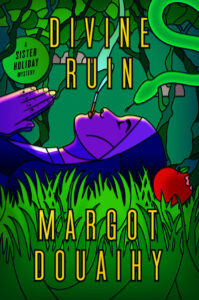
–Margot Douaihy’s latest novel is Divine Ruin (Zando).

Margot Douaihy
Margot Douaihy, PhD, is a poet, crime writer, and assistant professor at Emerson College. She is the author of the lyrical hardboiled mysteries Scorched Grace and Blessed Water, both published with Gillian Flynn Books, a Zando imprint, and both named a Best Crime Novel of the Year by The New York Times (2023 and 2024). The third mystery in her series, Divine Ruin, published in January 2026 and was an American Booksellers Association Indie Next Pick and a Publishers Weekly Pick. Margot is an active member of the Radius of Arab-American Writers, the Queer Crime Writers, the Sisters in Crime, and the Mystery Writers of America.