

Mark Edwards on Why Setting Is Just as Important as Plot and Characterization
The author of One of the Family takes a thriller research trip through the Scottish Highlands
Severe Alert: A RED warning for wind has been issued. Extremely strong winds associated with Storm Eowyn are expected to cause significant disruption….Stay indoors if you can. It is unsafe to drive in these conditions. Avoid coastal areas.
This warning, issued by the British government, the only time I had ever received an official alert, flashed on my phone on the afternoon of 23 January 2025. It appeared on the screen of my friend Ed’s mobile too.
This was not good timing. Because we were, at that moment, driving to a coastal area. To the very epicenter of the storm, in fact, which happened to be directly above the Air BnB we were due to stay at that night on the west coast of Scotland. I’d thought it was looking a bit blowy outside. Now, I had visions of flattened witches in stripy stockings and flying cows caught up in twisters. We needed to get home, take shelter, batten down the hatches.
Except we were on a research trip. We had books to write. We couldn’t let our readers down! It was worth the risk of being flattened by a flying cow if it meant getting the setting right.
Also, I was fairly confident we wouldn’t encounter any flying cows.
I was one month into the first draft of the novel that would become One of the Family. When I’d dreamed up the idea for this book, which is about a rich family with dark secrets they’re prepared to protect at all costs, seen through the eyes of the new boyfriend of the youngest daughter, I focused on three things: who were the main characters; what was the central premise; and where was it going to be set?
It needed to be somewhere remote and beautiful but also dangerous, a place where someone could die of natural causes but also where a family might feasibly have a vacation home. I ran through the options. Deep in a forest or some creepy woods? On an idyllic island surrounded by blue seas where one might drown? A mountain resort and all its treacherous cliffs?
There are a lot of destination thrillers out there, many of them set on sunny beaches, the kind of place where an author might like to relax for a week in the name of research. (I’m sure many thrillers are dreamt up on sun loungers or in pools.)
But I had already decided I wanted my new one to take place somewhere cold—because the plot I was working on involved someone being frozen to death. That doesn’t happen in the Maldives, no matter how much I’d like to spend a week there. Would, I wondered, the Scottish Highlands work? I’d been there only once, almost thirty years ago, but had a clear idea of what the Highlands look like, even if that was mostly from watching Outlander.
It was this idea—hitting upon the location, not thinking about the spicy historical time-travel romp—that brought the book to life for me. If it was set in Scotland, it could take place over Hogmanay aka New Year. I already knew I wanted to write about class in this novel, and now I could introduce a clash between Scottish locals and English interlopers. I could use local wildlife and history, even a dash of Celtic legend.
I suddenly knew exactly what kind of atmosphere I wanted to create and the feeling I wanted to invoke in readers. Suddenly, this work in progress became more than some scribbled notes and a vague idea of what kind of story I wanted to tell. It became real and exciting—and that excitement is crucial when you’re going to spend a year immersed in a novel.
The next step was figuring out the exact location. The Highlands is a big place, covering over ten thousand square miles. My friend Ed, who is Scottish and still lives there, suggested Applecross, which is just across the water from Skye on the west coast.
I Googled it. Checked Wikipedia. Looked at a map. It seemed perfect. It was by the sea, was sparsely populated, hours from a police station or hospital—the nearest police are in Inverness, eighty miles away—and easily cut off when it snows. Bonus: it’s easy to pronounce for a Sassenach like me.
Now I had my exact location, I could start writing, but I also knew that I wanted to visit Applecross. In the past, I’ve written books set in places I’ve never been to and was unable to get to. For example, I wrote a book that takes place in Maine but was stuck at home because of the pandemic, and there was another set in Romania which entailed many hours on Google Earth trying to figure out what everything would look like. It was a struggle.
I’ve also been on location-research trips and knew how those trips improved the books. A few years before, I’d written a book set partly on the Coast Starlight train that runs from Seattle to LA. Traveling on that train, and into the forests where most of the action takes place, made it much easier to write.
This is not only because of logistics and aesthetics. What’s more important is that on research trips you get to meet people. On that California trip I met a tow-truck driver who not only provided priceless information for that book but gave me ideas for at least three others. Local people will give you knowledge and perspectives that you would never get from doing online research.
So here we were, Ed and I, on 23 January, heading into the eye of the storm. We were meant to be going to look at some rock art the following morning, because rock art plays a small but crucial role in my plot, but because of the flying cow situation we decided we needed to get to Applecross as quickly as possible. We drove up the coast, pursued by the storm, reaching the peninsula just in time and taking shelter in the best place possible: the pub. That was where we met some locals who did exactly what I’d hoped, providing material for the book.
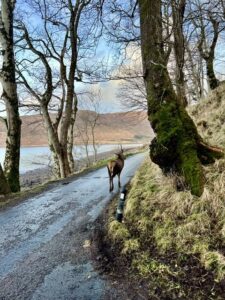 Photo provided by Mark Edwards
By the end of the weekend, I had realized that my imagined picture of Applecross was wrong and, without this trip, it would have been flat and inauthentic. Now I could see everything clearly and, crucially, the landscape, the buildings, the nature and the people we met gave me all the material I needed to create a complex and atmospheric thriller that was also authentic.
And in this cold, snowy place, the characters came to life in my head and, once I got home, on the page. It was a live example of plot, character and location working together in perfect harmony, each one informing and strengthening the other.
Ed and I survived the storm and our trip to Applecross—unlike some of the characters in the book. I do feel a little guilty about making so many terrible things happen in such a beautiful place. I wondered at one point whether I should fictionalize this community and give it a fake name. But I know from experience that if you set a book somewhere that isn’t London or New York or Paris, where everyone is blasé about this kind of thing, the locals will love it—even if you fill their beautiful village with dangerous psychopaths and lethal geographical features.
One of the Family is out now and I’m currently putting the finishing touches to my next book, which is set on my doorstep and didn’t require any kind of research trip. But I’m already thinking ahead to the next one.
Last month, I visited a small village on the south coast which had some peculiarities that immediately got my imagination racing. This would make a great setting for a crime novel, I thought. And with that came the first stirrings of an idea, with the location already nailed on. I just hope that when I go back to take a proper look around, there won’t be any storm warnings. I spotted a lot of sheep last time I was there, and I really don’t want one of them flying at me.
***


Mark Edwards
Mark Edwards is the bestselling author and coauthor of over twenty books, including those he has written with Louise Voss. Originally from Hastings in East Sussex, Mark now lives in Wolverhampton, UK, with his wife, their children, three cats, and a golden retriever. Find out more at MarkEdwardsAuthor.com.