On the Unfinished Nature of Bram Stoker’s Dracula: Pulling at Loose Threads
"As readers, we see enough of the ‘brides’ to be intrigued, but then we’re told so little!"
Bram Stoker’s famous novel has been retold and reimagined since Nosferatu’s Count Orlok first skulked onto cinema screens, and perhaps even earlier than that. Over a century later, we still love to reinvent this classic gothic tale. My personal theory as to why is that while Dracula is certainly a masterpiece, Stoker’s plot leaves more than a handful of loose threads. Once one catches our eye, we just can’t stop ourselves from pulling at it.
It was an autumn afternoon in Oxford when one of those loose threads thoroughly entangled me. Imagine historic buildings made of honey-coloured Cotswold stone, pavements slick with rain, and the warm light of libraries and bookshops spilling out into the street as the night drew in. I’d ducked into Blackwell’s to escape the downpour. Blackwell’s bookshop on Broad Street is an Oxford institution; downstairs, the record-breaking Norrington Room is the biggest bookselling room on the planet, but on that evening I headed upstairs to the Classic Fiction shelves. I browsed around, picking up and putting down any number of worthy tomes. Then I spotted a slender purple volume entitled, mysteriously, Who Is Dracula’s Father? I picked it up, and it changed my life.
At home in the suburb of Littlemore, just to the south of the city proper, I cracked open the cover and settled in with a cup of tea as the rain poured down outside. The essays were all interesting, even fascinating, but one in particular sent me to my bookshelf in disbelief. It was called Where did Dracula’s (English-speaking) harem come from? I thumbed through my battered copy of the novel to confirm the claim that the female vampires spoke English, certain that it couldn’t possibly be correct.
Professor John Sutherland, author of the aforementioned purple book, made a compelling argument. He demonstrated that when the vampire Count speaks to his so-called brides, the protagonist Jonathan Harker understands the conversation perfectly. Harker certainly doesn’t speak Dracula’s native Hungarian, and his German, the lingua franca of the Austro-Hungarian Empire of which Transylvania was a part, is rather lacking. Therefore, Sutherland reasoned, the vampires could well all be speaking English.
This idea possessed me. Why on earth would Englishwomen be in a castle in Transylvania in the late nineteenth century? And why might they be? I started to imagine them, these women, being whisked across Europe on the Orient Express, chattering with excitement as they drank Viennese coffee from elegant china cups, with no idea what awaited them in the land beyond the forest.
Bram Stoker tells us very little about the women we know as Dracula’s ‘brides’, but whom the novel calls only ‘sisters’. We see that they are charming, seductive, and vampiric — just like Count Dracula. Jonathan Harker writes that they are “ladies, by their dress and manner”. They are in some way beholden to Dracula and obedient to him, and they seem to be confined to the castle unless he tells them otherwise. And…that’s more or less it. They have no names, barely any personality, and only the tiniest hint of a backstory.
This narrative gap is tantalising. As readers, we see enough of the ‘brides’ to be intrigued, but then we’re told so little! We just can’t leave the questions they raise alone, so we focus on them in media adaptations and literary retellings over and over and over again. Who are they? What are they doing in Dracula’s castle? Why did he turn these women in particular into vampires in the first place? We might decide that they’re ancient, they’re young, they’re love interests, they’re feral, they adore Dracula, or they hate him. I feel part of an obsessed, strange little club when I think of how many people down the years have created their own answers to these compelling questions.
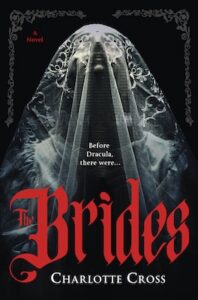
I didn’t originally intend for my debut novel The Brides to be a specifically feminist retelling, but centring female voices and treating female characters as fully realised human beings often seems to make a work feminist by default. Such a retelling is not not in the spirit of the original. Mina Harker, née Murray, can easily be seen as Dracula’s most capable and heroic figure, and both she and sweet Lucy Westenra are well drawn and treated as whole human beings, rather than as cardboard cut-outs.
On that autumn afternoon in Littlemore I sat staring into space, tea going cold, as my imagination ran riot. It would be three long years before I finished The Brides, and three more until its publication. The loose thread I pulled on unravelled in unexpected ways. The Brides winds both back and forth in time using the events of Dracula as more or less a midpoint, through the consciousness of many different characters. But it is still only one loose thread. There are so many others for another writer or filmmaker or artist to take hold of, whether they lead back to something familiar or, even now, one hundred and twenty-nine years after Dracula’s publication, into territory still unexplored. I can hardly wait to find out.
***

Charlotte Cross
Charlotte Cross writes historical speculative fiction, having been fascinated by stories of the past since she was a child. She grew up in southern England in a small town with a rich history, and spent many happy hours at the local museum where her grandmother was a volunteer. Charlotte now lives in central Scotland with her partner and their opinionated ginger cat. When not writing, she enjoys yoga, reading Victorian novels, and exploring her adopted country. The Brides is her first novel.