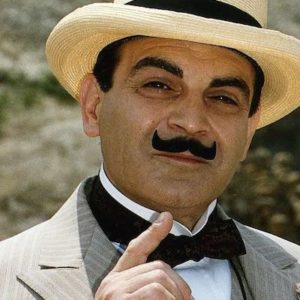

“Trains are relentless things, aren’t they, Monsieur Poirot? People are murdered and die, but trains go on just the same.”— The Mystery of the Blue Train by Agatha Christie
Crime fiction loves trains the way a pickpocket loves crowds. A train leaves the station, and the story is already in motion. No exits, no detours, only rails stretching ahead and a cast of characters hurtling through the night, harboring secrets and schemes. The confined spaces let us eavesdrop with impunity. A whispered murder plot, anyone?
Strangers jostle in narrow corridors. Conspiracies hatch inside plush compartments. The timetable becomes a ticking clock. Claustrophobia and momentum drive the action toward a pressure cooker of paranoia. That fellow in the cocktail lounge…did he follow me to the station?
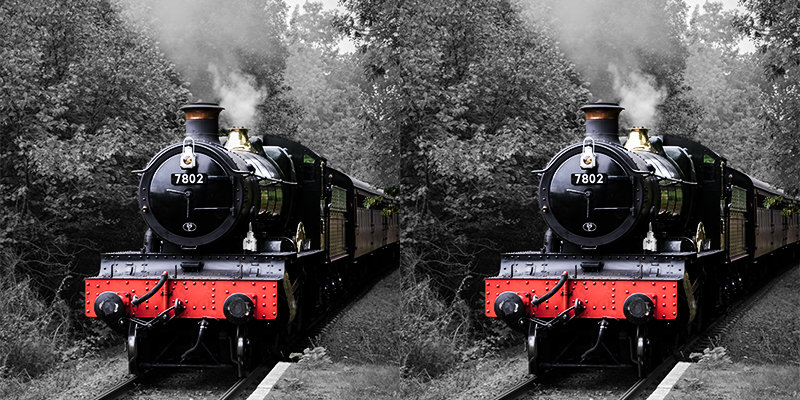
Outside, the changing landscape rushes by, warped by speed and reflection, twisted like unreliable alibis. Carriages plunge into dark tunnels then burst into light. Forged wheels sing against steel rails. Horns cry out at midnight crossings. Air brakes whoosh as the station nears, and danger lurks on every darkened platform. Everyone is a suspect. That oiler in denim coveralls…does he have a gun?
Crime fiction has long ridden the rails. A few notable stops:
The Thirty-Nine Steps (1915): John Buchan’s novel sends an innocent man racing to Scotland by train, pursued by police and enemy spies. It has been adapted into several films—most famously by Alfred Hitchcock—and a long-running stage play.
Murder on the Orient Express (1934): In Agatha Christie’s classic whodunit, everybody did it. The conspiratorial tale of revenge has been adapted into numerous films and television productions.
Strangers on a Train (1950): A chance meeting sparks a chilling bargain: I’ll kill your wife if you kill my father. Patricia Highsmith’s debut novel became a memorable Hitchcock film, with Raymond Chandler among the screenwriters.
From Russia with Love (1957): James Bond faces a booby-trapped briefcase and a SPECTRE assassin aboard the Orient Express in the fifth entry of Ian Fleming’s iconic series.
The Great Train Robbery (1975): A Victorian-era gold heist, loosely based on a real crime, drives Michael Crichton’s novel. Crichton also wrote and directed the film starring Sean Connery, Donald Sutherland, and Lesley-Anne Down.
Bullet Train (2010): Kotaro Isaka’s novel brings a group of assassins together at 200 mph in a tangle of revenge plots. The film adaptation, an action-comedy, stars Brad Pitt as the world’s unluckiest hitman.
The Girl on the Train (2015): Paula Hawkins’s psychological thriller turns a daily commute into a window on obsession, illusion, and violence. The bestseller was adapted into a film starring Emily Blunt.
Different routes, same destination: danger in close quarters.
Hitchcock loved trains for their “forced intimacy.” In North by Northwest, Cary Grant and Eva Marie Saint banter and flirt aboard the Twentieth Century Limited:
Cary Grant: “When we get out of this, you can ride the train with me again.”
Eva Marie Saint: “Is that a proposition?”
Cary Grant: “It’s a proposal, sweetie!”
Trains also play key roles in Hitchcock’s The Lady Vanishes, Shadow of a Doubt, and Foreign Correspondent. The director was masterful at exploiting the sights, sounds, and sensations of trains: the narrow spaces, the clack of steel on steel, swaying carriages, hisses of steam, screams of whistles.
All of which brings us to the glorious Santa Fe Super Chief, streamliner of the stars. Its 40-hour run from Los Angeles to Chicago was the epitome of luxurious travel and the first leg of coast-to-coast travel in the mid-Twentieth Century. Known for its hushed cars appointed like private clubs, spacious drawing rooms, and exquisite cuisine, the train was the conveyance of choice for studio heads, movie stars, and business tycoons. Amtrak it was not.
There were attentive Pullman porters and polished dining car stewards in crisp uniforms. You might catch a glimpse of Bob Hope and Bing Crosby in the cocktail lounge of the Pleasure Dome car or Clark Gable and Katherine Hepburn playing gin rummy in the observation car. As for fine dining, fresh swordfish with a meunière sauce would set you back 75 cents in 1938 while a dinner of calf’s liver with bacon was 70 cents.
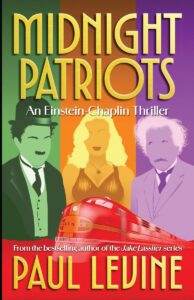
The second half of my newest novel, Midnight Patriots, is set on the Super Chief as it races from Chicago to Los Angeles in November 1940. On board are real-life friends Albert Einstein and Charlie Chaplin, gangster Mickey Cohen, Nazi spymaster Fritz Duquesne, William Randolph Hearst, Charles Lindbergh, J. Robert Oppenheimer, Lena Horne, an alert Pullman porter, and a beautiful German woman with a mysterious agenda of her own. A cross-section of America—and its enemies—sealed together at speed.
The plot runs on two tracks: a Nazi scheme to kidnap Einstein for Germany’s nuclear program, and Chaplin’s bid to stop Lindbergh from undermining FDR’s support for England.
Here’s my opening description of the train:
“At Chicago’s Dearborn Station, the Warbonnet locomotive—sleek and resplendent in red and yellow, its design inspired by a Navajo headdress—pulsed with quiet power, poised to chase the horizon. Behind it stretched a line of gleaming stainless steel carriages. Their interiors boasted satinwood and mahogany paneling, brilliant turquoise and lustrous silver upholstery. The Santa Fe Super Chief radiated elegance from its drawing rooms to its club cars, a palace on wheels.”
Let’s end as we began, with a quote from The Mystery of the Blue Train. Hercule Poirot is speaking to a young woman:
“Life is like a train, Mademoiselle. It goes on. And it is a good thing that is so.”
“Why?”
“Because the train gets to its journey’s end at last, and there is a proverb about that in your language, Mademoiselle: ‘Journeys end in lovers meeting.'”
Cary Grant and Eva Marie Saint would agree.
***

Paul Levine
Paul Levine is the author of the “Jake Lassiter” and “Solomon vs. Lord” series. He has won the John D. MacDonald Fiction Award and has been nominated for the Edgar, Macavity, International Thriller, Shamus, and James Thurber prizes. A former trial lawyer, he also wrote nineteen episodes of the CBS military drama “JAG” and co-created the Supreme Court drama “First Monday” starring James Garner and Joe Mantegna. His newest novel is “Midnight Burning,” first of his Einstein-Chaplin thrillers.