
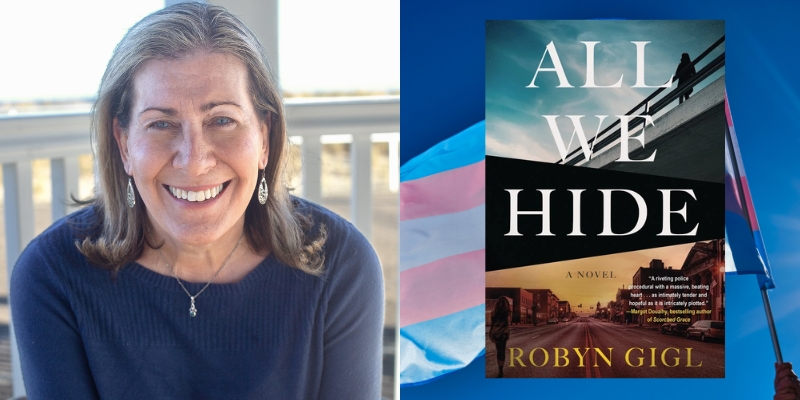
Robyn Gigl on Writing a Police Procedural with a Trans Protagonist Set in a Red State
Alex Dueben speaks with the author of 'All We Hide'
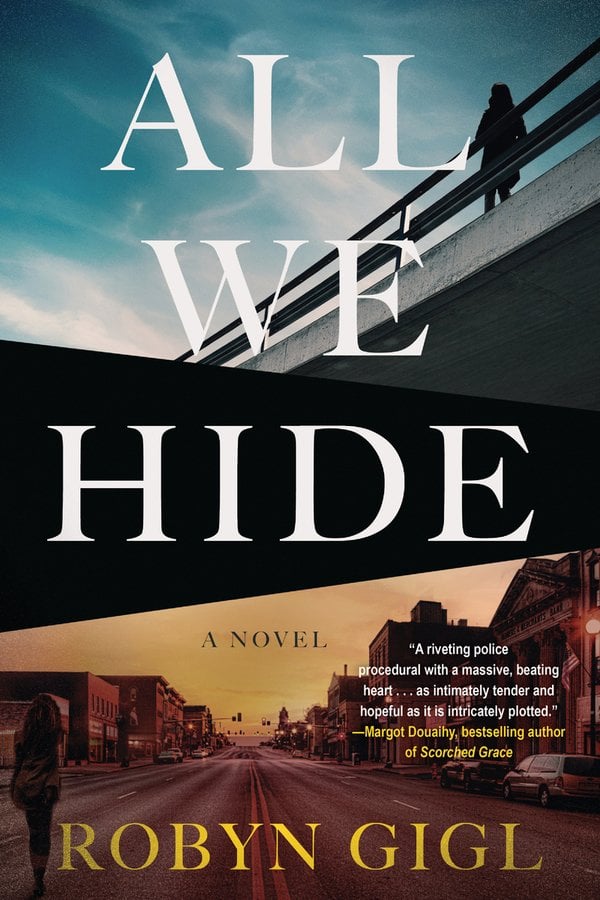
Over the course of the four Erin McCabe books, Robyn Gigl made a name for herself a great writer of legal thrillers. Her new book All We Hide is a departure, and also her best book to date.
Lauren Kelly, a newly promoted Lieutenant in the DA office and having been harassed since coming out as trans, is exiled to the cold case unit. The murder of a high school classmate, a trans woman named Sherry Darling, ultimately leads Lauren to connect it to the disappearance of her mother, her father who now has Alzheimer’s, and a county corruption scandal. All while Lauren continues to deal with her young daughter, the ex-wife she’s still in love with, and everything that has happened since she transitioned, which may have saved her life, but also exploded every aspect of her life.
The book is a story of municipal corruption, missing parents, abuse, and how violence echoes through time and across generations. It’s a masterful procedural, drawing on a deep understanding of police and legal work and a way of thinking that those jobs require. Girl is masterful at writing her supporting characters, both the likable and those impossible to like, imparting to the reader a deep understanding of who they are, finding their humanity, even if those characters refuse to find it in other people.
We spoke recently by zoom about the book’s origins, trying to write something different, and the struggle to write something hopeful and entertaining about trans life in the United States today.
*
Alex Dueben: Robyn, I really loved All We Hide, and I loved Lauren. This is a different book from the Erin McCabe series in many ways. What did you consciously want to do differently, and what do you feel you ended up doing differently with this book?
Robyn Gigl: One of the things that I wanted to continue is I’m one of the few trans women writing crime mystery stories in the United States. There might be others in Great Britain and other places, but in the U.S., I know of two others, Renee James and Dharma Kelleher. So I knew I wanted to have a trans protagonist, but I also knew that I had to make the story different so that it stood out from the Erin McCabe series.
I am a lawyer. I am a trans woman. Erin was easy for me because I was writing a lot from my own personal experience, not necessarily as a trans woman, but as a lawyer. I knew the law. The series was set in New Jersey. I knew the surroundings. For this book, I wanted to set it somewhere different. New Jersey is a progressive state and I wanted to do it somewhere that is not as progressive. I don’t name the state. I just knew that it was somewhere that was basically a red state, a red county.
I also didn’t want to make it another legal thriller. I love police procedurals. I love Tana French and her Dublin murder mystery series. That’s what I was thinking about.
I knew if she’s going to be a trans woman, even if she’s a detective in a different state, I have to do something different to distinguish her. I wrote it from the first-person point of view. The Erin books were always written in a third-person point of view. It was challenging for me because I had never written in a first-person point of view, but I thought as a police procedural that was a better mechanism to use.
That was a conscious choice. Putting her in an unknown state was a conscious choice. Making her a detective, not a lawyer, conscious choice. When the Erin McCabe books take place, Erin is in her 30s, she’s a relatively young, attractive woman. Lauren’s in her mid 40s, so still not close in age to me, but a little bit closer. [laughs] Those were the conscious choices that I made in terms of trying to make sure that Lauren stood on her own and people didn’t look at it and go, oh, it’s Erin McCabe but as a detective.
AD: Lauren is a little older and I kept thinking of this as a midlife reinvention book. Because you can see that in not just her decision to come out and transition, but for many of the characters.
RG: I think one of the advantages of writing in the first person point of view is it felt a lot more personal. Lauren had a lot of angst for different reasons, and with first person point of view, as the author you have to be in the person’s head. I got to deal with those emotional issues a little bit more than I did with Erin. I mean, midlife crisis, we all have those. Or most of us do.
As far as transitioning and the impact on her family, her career, I got to deal with those issues on a more emotional level, I think. That was the goal anyway.
AD: Lauren has a lot of angst, but there is this way that she knows who she is. The egg cracked and she very quickly went, this is who I am. The problems come from literally every other aspect of her life.
RG: Yeah. That’s something that I have experienced personally. I transitioned later in life. I have a family. Three kids. Five granddaughters. My wife and I are separated but still good friends. For that kind of stuff, I could draw on those personal emotions in terms of what happens in the aftermath. Trying to not put the egg back together again, but make an omelet that works. [laughs]
AD: [laughs] One reason that Lauren is so raw is this family history of tragedy. This is a story about violence and unintended consequences. The way it consumes everyone around.
RG: Yeah, and the vicissitudes of life, how it’s the little things that happen that set off the chain reaction. Those little things that at the time you don’t think about, and then all the things flow from that. Life choices that have all kinds of consequences. One of the things that I enjoy doing, or at least I hope I did, was that other than one character who has no redeeming value, everybody else, even if they’re an antagonist in the book, there’s a logical reason for why they did what they did.
Because I think that’s so human. We all make choices, not realizing what the consequences are going to be, and then we’re locked into things that we never really envisioned. I think that’s so human. Even people who do bad things sometimes think they’re doing them for the right reasons.
AD: As you were saying that, I kept thinking of Snyder, her captain, who is such a well-drawn character. He is impossible to like, but is so well-drawn.
RG: Thank you. And again, you find out towards the end that Snyder was just going along with the guys.
AD: But there were lines that he would never cross. Like Sherry’s brother, who is nasty and violent, but also–
RG: He’s got a good heart. In a way. [laughs]
AD: In a way.
RG: I know people like that. You can look at them and say, they’re a bad person. They were involved in crime. They did this. They did that. But you deal with them on a one-on-one level and they’re a much different person. They do have some redeeming qualities that maybe you don’t always see. Those characters, even though they’re on the periphery, I wanted them to be complex and to have a story. So that people at the end would understand why they acted the way they did.
AD: I love the character of Lauren and she’s very sad. I mentioned midlife and one reason is that she’s understanding her parents for the first time. There are lot of plot reasons for that as readers will learn, but that scene where Joan said, I knew your mother, Lauren has this physical reaction. She never thought of her mother that way.
RG: My mother passed in 2000 at the age of ninety-six. She had a good life. My mother was a saver, and one of the things that we found after she died that we had never seen before were wedding pictures of when her and my dad got married. To see the two of them as a young couple, and there were some of them as a couple from even before they were married. To see those pictures and realize that here’s this woman that I have known my entire life, and there’s a story to her that I had no idea existed.
You just don’t think of your parents that way. Then when you see something, it’s that a-ha moment of, oh yeah, they were something other than a parent.
AD: Lauren’s father has dementia and my grandmother had dementia, and you did a good job of kind of capturing that sense of complete uncertainty over who you’re going to encounter that day and how they’re going to respond to you at any given minute. And that the person you knew isn’t there anymore.
RG: Yes and I hope that scene worked where Lauren looks back at her dad and she wants to feel rage and hatred, yet the person that she wants to hate isn’t there anymore.
I know you haven’t asked the question, but I do like to tell the story that the Sherry Darling case, the underlying cold case of the book was inspired by a real case. I don’t know if you ever saw the movie Paris is Burning about the New York ballroom scene. There’s a person in that documentary, Venus Xtravaganza, and at the end of the movie, we find out that Venus had been murdered. She was strangled in a New York motel.
Venus was the inspiration for Sherry Darling, because in 2020, I got a phone call from a friend who had made a connection with Venus’s brothers. She has three surviving brothers. My friend had called me to say, I’m working with her brothers, they’d like to change her death certificate to Venus Xtravaganza.
I said, well, she was murdered in New York. I’m a New Jersey lawyer. I can’t do anything. And besides, I don’t think you can change a death certificate. He goes, what about a birth certificate? I said, where was she born? He said, Jersey City, New Jersey. I said, a-ha.
Long story short, I worked with a couple other people and we posthumously changed Venus’s name in New Jersey. There’s a movie about that, although I’m not in it, I always had COVID when they were filming, called I’m Your Venus. It’s a very moving movie because it’s about the healing between Venus’s birth and ballroom families. As you might imagine, back in the 1980s, Venus’s brothers weren’t always the most understanding of their transgender sister. And the movie is about them trying to do right by their sister, and the reconciliation between them and her ballroom family, the Xtravaganzas. It’s a really interesting documentary, and very moving.
That back story, about Venus being strangled, I took that little nugget and fictionalized it. That was the inspiration. Working on that and, you know, exploring Venus’s life a little bit, getting to know her brothers and their relationship to her, that that was an inspiration for the book.
AD: We haven’t really talked about the plot, although you spent a lot of time and effort in structuring this book, which is about political corruption. I’m from Connecticut and we have lots of corruption sagas. I know you’re in New Jersey.
RG: We’re second to none! [laughs] Again, I wasn’t setting it in New Jersey. Anyone who thinks that corruption is limited to New Jersey or New York or California. No. It is baked into the political system, unfortunately. I’m not saying all politicians are corrupt or corruptible, but there are a lot who are and have been. I think it’s important to kind of point the finger and say, this is what power can do, especially when you have absolute power. And to try to point the finger at that. I did that in the Erin McCabe books. Those were set in New Jersey, so it was very easy to point the finger in New Jersey. This is not, but as I said, it’s unfortunately a systemic problem.
I like to deal in terms of the dynamics between the powerful and those that don’t have power. That struggle for justice and how justice plays out in a system where the powerful hold most of the cards. Is there a chance for those that don’t hold the power to somehow gain the upper hand? That’s the classic battling against the system, the little guy trying to make things right. It’s a trope that’s been around forever.
AD: Lauren makes a point in the book that it’s not quite the police against everyone, but it’s much more complicated and she finds herself in a difficult place.
RG: Lauren had been part of the “us” versus “them” mentality, which is common in law enforcement. I understand how that mentality can creep in when you’re out there and your life is on the line every day.
But when Lauren transitioned, she went from an “us” to a “them” and dealing with what it’s like to be on the inside the system, dealing with those issues that people on the outside usually have to deal with. She had never had to deal with them before. Now suddenly she’s a “them” and how that impacts her and not only her relationship to the people that she’s working with, but how she does her job.
I’ve never been in law enforcement, I’ve never been a police officer, I’ve never been a DA, but as part of my job as an attorney, I have worked with a lot of people in law enforcement. And I know and respect a lot of people in law enforcement, but also have gotten to know the law enforcement mentality as a result of representing them. I could draw on that in terms of knowing how people in law enforcement think, how they might react to a given situation. So I had the benefit of having some experience in terms of not being a cop, but knowing a lot and working with them.
AD: Some of Lauren’s changed attitude post-transition is about really seeing for the first time the systems that she took for granted for so long. Like, she talks about going jogging in the morning since she was young, but since transitioning, she feels a little uncomfortable doing that.
RG: That’s a dynamic that I have experienced. As a guy, you don’t necessarily think about your safety when you’re out. As a woman, if you don’t think about your safety when you’re out, you’re in trouble. That’s a dynamic for all women, but for someone who’s trans and has transitioned, you all of a sudden realize that power shift. All of a sudden you went from theoretically someone with power.
Not all men have power, obviously. But someone who’s like, I’m safe, nobody’s going to do anything to me, to somebody who’s very vulnerable. That’s a real thing. I just wanted to like throw those little nuggets in there.
AD: I also kept thinking about Sherry and her brothers. How their father was a criminal and had a very white ethnic name, and part of becoming a part of the rest of the world isn’t just leaving the neighborhood but Anglicizing their name, which is a transition of its own.
RG: We all wear different disguises as we go through life.
AD: “We all hide,” to rearrange your title.
RG: There you go. [laughs]
AD: Talk about figuring out the structure of this book, because it sounds like there were a lot of elements that were in your mind, but turning them into a book is something else.
RG: I had two things when I started. I am a pantser. I am not a plotter. I don’t have sticky notes all over the place or whiteboards or anything like that. I am at heart a pantser. So I had two things. I had the Venus Xtravaganza idea floating around in my head. When they redid Venus’s gravestone, taking away the name that she was given at birth and putting the new gravestone in with Venus Pellagatti Xtravaganza, I was there and I was really emotional. That really was the fulcrum.
The other thing I had was the opening line: “I was five years old the day my mother left.” I don’t know where that line came from. I just had it. I am a sucker for a good opening line. [laughs] I don’t know if it’s a good opening line, but I thought it was.
So I had these two ideas. I knew it was going to be a trans detective and I knew it was going to be a police procedural, for the reasons that we talked about earlier. So I had these two threads. I knew the reason why mom left had nothing to do with what Lauren thinks it is, and then the Sherry Darling case. Then it was, how and when do I weave these two plots together? That’s where I started.
I owe a lot of credit to my editor at Soho, Alexa Wejko. I had those plot points weaving together much earlier in the original version that Soho acquired. Now that happens around page 150 where all of a sudden you find out about Lauren’s mom. Originally, I had them around page 50. Alexa was like, no, we need to have Sherry’s case developing a lot more before we get to this.
The other thing that Alexa did, which wasn’t in the original version. She said, I don’t know Sherry Darling. I need to know Sherry Darling. You need to find a way that I can get to know her. And so all of those scenes of her being on the talk show weren’t in the original. Again, a big thank you to Alexa, because, although she didn’t tell me how to do it, she said, find a way to do it.
I thought of the Jerry Springer show which was, you know, a big deal back in the day. Before all the current brouhaha about trans people, Jerry and a number of other daytime talk show hosts would have trans people on. It was always for exploitive purposes, like their boyfriend didn’t know. I was like, this is a way that people can get to know who Sherry was.
Again, I had the two plot points, and at some point, the characters tell me where they’re going and how I’m going to get there. I had Frank with dementia. I knew that there was going to be a strained family relationship. Brian, the brother, was because I wanted someone to be part of her support system, and so Brian, you know, took on that role. I don’t know how I do these things. [laughs] I mean, that sounds really weird, but I just sit down and I start writing. I revise a lot.
Even after Soho acquired it, as I said, Alexa came up with two major things that required decent rewrites in terms of restructuring the book a bit and adding the things about the talk show. It wasn’t perfect. I’m not sure it’s perfect now. It just all kind of started to come together as I was writing it.
AD: Was the detention scene with Lauren and Sherry there from the beginning? Because that was just a small scene, but it was so vivid.
RG: It was. As someone who lived in the closet for fifty years, there’s always that fear that if you do something, somebody’s going to suspect who you really are. That was an easy scene to write, because I know that guilt of being in the closet and not wanting to show in any way that you are part of a community that’s really ostracized. And so yes, that was there from the get go.
AD: You mentioned before about possibly writing another. Have you started thinking about that or writing one?
RG: A few months back, Alexa said to me, have you thought about a book two? I said, more importantly, have you thought about a book two? [laughs] She said, yeah, we’ve thought about it. Send me fifty pages and a synopsis. So I did that, and I have continued to write beyond the 50 pages since then.
I want to be a little judicious in what I say, because I don’t know if there will be a book two. In the environment in which we are, especially around trans issues, I’d like to do a book two, but I fear that it would be a really dark book. Because we are in a really dark time in terms of trans issues and the way trans people are being treated in the country.
I don’t know how I can write an upbeat book right now. Because I’m not feeling upbeat. I don’t want to call All We Hide an upbeat book, because it’s not, but it ends on a bit of a positive note. I don’t know that I could do that this time. Look, I’m seventy-three years old. I’ve lived my life. I don’t worry about me.
But if I can feel what’s going on, and feel the oppression that’s going on in this country toward trans people, even when I don’t really give a wit about what people think about me, I can’t imagine what it’s like for a twelve- or thirteen- or twenty-year-old person who’s trans, trying to deal with what’s going on in this country and the attacks on them, their ability to get healthcare, their ability to just live their lives. I know that I’m going off on a mini rant here, but it’s a really tough time.
That translates into my psyche, and it would translate into whatever I’m going to write. I started All We Hide in ’23, and it went out on submission in September of ’24. So it was written before the most current events. That’s why there could be a little bit of optimism in it. Things have changed since then. They’ve changed dramatically. And for the worse.
When I write my books I want to entertain. I want anybody who likes a legal thriller or police procedural to pick up my books and read them, but I also write with the hope that I can educate a little bit. Especially for cis people who don’t know anyone who’s trans, who get all their news from social media, or Fox News or wherever, where we are being demonized all the time. To just paint a different picture that we’re human beings just trying to live our best lives.
I say this in the book, what difference does it make to anybody else who I am? It doesn’t impact their lives. One of my purposes is to try to help people understand and to educate them a little bit. Whether or not I’m successful or not, who knows, but that’s one of my goals in writing these books. And now in the times where we are, I think it’s even more important to deal with the issues and the impact that it’s having on people’s lives.
***

Alex Dueben
Alex Dueben has written for The Believer, Vulture, The Millions, The Los Angeles Review of Books, The Brooklyn Rail, and many other publications. He is the writer and editor of the artist monograph Hurricane Nancy, and his debut novel is forthcoming.