Three knocks.
“Victoria, wake up.”
I drift back to sleep, to thoughts. To the work of my Abuelo. There was something in that methodical yet brutal work he did for years. Although, that’s the place where I think he was able to find some peace. Maybe it was in that rhythmic, precise motion, repeatedly swinging his machete, trimming away leaves, and sorting sugarcane stalks by size. I’d imagine it must be like putting oneself into a hypnotic trance state. Abuelo once told me how he’d speak to himself out there, in low whispers. Beneath the buzz of insects, his skin darkening by the sun and sweat. He told me how he’d talk to my mami and papi and me out there.
“Abuelo,” I say, standing in the dark hallway, rubbing at my eyes.
The casita is small, and I can see directly into part of the living room that faces the kitchen. I move slowly, confused, unsure of what time it is exactly.
I find him at the stove. He’s wearing black slacks and a clean white guayabera shirt. The wisps of gray hair on his head are still a little wet, but nice and clean and combed over.
He must have bathed in the metal tub outside using rainwater while night completely covered the mountain.
He wasn’t dressed to go to Pellejas today.
Abuelo doesn’t turn around. He continues stirring the boiling coffee on the stove, which fills the kitchen with a roasted aroma.
“Today is the last misa, Victoria,” he says, sounding a little bit sad and a little bit serious.
I remain silent, unsure of what to say.
He looks over his shoulder and smiles his regular warm smile, and I feel a sense of relief, even considering the shocking news he just shared.
“You look very nice today,” he says.
I look down and admire my white dress that goes down past my knees, white socks, and white shoes.
I laugh to myself. “It looks like I’m dressed for Easter.”
The sound of the metal spoon against the metal pot stirring coffee stops abruptly. Abuelo’s shoulders shoot up once, as if he’s been startled by a loud bang. He turns around again. His eyes are widened. “No, not Easter. Palm Sunday.”
I look down at my hands. “Palm Sunday,” I repeat. “Aren’t we supposed to go to the . . . ?”
“Victoria . . .” Abuelo calls my name again, making me lose my thought. “The guests are on their way.”
Right. Guests. For la misa. The last misa.
“What time are they arriving?” I ask.
“They should be arriving by the time the sun rises.”
The chickens are clucking outside, being chatty. A dog barks in the distance, followed by another.
“Where are they from?” I ask.
He turns off the burner and continues stirring. “San Juan.”
San Juan. The city. I find myself growing self-conscious. My dress is pretty, yes, but maybe not San Juan pretty. I imagine the people who live in San Juan all dress so modern, in American styles. I find myself scanning our walls, bare wood with pictures Abuelo had taken at the photo studio in Ponce for a dollar. There were paintings he had done himself, watercolors of Cueva de Camuy, of fruits like quenepas, or birds like the green parrots that swooped above, branch to branch. The prints were whatever he could find, cutouts from Time with pictures of the island or articles with Don Pedro, the president of the Nationalist Party and the first Puerto Rican to attend Harvard Law School. Abuelo was so very proud to call Don Pedro his friend. There were so many more pictures and prints and paintings all on the wall.
Our casita is small, yes, but very clean. The walls are made of wood with a tin roof. I keep the outside well tended and maintained and the animals happy, but our home is nothing like the stately houses in San Juan. Those houses in the main city are made of stone, with wrought iron balconies. Inside they have courtyards and inner gardens with large water fountains and bright purple bougainvilleas climbing across walls.
Abuelo holds a strainer over his coffee cup and carefully pours the dark liquid from the metal pot through it into his mug, the coffee grounds catching in the mesh fabric.
“The mother is named Mrs. Camila Rosario. She’s a poet and a professor. Mrs. Rosario teaches at the University of Puerto Rico. The misa is for her son, Jonathan. He’s just a few years older than you.”
I’ve never met a poet, let alone a professor before, and to think, a woman who is both. Even though I feel a little embarrassed to meet them, I am still very excited.
“They must be so rich,” I find myself saying.
Abuelo takes a sip of coffee and then smiles to himself, happy with his work. He then sighs. “Rich doesn’t mean money or owning things, Victoria. You can be a millionaire and truly have nothing. My mother used to say: ‘We live better up here than all of the rich people in the world.’ ”
“Why is that?”
“Because we are happy, regardless. We find something to get us through our days, to be grateful.”
Abuelo is right. I am grateful for him. I am grateful for the chickens and the goats and the music made by crickets at night. I am grateful for the mountain.
“They will have a lot of questions for you.”
Questions for me? I’m confused. That’s not how the misa works. Usually, the questions are for other people. “What do they want to ask me?”
“The son, Jonathan, has been having bad dreams.”
Abuelo sets his coffee down and shuffles over to a small room where I did not enter. He leaves the door open and appears moments later carrying a small table, then proceeds to set it up in the middle of the living room.
None of this is sounding at all like the past misas we have had.
“I don’t understand,” I say from the living room.
Abuelo returns to the room and emerges carrying two chairs, which he positions at opposite ends of the table, before going back to gather the last two chairs. He places the chairs on the remaining ends of the table. Under one arm he holds a white folded sheet. He unfolds the tablecloth and smooths it over the table’s surface. It is so bright white, it nearly glows against all this wood. He then goes back to the room once more and closes the door.
Abuelo moves to the front door and opens it in anticipation of our guests.
The house is so small, I can see right outside from where I’m standing.
He takes a deep breath and then enters the kitchen, sips from his coffee cup he left on the counter, then says, “You’re going to confirm to Mrs. Rosario what Jonathan sees in his dreams.”
Misas are for the living to communicate with the dead, I think, and they usually don’t have anything to do with dreams.
Misas are for the living to communicate with the dead, I think, and they usually don’t have anything to do with dreams.
“Is that what makes it the last misa? Because misas are for when we talk to the dead, and at this misa we are speaking to the living?”
“Yes.”
I’m upset, and so I focus on the wall in front of me, admiring more pictures. There are photographs of Abuelo with Mami and Papi and me. There is a picture of Abuelo and Abuela on their wedding day. There is a picture of Abuelo, Papi, Don Pedro and all the male members of the Cadets of the Republic. In another picture, there is Mami and me with all the women from the Nationalist Party in our area, the Daughters of the Republic. In each of those images, we are standing in front of a two-story corner building with a second-floor wraparound balcony.
I take a step forward, and then another. That two-story building. I remember it.
The floorboards creak behind me. I hear Abuelo shuffling slowly toward me.
“This . . .” I point.
“Yes . . .”
Papi got the permit for the parade. He was so excited. “We’re celebrating all day,” Papi told me. He later explained to me that the parade was the sixty-fourth-anniversary commemoration of when it became illegal to own slaves in Puerto Rico.
“It happened already,” Abuelo said behind me. “That celebration, I mean.”
I don’t remember that day at all. We were all going to meet in front of the Nationalist headquarters, that two-story building, and then the procession would kick off down the street. How did it happen already? I find myself trying to recall that memory, but nothing arises. There’s a black spot that covers that moment.
“But we haven’t been back to the Nationalist Party headquarters since that day?” I ask. Because I would have remembered that at least.
Abuelo doesn’t say anything.
“How is Don Pedro?” I ask to break the silence.
I turn around to face Abuelo, and his eyes are watery. He presses his lips together and turns around, walking away from me, returning to the counter. He’s drinking from his cup and looking out the window.
“There were revolts, all across the island. Mayagüez. Arecibo. Peñuelas. San Juan. Blanca was in charge of the uprising in Jayuya. She held the town for three days. We were met with resistance quickly. The National Guard was called in. Dozens had been killed.” He reaches a hand to his face, wiping away tears.
Abuelo’s words continue coming, now in short, hitching sobs.
The more he says, the more I can’t believe what I’m hearing. A dull ache begins to pulsate within my rib cage.
“Four Nationalists surrendered in Utuado. The youngest, seventeen. The National Guard made them take off their shoes, their belts, and they were made to march in front of everyone to the police station. When they arrived, their surrender was met with a machine gun. They were assassinated, Victoria.”
I feel myself stagger backward. “They can’t do that . . .”
I think about how we recite the Pledge of Allegiance in school, with our hands over our hearts. Liberty and justice for all. I believed that. I wanted to believe that. But now it feels like the ground beneath all these words is crumbling, and I don’t know what’s real anymore.
I pledge allegiance to the flag of the United States of America, and to the
republic for which it stands, one nation under God, indivisible, with liberty
and justice for all.
I think about how an American flag hangs in the front of each of our classrooms. Red, white, and blue.
I think about how we’re scolded if we speak Spanish in school, and how all the lessons are in English.
My face feels cold. My arms and hands go numb. The dull ache in my chest intensifies.
“Aren’t we a part of America? How can America bomb its own towns?”
“I don’t think they think of us as similar to them, Victoria. We’re just something to hold, to keep.”
The sun is fully up now. It’s a bright blue day. I glance out of the door, and that’s when I notice it’s missing.
“Where’s the flag?”
“What?”
I stomp outside and stand and point beside the door. “Our flag. It hung right here.”
He follows me and stands at the threshold. He takes a deep breath and sighs. “They passed a law.” His voice is quiet. “The Gag Law. Ley de la Mordaza. We’re not allowed to display our flag. We’re not allowed to sing patriotic songs. We’re not allowed to participate in the independence movement.”
I shout. “Our flag is illegal? Our songs? What we believe? We’re illegal? How? We live here!” I stomp my feet.
“Victoria, come inside,” he says gently.
My entire body is shaking with anger. I can’t believe any of this is real. Inside the casita anger doesn’t subside, and I shout again, “It’s against the law to display the flag of Puerto Rico in Puerto Rico!?” I stomp my feet on the floor so hard this time that the entire house shakes.
Abuelo raises a hand to his chest. “I’m so sorry, Victoria.” He’s crying now.
I shout. “Our flag is illegal? Our songs? What we believe? We’re illegal? How? We live here!” I stomp my feet.
“Where is it?” I run over to the few wooden shelves in the living room. I scan across statues of saints: Our Lady of Providence, Saint Joseph, Saint Anthony, Saint James. Beneath them is a shelf where Abuelo keeps other things, magazines and books, pamphlets and prayer cards. I come across three books I hadn’t seen before.
The Spirits Book
The Gospel According to Spiritism
The Book on Mediums
All written by a man named Allan Kardec.
My fingers pause, scanning the shelves. “What are these?” I turn around to see Abuelo folding his hands in front of him.
He looks to the door and says, “We don’t have much time, but it’s important that you know all this.” He’s facing me now. “Allan Kardec was an author and educator. His books, his teachings came to Puerto Rico from France, many years ago. The 1850s. He developed a science called spiritism. A process for the living to communicate with the dead. The first séance happened in San Juan around that very same time when Kardec’s teachings made their way here. At first it was a system used mostly by the wealthy. And the spiritists here were good people. They founded hospitals, promoted literacy, fought against the death penalty, and pushed for better social conditions. Then the practice spread throughout the island and made its way here, to the culture of the jíbaros. But here we call it espiritismo.”
I cross my arms, shake my head, and say, “Jíbaros.” I know that’s what they all—the people who come from wealth—call us. The owners of the sugar mills and coffee plantations . . . they like to call us that to insult us. The rich want to remind us that we’re poor, that they think we’re unworthy. It’s the rich who continue hurting and harming the poor over and over again, and I guess Abuelo is right. Wealthy people must be so deeply unhappy if they find satisfaction in relentlessly hurting those with less.
As if Abuelo knows exactly what I’m thinking, he says, “We’re not peasants.” He points over at the Sleeping Giant. “We live here among gods.”
I straighten myself up. “The misa, it came from these books?” I motion to the shelves.
“Yes, but some customs we take from Catholicism, some we take from the Tainos, and some we take from the cultura of the jíbaro.”
The room tilts, as if the ground itself no longer knows what it is. I blink, trying to catch up. My heart is racing, not from fear, but feeling like everything I thought I knew might be wrong. I don’t understand any of this. Why was he telling me all this now? I feel so lost. My hand reaches for my stomach, feeling as if I’m going to throw up, but I can’t recall the last time I’d eaten.
“When I find our flag, I’m hanging it back up!”
He opens his mouth to say something but pauses when we both hear the slow rumble of an automobile making its way toward us.
“Victoria,” he pleads. “If the police see it, they can enter our home. They can seize our property. They can arrest us.”
The automobile slows, pulling up alongside our house, its tires settling on the grass just outside. It is shiny and black and new. We hear as the rumble of the engine silences when the car is turned off.
There is no more time to discuss this, at least not right now, and I feel so defeated.
What more does America want from us? They took our land. They took our language. They’ve now taken our right to display our own flag. They’ve taken our hope that Puerto Rico can decide for itself whether it wishes to remain a part of the United States or become free. It’s our island. This is our home. How can we not determine how it is we want to live?
Abuelo’s voice is low and full of pain. “This is what it means to be conquered, Victoria. This is what colonizers do. But we’re not giving up. We will find another way.” He reaches for his nice hat, not the pava. A fedora Papi had gifted him. It is cream with a satiny black ribbon. “They’re here,” he says and steps outside.
I lean against the doorframe and watch as Abuelo greets the woman who emerges from the driver’s-side door. She is wearing a white dress, too, with a white jacket and large buttons. Her dark hair is short, just above her shoulders and styled in big curls. I hadn’t seen this fashion before, any of it. People in San Juan seemed so modern. The passenger door opens, drawing my attention. A boy climbs out wearing black slacks and a neatly pressed white short-sleeve button-up shirt. His fair hair is combed flat, and his green eyes glance around, quiet and solemn.
He spots me right away in the doorway, raises a hand, and says: “Hello?”
Mrs. Rosario shoots him a confused look and then says, “Jonathan?”
___________________________
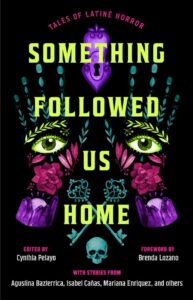
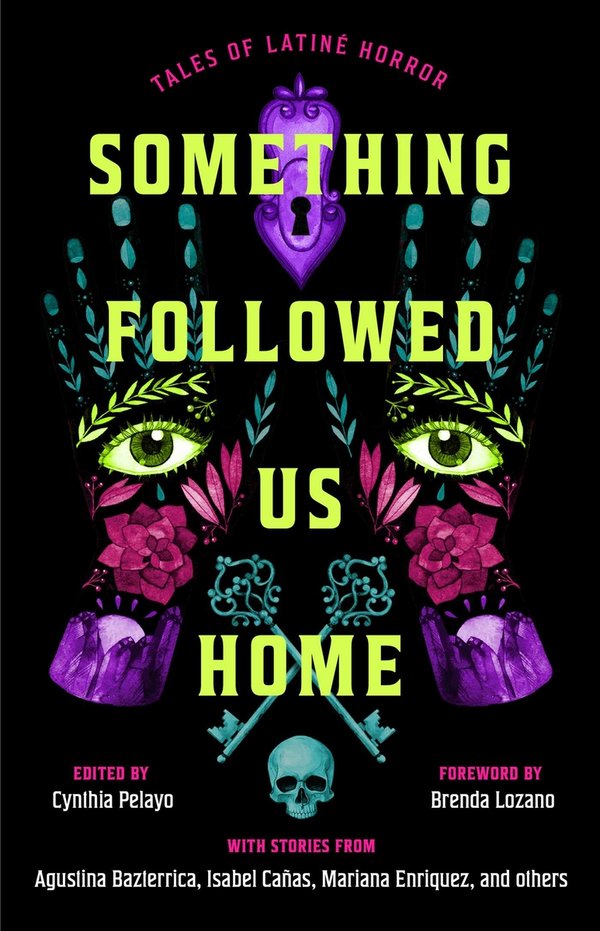
Excerpted from SOMETHING FOLLOWED US HOME: Tales of Latiné Horror
© 2026 edited by Cynthia Pelayo. Reprinted with permission from {Primero Sueño Press, an imprint of Simon & Schuster}. All rights reserved.