The 96-Year-Old Murder Mystery Film With an All-Dog Cast That Just Broke the Internet
MGM's "Who Killed Rover" is back in the conversation... but reminds us about an era before animal protections in Hollywood.
I can’t tell you how many people have contacted me, in the past few days, asking if it’s true that, in the 1930s, there was a silent film about dogs solving a murder mystery. In this age of AI, it’s possible to generate a film and claim it’s old—and if people like to fake anything, it’s cute animal videos. News of the existence of this film went viral this week, and obviously people were thrilled, because it is a silent film about dogs solving a murder mystery. Based on this description, if you don’t want to watch that, I don’t know what’s wrong with you. Indeed, just about everyone I know did want to watch that… and wanted verification that it’s not an AI prank.
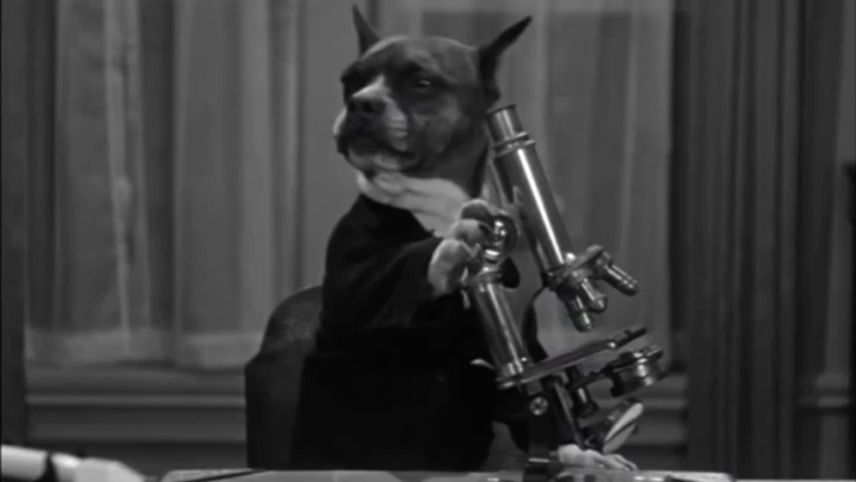
I can assure you… it’s real. MGM produced a series of shorts called “Dogville Comedies” from 1929 to 1931, all parodies of popular contemporary features. There were nine, and they were all directed by Zion Myers and Jules White (who later collaborated on The Three Stooges shorts). The murder mystery is called Who Killed Rover? (with the subtitle “The Dogville Murder Case”), and it was the third in the series, released in 1930.
For those interested, the series goes as follows:
- College Hounds (1929) a parody of the college sports movie Brown of Harvard
- Hot Dog (1929): a parody of the legal drama Madame X (1929)
- Who Killed Rover?: The Dogville Murder Case (1930): a parody of The Canary Murder Case (1929)
- The Dogway Melody (1930): a parody of the musical The Broadway Melody (1929)
- The Big Dog House (1930): a parody of the prison film The Big House (1930)
- So Quiet on the Canine Front (1931): a parody of All Quiet on the Western Front (1930)
- Love-Tails of Morocco: a parody of Morocco (1930), which is about the French-Foreign legion
- The Two Barks Brothers: a parody of Gentleman’s Fate (1931)
- Trader Hound: a parody of the adventure film Trader Horn (1931)
Who Killed Rover? is inspired by a detective very familiar to readers of this site: Philo Vance. (The dog detective’s name is “Phido Vance.”) The plot is about a
The special effects are truly incredible… though it is important to remember that this film was made during an era where there were no animal protections in Hollywood… and there wouldn’t be for decades. In the 1925 epic Ben-Hur, more than one hundred horses were killed to film the chariot-racing scene. In 1936, to film the pivotal charge scene at the Battle of Balaclava in the film Charge of the Light Brigade, 125 horses were tripped with tripwires, leading to the deaths (including euthanizations) of several. In his autobiography My Wicked, Wicked Ways, actor Errol Flynn (who had starred in the film) wrote, “As for the treatment of the horses in this film, I myself complained to the Society for the Prevention of Cruelty to Animals.”
And in the 1939 film Jesse James, a horse was tricked into running off a cliff. According to The LA Times, the scene involves a “thundering chase in which Tyrone Power as the outlaw James was pursued by a posse on horseback to the edge of a cliff. There, James and his horse made a daring leap to freedom. To shoot the scene, a stunt man raced the blindfolded horse onto a sloping greased platform rigged to tilt and plunge horse and rider to the water below. The stunt man, knowing what to expect, survived. The horse fell to its death.”
After this, the American Humane Association (AHA) opened an office in Hollywood and teamed up with Will Hays, who ran the Production Code that prohibited certain experiences (sex and violence) from being included onscreen. Slowly, animal protections increased… but still, even to this day, the phrase “no animals were harmed during the making of this picture,” only refers to the events that happen during filming, not including other moments on set in between takes, or off-site at the facilities where they sleep and eat. And although animal protection monitors are present on sets, it is their subjective judgements and willingness to report incidents that ultimately control the fate of the animals being forced to work, which means animal protections to vary from set to set.
For example, while making the 2012 film The Life of Pi, the Bengal tiger (named King) used for the film nearly drowned while being made to swim in the water tank—an accident that the AHA representative monitoring the set attempted to cover up. In leaked emails found during an extensive investigation into animal cruelty in Hollywood by The Hollywood Reporter, the AHA representative Gina Johnson (who was allegedly in a relationship with one of the producers of the film), wrote “Last week we almost fucking killed King in the water tank. This one take with him went really bad and he got lost trying to swim to the side. Damn near drowned.” She added: “I think this goes without saying but don’t mention it to anyone, especially the office! I have downplayed the fuck out of it.” Evidently, the AHA became aware of Johnson’s email, but still allowed the film to include the “no animals were harmed…” certification. In 2015, a leaked video from the set of A Dog’s Purpose shows a terrified German shepherd (named Hercules) thrashing while he is being shoved into water by a handler, while a voice can be heard urging the handler to “throw him in,” prompting an investigation into possible animal abuse on set.
My point is, there is a very long history of forcing animals into exhausting, dangerous, abusive, and life-threatening situations for the sake of a film, or even a single shot. So, when you watch a charming-seeming film from 1930 like Who Killed Rover?, featuring dogs wearing clothes, working hard to do tricks and stunts, being fed sticky or spicy substances to get them to move their mouths to create the appearance of “talking,” and often made to walk on two legs while being held up by piano wire, it’s important to watch with the awareness that it was made in an era that unfairly treated animals as props and puppets, and these are things that should not be repeated today, under no circumstances. In most of the scenes, the dogs appear nervous or fearful… very few have wagging tails and visibly happy body-language. In some scenes, for example, a clearly-afraid dachshund is dragged on a leash, while, in another, a terrier is “tied up” on a chair and has a gag in his mouth, tied back around his head. In 1931, in the UK, The Performing and Captive Animals’ Defense League protested the Dogville Comedies for animal cruelty, convincing the British Board of Film Censors to ban some of the shorts in the series. The series ended after the jungle-set Trader Hound, in which some of the characters turn to cannibalism (not literally, but on the level of narrative), which attracted further protests.
I’d like to add that narratively speaking, Who Killed Rover? is rather… sad? Unsurprisingly, it turns out that, even if the film were made completely ethically, it’s a real bummer to watch a dog play a murder victim in a whodunnit? And, I’m sorry to say, Phido Vance isn’t a very good detective. (I will say, the Nosferatu-esque “claws” of one of the “bad dogs,” which are clearly fake, are hysterical.)

Olivia Rutigliano
Olivia Rutigliano is an Editor at Lit Hub and CrimeReads. Her other work appears in Vanity Fair, Vulture, Lapham's Quarterly, AirMail, the Los Angeles Review of Books, Public Books, The Baffler, Bright Wall/Dark Room, Politics/Letters, The Toast, Truly Adventurous, and elsewhere. She has a PhD from the departments of English/comparative literature and theatre at Columbia University, where she was the Marion E. Ponsford fellow. She hosts the podcasst "Culture Schlock" at Lit Hub Radio. She is on instagram at @oldebean, twitter at @oldrutigliano, and bluesky at @oliviarutigliano.bsky.social.