
The Darker Side of Burbank, California
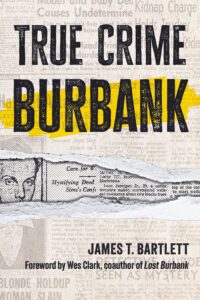
In a new book, James T. Bartlett offers up a true crime history of the seemingly idyllic city.
Burbank, California, is a small city, but it has some notable long-term residents. Warner Bros and Walt Disney have their studios here, and Universal Studios is a very close neighbor.
Johnny Carson filmed The Tonight Show at Burbank’s NBC Studios for 20 years, and though the phrase “Beautiful Downtown Burbank” was first coined on Rowan & Martin’s Laugh-In, which also shot at NBC, it was Carson who made it famous across America.
In short, Burbank was the affectionate butt of a joke. Over the hill from Hollywood in the super-hot San Fernando Valley, it was seen as a safe suburban area with a few quirky stores, diners and homes, but little else to get excited – or scared – about.
When I began research for True Crime Burbank, I wondered if I would be able to fill the pages. It didn’t seem like the kind of place where serial killers roamed, nor where women murdered their husbands and became a media sensation.
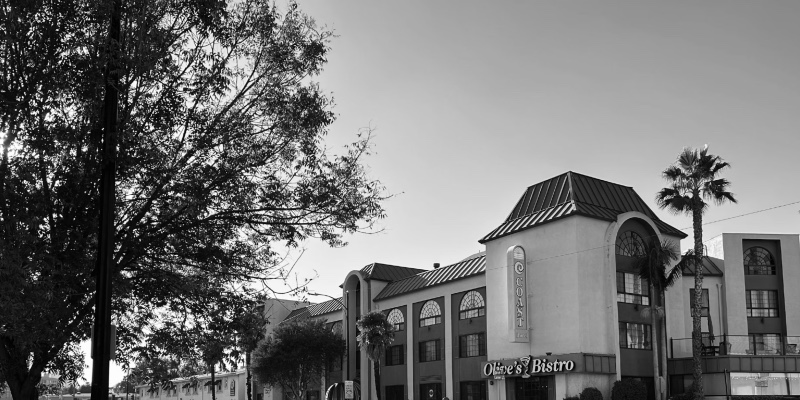
No, that kind of deadly drama was created behind the studio gates, not on the quiet leafy streets, and so on the night of March 24, 1934, residents in a building near the Warner Bros. studio barely paid attention to the sound of gunshots. Doubtless the crime comedy Midnight Alibi was just filming late.
But in one of the apartments, several bullets had been fired into Eric Madison by his angry wife Nellie. She left a “Do Not Disturb” note on the door and fled the scene – straight onto the front pages of the scandal-hungry Times and Herald and Express, two of the biggest competitors among Los Angeles’ many newspapers.
They nicknamed her “The Sphinx”, and she was found guilty of murder and sentenced to death. Nellie didn’t help herself at trial, claiming that the dead man she buried wasn’t her husband, but because the public became aware of the domestic abuse she had suffered – something of an unknown term at the time, and not considered part of an investigation – she escaped the noose.
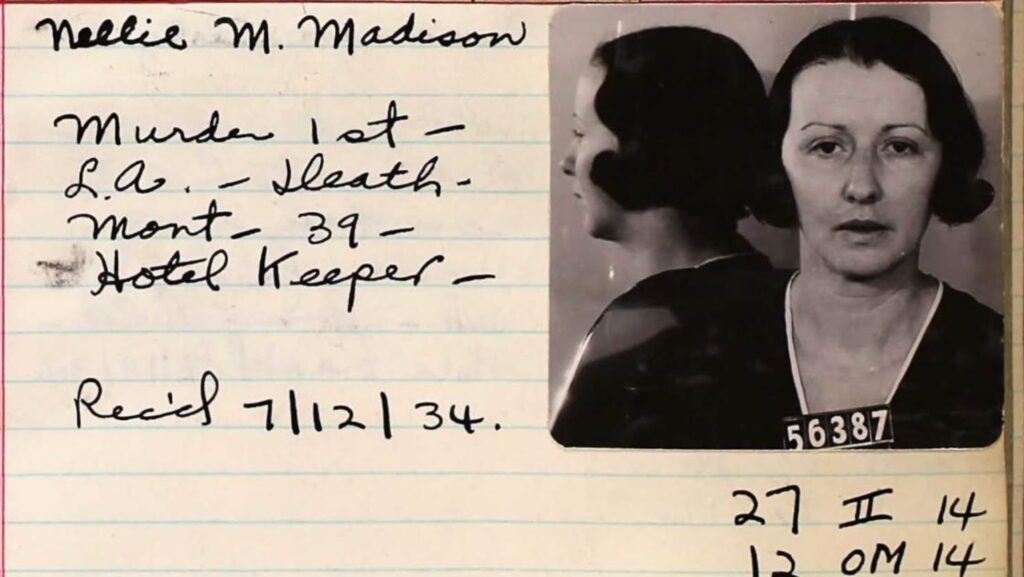 Nellie Madison’s prison record noting her death sentence in 1934. California State Archives.
After serving eight years Nellie disappeared into obscurity, but her trial had a lasting effect on future law – and it happened in Burbank.
Nearly 25 years later, a successful jazz-tinged movie was made about the attractive and outspoken Barbara Graham, one of a gang charged with the robbery/murder of elderly Mable Monohan at her home in Burbank in March 1953.
The trial revealed that “Bloody Babs” and her co-defendants met at the Smoke House in Burbank to plan their home invasion, and she was sentenced to death alongside two of her collaborators.
All the accused – and the fourth gang member, who sang like a canary – blamed each other, and it was a hugely controversial case.
Graham’s previous petty crimes paled against those of her co-accused, all of whom were career criminals, and as with Nellie Madison, the public still believed that violence wasn’t in a woman’s nature. Even if they committed murder, they could surely be rehabilitated?
Not so for Graham, as the title of the movie, I Want to Live! made clear.
Directed by Robert Wise, the last sequence of Graham going to her death undoubtedly helped Susan Hayward win 1959’s Best Actress Oscar. The movie was also credited with helping change public attitudes towards the death penalty, and was retold in 1983, with former The Bionic Woman star Lindsay Wagner in the lead role.
A couple of years before the Monohan murder, the Smoke House had already been a background extra in an infamous gangster massacre that happened over the hill in Hollywood. Tony Brancato and Tony Trombino – the “Two Tony’s” – were gunned down in their car, and Jimmy “The Weasel” Fratianno and Charley Battaglia were charged with the crime.
The duo insisted they were having dinner there at the time of the murder, and though server Mildred Blue bravely testified this wasn’t the case, the trial conveniently collapsed. It wasn’t until years later that Fratianno, then in Witness Protection, admitted he was indeed the gunman.
Years later, Grant Heslov and actor George Clooney named their production company after the Smoke House – they loved the food at this now-old school joint. Maybe not so much its criminal past. But who knows?
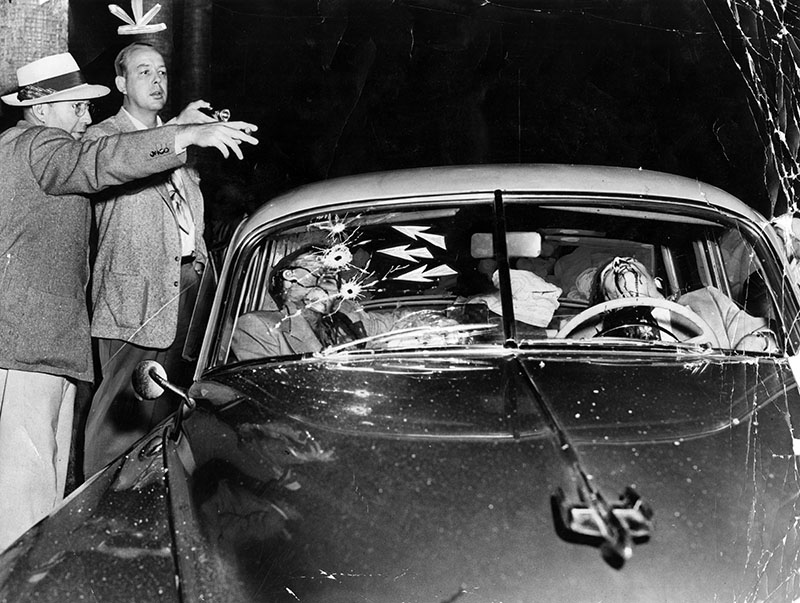 Two Tonys – the gangsters shot by Jimmy “The Weasel” Fratiano, who (lied) that he was having dinner at the Smoke House at the time
In the 1970s and 1980s, Burbank suffered like many other parts of California when it became the hunting ground for duos like the Toolbox Killers and Sunset Strip Killers, and lone wolves like “Dating Game” killer Rodney Alcala. He was the villain in the story Woman of the Hour, a 2024 movie directed by and starring Anna Kendrick. “Night Stalker” Richard Ramirez terrorized a victim here too.
Of course, Burbank has had plenty of “everyday” crimes: family arguments that turned fatal, kidnappings, drug busts, robberies, and the slayings of private eyes, detectives and secret gamblers. I also wanted to shine a light on some of the forgotten or unsolved crimes that happened over the decades.
In the introduction to the book, Burbank-raised author and historian Wes Clark describes Burbank as a kind of “Mayberry”, a reference to the idyllic small-town life of The Andy Griffith Show. Historically Burbank does have a low crime rate, but it’s always interesting to step into the shadows and examine your neighborhood archives: you never know what you might find.

James T. Bartlett
James T. Bartlett is currently researching “Bud” Bodell’s life and career. His Anthony Award-nominated book The Alaskan Blonde can be found on Amazon, with more details of the crime and the investigation at www.thealaskanblonde.com