Why this Film: Mad Max: Fury Road is, for the most part, one long chase sequence. There’s a reason why, right from its earliest days, cinema has been obsessed by chases—whether on foot or via other modes of transportation: because they work! The chase format generates suspense and tension, and provides a structure on which to build character, backstory, and an entire world, without having to sacrifice forward momentum. It also creates a natural story arc—will the pursuer catch his target?
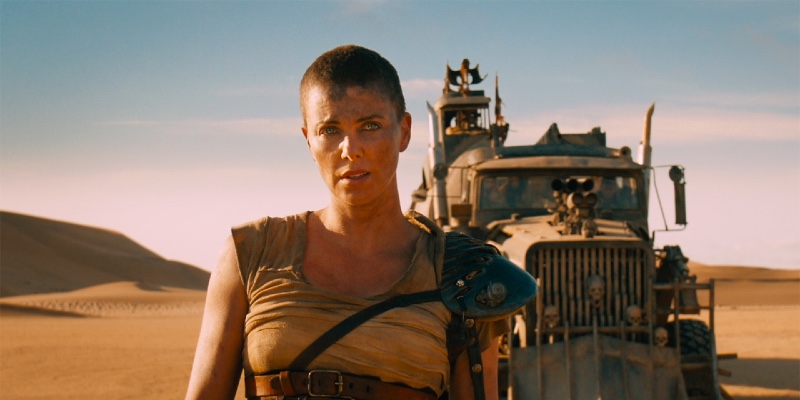
In Fury Road, set in a post-apocalyptic future, the tyrant Immortan Joe (Hugh Keays-Byrne) controls the water supply for a swathe of oppressed people. He orders his one-armed Imperator Furiosa (Charlize Theron) to trade water for gasoline and other supplies. She drives off in her “war rig” – but takes Joe’s wives/breeders along with her in order to lead them to freedom. When Joe realizes what’s going on, he assembles his troops, and the no-holds-barred chase through the desert begins.
What’s brilliant about the movie is how efficiently it builds characters and how all the Jerry-rigged vehicles and weaponry used in the chase contribute to the world-building of this harsh future. The action never stops to explain the politics or the people to the viewer—you pick up information about them through the action, through their names, and their costumes. Every little detail adds a layer.
Costume designer, Jenny Beavens explains: “All costume is storytelling so the Wives were kept in a bubble and needed little in the way of clothing. Immortan Joe needed protection for his rotting skin but also needed to look like a powerful Dictator, Furiosa is a woman in a man’s world – a skilled engineer and driver of the War Rig, so needed a practical outfit that would support the harness that held her false arm in place.”
The music played by a manic musician hoisted to the front of one of the rigs ratchets up the pace and tension. The film was shot in the Namibian dessert which adds a level of ferocity and realism to the action. And then there’s Theron’s Furiosa. (Mad Max—Tom Hardy—seems like a secondary character here.) She’s tough, she has a backstory, but she’s not sentimental, and she doesn’t say much, nor does she lean on the men for support. And she still feels believable. She’s the glue that holds the movie together.
What they said: In an interview, George Miller explained his fascination with movies that are purely visual: “So with the first Mad Max (1979) I basically wanted to make a silent movie. With sound. The kind of movie that Hitchcock would say, ‘They didn’t have to read the subtitles in Japan’… Because for me, once I got interested in cinema as moving pictures, I went back to the silent era. And I was particularly struck by the films of Buster Keaton and Harold Lloyd and those kind of very kinetic action montage movies that they made… And basically I saw the action movie, particularly the car action movie, as an extension of that… I call them ‘pure cinema.’”
Written by George Miller, Brendan McCarthy, and Nick Lathouris. Directed by George Miller. With Tom Hardy, Charlize Theron, Nicholas Hoult, and Hugh Keays-Byrne. 120 minutes.
Streaming on multiple platforms.

Radha Vatsal
Radha Vatsal is the Film/TV Columnist for CrimeReads. She is the author of No. 10 Doyers Street and the Kitty Weeks mysteries, and her essays have appeared in the The New York Times, The Atlantic, the Los Angeles Review of Books, and elsewhere. She holds a Ph.D. in Film History from Duke University. You can find her on Instagram or email: rvatsal@lithub.com