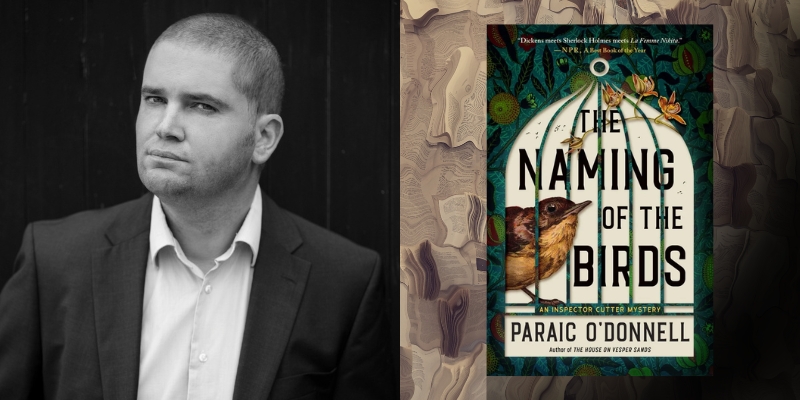
Who Cares Whodunit: Paraic O'Donnell on What Matters More Than Revealing a Story's Killer
The author of The Naming of the Birds explains why crime fiction should focus less on endings
I’m going to start with a confession.
I’ve read quite a few crime novels in my time. Not as many as some, I’m sure, since I get around quite a bit among other genres. Somewhere in the hundreds, let’s say. And since I’m not one to persist with a book if I’m not feeling it, I’m pretty sure I enjoyed most of those. I know I could list dozens that I straight-up adored.
Here’s the thing, though. In many cases, I struggle to recall how those novels ended.
More precisely—and this clarification may not help my case much—I struggle to recall what their endings revealed. What I often fail to remember, in other words, are little details like, I dunno, who the killer was.
This does count as a shocking admission, doesn’t it? It’s not just me, right? It’s certainly something I hesitated to reveal publicly, especially to this particular audience.
This is CrimeReads, after all, a publication devoted to crime fiction and consulted by its most discerning fans. It’s true, of course, that crime fiction encompasses a rich diversity of form and style. It’s true, too, that crime is not synonymous with mystery, and that even among mystery novels, the conventions of the whodunit are not always slavishly observed.
Still, it’s hard to escape the sense that for fans of crime fiction, however sophisticated their palates, plot remains highly prized and the ending is something close to a defining feature.
Other genres may grant more laxity: In literary fiction, if you otherwise bring the goods, you can skate or sashay over the line pretty much any old how. But in crime, there are certain expectations. The central mystery need not take the form of a body in a library, but some vital question must remain unanswered as the pages thin out. This answer, likewise, need not be magniloquently delivered before the drawing room fireplace, but in some form it must be delivered.
In crime fiction, in other words, the ending is in some sense the entire point. By failing to remember it, then, am I not missing that point? Am I not demonstrating that I lack the intellectual rigour, the tenacity of mind, the basic equipment that the genre demands? And if I’m not cut out for crime novels, why do I persist in reading them?
More pressingly, perhaps, what on earth am I doing writing them?
On that last point, at least, I can offer some reassurances. Writing demands entirely different forms of concentration to reading. It lasts much longer, too, and is both more deeply immersive and more exhaustingly iterative. Trust me, there’s a lot that I’d like to forget about my own fiction, but the nature of the process makes it impossible.
When it comes to reading, too, the phenomenon I’m describing does have certain nuances. I should first make clear that I don’t disregard plots and endings entirely. I’m as susceptible as anyone else to the compulsive effects of skilled storytelling, and to the ancient and childlike delight of turning pages simply to find out what happens. I should clarify, too, that I don’t forget the ending immediately. I can process a novel’s final revelations just fine and retain them for long enough to hold a sensible conversation afterwards, or even write a reliable review. Seriously, there are receipts on this.
A year later, though, even when a crime novel makes an otherwise lasting impression, such key particulars may well have faded. Some examples might help here. As I write this piece, I happen to be reading Broken Harbor by Tana French, which for a number of reasons forms an ideal case in point.
First, as crime writers go, French is among my S-tier favorites, and I this is for me among her most accomplished and affecting novels. Also, and most tellingly, I have read it before, and not just once but twice. Yet even now, eighty-odd pages in to this second reread of a cherished favourite, I sincerely cannot recollect who the killer is.
This is inescapably weird, even by the most inclusive and compassionate standards. What makes it weirder still is that I remember almost everything else. The characters remain vividly present, for a start. As ever, French draws these with minimal fuss and uncanny precision, and her first-person voicing of Detective Michael “Scorcher” Kennedy is a masterclass: all note-perfect machismo and insidious self-outing. Even that nickname is doing all kinds of subtle work.
But what makes the novel truly indelible, at least for me, is its utterly haunting sense of place. Ireland’s ghost estates were a product of its Celtic Tiger headrush and the calamitous financial hangover that followed.
Lavishly marketed and shabbily constructed, many were abandoned unfinished, leaving their few residents—young and hopeful couples, for the most part — to pick through literal ruins whenever they left the house. Much has since been written about these places, but none of it evokes their liminal desolation (their air of “strafed hope,” as French exquisitely puts it) quite as perfectly as this baleful jewel of a novel.
I have returned often, too, to Lee Child’s Reacher novels, and for somewhat similar reasons. These hew more closely to the traditions of the thriller than of the procedural, but they are nothing if not event-laden and their eighteen-wheeler plots certainly don’t lack for momentum. I’m entirely here for these attractions, but — and I say this as the most ardent of fans — they would not in themselves stand up to repeated readings.
So, what does draw me back? When I interviewed Lee Child for this publication, I suggested half-jokingly that, having passed the fictional torch to his brother Andrew, he might turn his hand to travel writing. Joking aside, I was quite sincere in paying tribute to his skill as a documentarian of American landscapes.
Jack Reacher is among fiction’s best known drifters, allowing him — like his forebears in classic Westerns — to range unhindered over grand vistas towards moral confrontations that loom just as large. But these landscapes, in the Reacher novels, are much more than just archetypal set-dressing.
As the big guy criss-crosses the South, the Mountain West and the Heartlands, what captures his attention are not the painterly elements of landscape — the sunsets and skylines — but the minutiae of the built environment. He is, like Lee Child himself, endlessly attentive to the fabric of the modern world, from the arcane grammar of Interstate signage to the rich semiotics of exurban strip malls.
These fine nuances—of lighting, of color, of typography—are fascinating in themselves, but they are also the means by which Reacher navigates, guiding him to welcoming diners, to good-enough motels, to bars with the right kind of bigmouth or stash houses with the right kind of fourth-hand Glock. They form the fine texture of life itself, in other words, and like life itself their appeal never gets old.
As a reader, you might conclude, my problem is that I’m pathologically distractable. That may well be true, and it would certainly be consistent with the rest of my failings. At events and social gatherings of all kinds, to explain the problem in cinematic terms, I persistently neglect the principal action in favor of the nuances of language, the subtleties of performance, the framing, the composition, the score, the color palette, and sometimes—sure, I’ll cop to it—just the straight-up vibes.
What I would argue, though, is that in fiction as in related art forms, it is in this complex tissue of seemingly extraneous elements that individual artistry is most distinctly evident. Just look at Shakespeare. As an early specimen of crime fiction, it’s hard to make much of a case for Hamlet. Sure, it has a body count to rival the Red Wedding, but the killer gets fingered in the first act and Hamlet himself — though gifted in both self-talk and self-sabotage — lacks any aptitude as an investigator.
I bring up this example because, as with all of Shakespeare’s major works, the plot of Hamlet—the pillars and struts of its narrative infrastructure—were borrowed without compunction from earlier sources to be wheeled out and thoroughly refitted. This was a common and unremarkable practice, and it has never detracted in the smallest degree from the majesty of the plays.
Their “plots” barely matter anyway, beyond a few thematically central contours. I’ve read and seen Hamlet dozens of times since my schooldays, and I still can’t keep the sequence and circumstances of all the deaths straight. That’s because the circumstances are in some cases downright ludicrous and in others simply immaterial to the dramatic experience.
It’s certainly possible to exhibit genius in plotting alone—Elmore Leonard arguably did so, though he was other kinds of genius too — but that doesn’t change the fact that plots are the most fungible and commoditized of literary materials. And this in turn reflects a deep truth about how art represents our nature as humans. It offers one possible explanation, too, for my peculiar habits of mind.
However rarefied our sensibilities, our attention mechanisms have been shaped by the long millennia of our animal existence, and throughout the vast preponderance of evolutionary time that existence has been an unremitting cycle of need and pursuit, of one damn thing after another.
These are the pulses and cadences for which our faculties and senses were honed, and like our music our stories must echo these rhythms.
And then, and then, and then, and then, and then.
To hold our gaze, our fictions must sate these instincts with an unceasing procession of events. To delight us, though, and to endure beyond itself, it must linger on the magical in-between, on the excess beyond the necessary and on the endless superfluity of what is beautiful and strange.
***
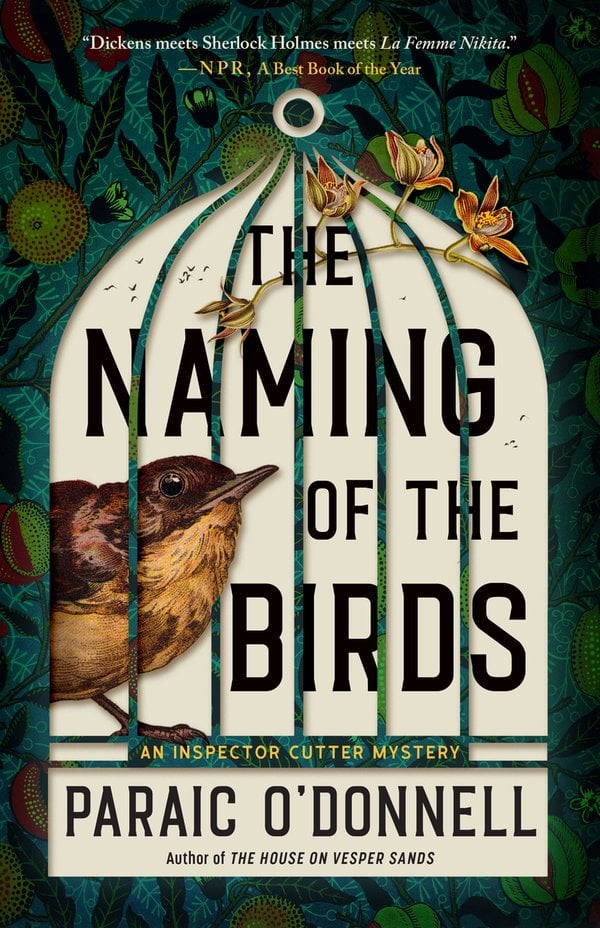
Paraic O’Donnell is the author most recently of the historical crime fiction novel The Naming of the Birds (Tin House/Zando), out now in paperback.

Paraic O'Donnell
Paraic O'Donnell's essays and reviews have appeared in the Guardian, the Spectator, the Irish Times, and elsewhere. His first novel, The Maker of Swans, was named the Amazon Rising Stars Debut and was shortlisted for the Bord Gáis Energy Irish Book Awards. His latest novel is The Naming of the Birds