
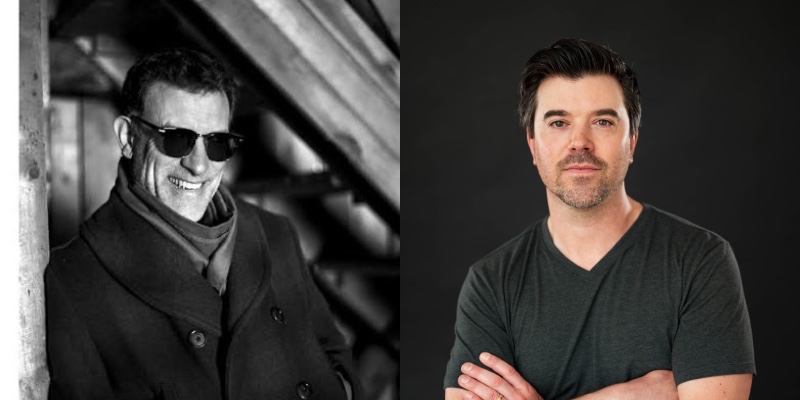
Beau L’Amour and Ryan Pote Discuss a Long Legacy of Thrillers
A conversation between the authors of the new thrillers, 'Skyring Water' and 'The Ghost City'
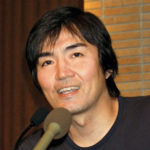
Beau L’Amour is a writer, art director, and editor. He has written and produced several films, including USA Network’s The Diamond of Jeru. Since 1988 he has been the manager of the estate of his father, Louis L’Amour.
Ryan Pote is a twelve-year veteran Navy helicopter pilot who was part of a joint interagency special operations task force deployed throughout Central and South America combating drug cartels and transnational criminal organizations. After being medically separated, he investigated prototype aircraft development programs for six years with the Department of Defense. Before the Navy, he lived and worked in Hawaii as a SCUBA diving instructor and a lab assistant conducting microbiological research for Shell Oil. He has a masters degree in History and lives with his wife and kids in Maine.
Their new books are Skyring Water (L’Amour) and The Ghost City (Pote).
Ryan: Skyring Water feels like a true collaboration across time between you and your father. How much of the novel had Louis actually completed before his passing, and what was the process like for you to bring it to its final form? Were there particular challenges—or moments of discovery—in finishing a story he began?
Beau: Dad wrote an entire draft, about 250 pages, in 1960. It was pretty rough and he never liked it enough to revise it, although I tried to push him to do it in the late 1980s. The plot of those 250 pages is somewhat equivalent to the last third of the new version of the novel. Its main weakness was a lack of characterization, so picking up the stream of the narrative earlier and building out the characters, some of them new, solved a lot of problems … and steered the plot in new and sometimes surprising directions. I did have a general idea of everything I wanted to do before I started writing but the journey of getting there was quite an adventure!
Ryan: While your father is best known for his iconic Westerns, Skyring Water sits closer in spirit to the shorter adventure tales he published over the years. What do you believe was his goal with this story, and what drew you to publishing it now as a full-length novel? What do you hope readers take away from this different side of his storytelling?
Beau: Dad started his career writing “High Adventure” short stories in the 1930s, but he made his name writing westerns in the ‘50s and ‘60s. He always wanted to be able to succeed at writing all different genres and, in the late ‘50s, gave it a shot. That attempt failed but, finally, toward the end of his life he was able to sell other types of material … I see Skyring Water as a continuation of that effort, fulfilling dad’s dreams.
Ryan: Are there other unfinished standalone ideas, fragments, or previously published short stories from your father’s archives that you’d love to see expanded into full-length novels? And looking ahead, do you plan to continue developing new work under the L’Amour estate name, or is Skyring Water the final chapter in this remarkable, multi-generational storytelling journey?
Beau: There are a number of unfinished stories I’d love to dive into. But I’m a slow writer so I have to be sure that anything I choose to take on is worth the time it would take. That means the goal is not to flood the market with quickly dashed off L’Amour novels. My next project will almost certainly be a formal biography of my father, probably in two volumes. All other plans will have to wait until that is complete.
Beau: The Ghost City functions both as a stand-alone episode and as a part of what will no doubt be a greater series. Theoretically, that means you can keep going as long as you want, or stop at any point … but, have you got an end point in mind? Are you aiming at an over all trajectory or is that an evolving part of the plan?
Ryan: I spent a lot of time deliberating the trajectory of the series. Two points make a straight line, so it’s really the second book that sets the tone going forward. For a sequel to a debut, in a series, it’s very easy to churn out the exact same book dropped in a new location. But I didn’t want to do that at all. I wanted to try and capture the exact same experience readers had from Blood and Treasure but try and make the book as different and unique as possible. In doing that, I can claim the space between both the books to drop a future installment anywhere I want—in terms of genre, plot, and structure. If book 1 is in right field, then book 2 is in left field.
Beau: I tend to attack the creation of characters from a number of directions, the needs of the story, people I have known, ideas I have in the middle of the night … so how do you do it? You are slowly revealing new layers and adding players to your series. How do your characters become who they are .. and who they will be in the future?
Ryan: I come up with the plot for the story first, then decide how best to tell it. From that, I know what scenes I’ll need and the characters are generated based on that. I only create characters that are essential to tell the story I want to tell and try not to create any more than necessary. For the second novel, I didn’t want it to be a consistent gang drama, so I wanted to show readers that some major characters can fade and become minor. Some minor characters can become co-leads. New characters can emerge and develop more of the world. Whatever I need to serve the story. The characters each start out with someone in mind that I know or have worked with in real life, then they quickly become their own person once I start writing their dialogue. I love to find out who they are as I go. For The Ghost City, the reader gets acquainted with the villain, Shan Zhang, early on. I was able to do this because I structured the plot around a core mystery with many twists—which allowed me to have the villain front and center with a big sign that says, “I’m the villain”, and there was freedom in that to have fun with him in ways I couldn’t do in Blood and Treasure.
Beau: Like Cussler and Crichton you weave science, alternative history, and ancient myth into your plots. Is it fact or fantasy that sets you off down the story rabbit hole? How do you juggle research versus the creative tissue of the narrative itself?
Ryan: The entire world is fantasy, but every story always starts with facts. A lot of them. I find as many details as possible, even ones that only loosely align, then I use fiction to properly knit them plausibly together to form the fabric of the story that feels lived-in and real. Sir Arthur Conan Doyle was meticulous about his research for Sherlock Holmes novels, yet he never let facts override drama. I follow that logic and aim to serve the reader and the story first and foremost. To do that, I use what historians call “surface” research to get the basics, then I come up with the story. Only after I have a working plot to my story do I dive into research. That’s when I know what I need to find out, and in how much detail. And what I need to figure out to make the logic work. Whether the knitting will be done by fact through research, or fiction through craft. I strongly feel that the way you intend to present the story to the reader, how you design and structure the narrative, should inform the research—not the other way around. But, in summary: I do a hell of a lot of research. I just do it efficiently and waste nothing. Especially my time.

Beau L'Amour
Beau L’Amour is a writer, art director, and editor. He has written and produced several films, including USA Network’s The Diamond of Jeru. Since 1988 he has been the manager of the estate of his father, Louis L’Amour.