
Counting Down the Greatest Crime Films of All-Time: #20
The Conversation (1974)
Otto Penzler ranks, analyzes, & celebrates the 106 greatest crime films of all-time. Catch up on the series and find new installments daily here.
__________________________________
The Conversation (1974)
__________________________________
TYPE OF FILM: Crime
STUDIO: Paramount
PRODUCER: Francis Ford Coppola
DIRECTOR: Francis Ford Coppola
SCREENWRITER: Francis Ford Coppola
SOURCE: Original
RUNNING TIME: 113 minutes
PRINCIPAL PLAYERS:
Gene Hackman…………………………………….……………………………………Harry Caul
John Cazale………………………………………………………………………………….…Stan
Allen Garfield……………………………………………………………………..…Bernie Moran
Frederick Forrest………………………………………………………………………………Mark
Cindy Williams…………………………………………………………………………………Ann
Harrison Ford…………………………………………………………………………..Martin Stett
Michael Higgins………………………………………………………………………………..Paul
Elizabeth MacRae……………………………………………………………..………….Meredith
Teri Garr……………………………………………………………………………………….Amy
__________________________________
DID YOU KNOW?
__________________________________
Although one of the most brilliantly conceived and executed crime stories ever to reach the screen, The Conversation was poorly promoted, and released as if it were protected by the Official Secrets Act and so was not a big box-office success. The chosen few who actually got to see it became devotees because of its sophisticated demonstration of bugging and surveillance techniques that came just at the height of interest in the bungled Watergate break-in and Richard Nixon’s secret tapes. While many people then assumed that the film was inspired by those events, in fact Francis Ford Coppola had written the screenplay many years earlier and production had already begun when the inept burglary took place. The film failed to earn back its cost.
__________________________________
THE STORY
__________________________________
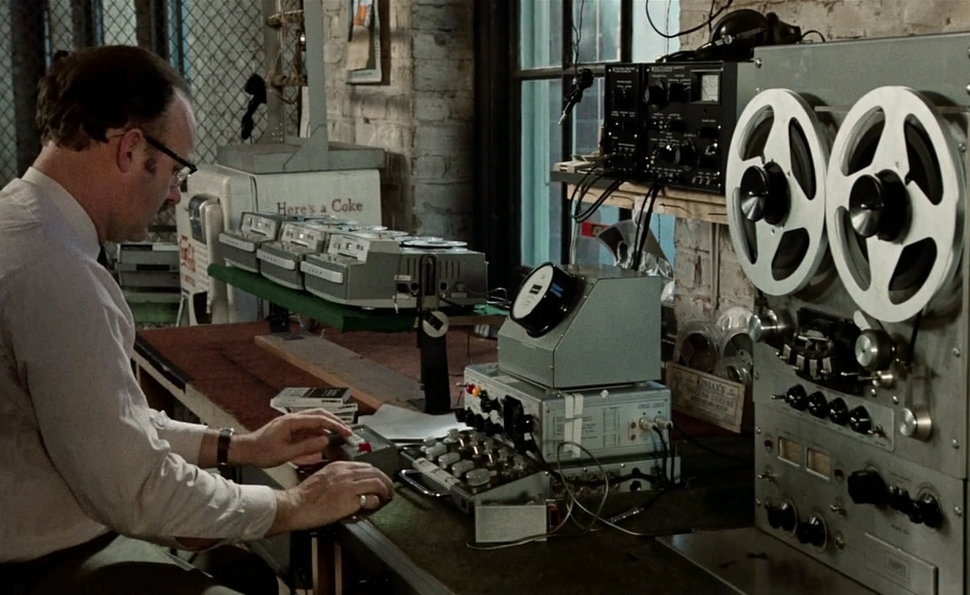
Harry Caul is a professional industrial spy who sells his services to anyone who wants them. With the help of his hired hands, he tracks a young couple, Mark and Anne, and gets photographs and audio tapes of their clandestine meetings for a man he doesn’t really know, “the Director” of a secret company. The tapes, gathered using highly powerful shotgun microphones among other sophisticated techniques, are cleaned up and reveal a murder plot, with the assumed victims to be the young couple because the woman clearly has been guilty of marital infidelity.
Martin Stett, the Director’s assistant, attempts to get the tapes from Harry, who refuses to give them to anyone but the man who hired him, even though Stett assures him that they are working together. When Harry still refuses, a blonde named Meredith seduces him and he wakes up to find the tapes gone—obviously delivered to Stett.
This turn of events is particularly upsetting to Harry, a paranoid with three locks on his door, no listed telephone number, and so protective of his privacy that he alienates those few he allows into his life even superficially, including his girlfriend, Amy, who doesn’t know where he lives, what he does for a living, or how to reach him.
Usually distant, professional, and incurious, Harry becomes guilt-ridden with this job. He is haunted by the sound of the young woman’s laugh and charmed by her innocent-looking face. Feeling sorry for and protective of her, he is convinced that she has been doomed because of the tapes he masterfully produced.
A murder is committed at the place and time anticipated in the lovers’ conversation but they are not the victims. As Harry replays the tape in his mind at the scene of the murder, he realizes that the young couple had not been afraid for their own lives but had been plotting the murder of the young woman’s husband, the Director.
Back in his apartment, Harry gets a telephone call from Stett, saying they know that he knows and to stay uninvolved. “We’ll be listening,” he says. Frantically tearing apart his sparse furniture and even breaking the plaster on the walls and ripping up the floorboards, using all the expertise he’s gained in his career, Harry is still unable to find the bugging device. He finally picks up his saxophone and plays along to jazz records, totally alone and neurotically paralyzed into inaction by the notion that he is being spied on.
***
While there is remarkably little action and virtually no sex or violence in a film about those very subjects, The Conversation moves swiftly in a remarkably suspenseful narrative. Produced, written and directed by Coppola, it was his first film after The Godfather—an enormous departure from the blockbuster in terms of scope and size.
Robert Duvall as the Director has an uncredited cameo.
An Academy Award nomination went to The Conversation for Best Picture. It was named the Best Film at the Cannes Film Festival.
__________________________________
BEST LINE
__________________________________
Late at night, Meredith, a model, stays at Harry’s workshop after a small party. He is uneasy, racked with guilt about the girl he thinks he has sent to her death, troubled by how confused and frightened she sounds. Meredith tries to comfort him, telling him: “Forget it, Harry. It’s only a trick. It’s a job. You’re not supposed to feel anything about it. You’re supposed to do it, that’s all.”

Otto Penzler
Otto Penzler is the founder of The Mysterious Press and The Mysterious Bookshop. He has written and edited several award-winning books and is regarded as the world's foremost authority on crime, mystery and suspense fiction.