
Still Not Safe: The 50th Anniversary of Marathon Man
Fifty years later, the classic thriller still lives in a world of almost unbearable tension.
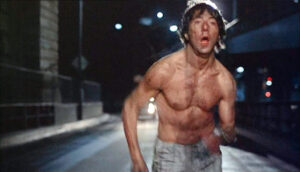
Thomas Babington “Babe” Levy has it rough. He’s poor, single, and lives in a slum. He’s mocked by the street gang on his block. He grinds through long morning runs around the Central Park reservoir, lacking enough stamina to finish the marathon he dreams of winning someday. And while he’s also a gifted doctoral candidate at Columbia, his advisor knows full well that Babe is just following in the footsteps of his father, a famed historian hounded to suicide by the McCarthy hearings.
Babe needn’t chase the past. The past is coming for him, armed with a dental drill.
Fifty years after its release, Marathon Man holds up as one of the most nerve-racking thrillers ever made. Its pedigree is impressive even by the high standard of 1970s cinema. Master screenwriter William Goldman adapted his own novel. Producer Robert Evans, fresh off a stellar run as head of production for Paramount, hired John Schlesinger to direct. Schlesinger had won the directing Oscar for Midnight Cowboy and wanted to take a swing at a property everyone agreed had huge commercial appeal.
Evans claimed that the team got their first choice of actor for every role. That’s a bit of Hollywood exaggeration, but it’s true that the picture has a loaded bench. Dustin Hoffman stars as Babe, supported by Roy Scheider, Marthe Keller, William Devane, and in a performance that would introduce him to a new generation of movie fans, Laurence Olivier. Even the minor roles are filled by character actor royalty: Marc Lawrence (of two James Bond films) and Richard Bright (all three Godfathers) play the film’s lurking heavies.
Despite Hoffman’s heat as a movie star, Olivier was considered the biggest get. The legendary actor had gone into semi-retirement as he battled a variety of serious health issues. Special arrangements had to be made for his insurance. The gamble paid off. Olivier was lauded for his icy, terrifying performance, earning an Oscar nomination and a Golden Globe win.
(Spoilers abound from this point on. It hardly matters. Marathon Man is as much a vibe as a story.)
Two old men, one German, one Jewish American, have a fierce argument one blistering Manhattan afternoon that escalates into road rage and a deadly crash. Fitting, because the movie itself is a violent collision of popular 1970s genres and tropes: the paranoid political thriller, a contemporary fascination with Nazi hunting, revenge movies, and the gritty urban decay of New York City.
The elderly German in the crash was the brother of Christian Szell (Olivier), an infamous Nazi physician and dentist now hiding in Uruguay. The brother’s death forces Szell to enter the United States, in hopes of retrieving a fortune in diamonds that Szell had stolen from victims of the concentration camps. The diamonds, and Szell’s willingness to inform on fellow Nazis to authorities, have long ensured his safety in a precarious agreement with a shadowy US government agency and various couriers. But now, even those thin shreds of trust are gone. Every side is out for itself.
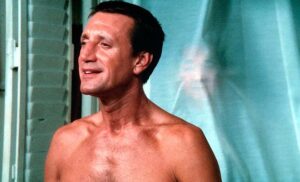
Roy Scheider’s sophisticated covert operative, codenamed Scylla, moves through Paris meeting his contacts. It soon becomes clear that someone is stalking them, eliminating each link in a chain. Scylla barely escapes with his life and his colleague Janeway (Devane) spirits him back to the United States. Scylla’s first stop is the apartment of his younger brother: Babe. Babe has no idea that his beloved brother “Doc” is a spy. But he’s eager to tell Doc all about the one bright spot in his sorry life: a new romance with a Swiss beauty, Elsa (Keller).
Trying to explain the plot further would only lead us into deep, dark holes. Roger Ebert found Marathon Man effective as a thriller, but noted that Babe is “involved in an intrigue so labyrinthine that neither he nor the movie ever quite figures it out.”
A light suspension of disbelief helps on all fronts. Hoffman in his late thirties is tough to swallow as a naive prodigy scholar. The actor was well aware of the hurdle. His intense preparation, including running multiple miles each day, delivered the goods. And Scheider, note-perfect as usual in his acting and physicality, similarly looks too old to have been a child with Hoffman, even though there were only five years between the men in real life.
These are nitpicks, as are any complaints about plot holes. The film just plain works. Schlesinger and Goldman loaded the movie with enough twists to maintain the tension and enough speed to glide over a handful of rough spots. The action scenes are crisp and brutal, with violence verging on giallo. (It might have been even tougher: audience reactions to early screenings prompted Schlesinger to trim the bloodiest bits.)
Through it all, Schlesinger and cinematographer Conrad Hall encourage our paranoia. Shadows swallow characters whole. We catch fleeting glimpses of strangers staring openly at our heroes. The score by Michael Small hints at someone shrieking, far away.
Goldman had won the Academy Award for Butch Cassidy and the Sundance Kid and would soon earn another for All the President’s Men. But writing the screenplay for Marathon Man gave him trouble. Most of his novel takes place in the interior thoughts of the characters. Only one scene proved easy for Goldman to adapt, and it’s the best in the movie. The war criminal Szell must walk through New York’s diamond district, surrounded on all sides by Jewish people. Many of them old enough to have met Szell long ago, in circumstances no one could forget. The farther Szell goes, the more eyes he feels following him…
The production team made great use of locations: The German neighborhood of Yorkville in NYC, Babe’s tenement in Hell’s Kitchen, even a real garbage strike in Paris. Los Angeles provides two key exteriors: a downtown sculpture as a backdrop to a meeting between Doc and a furious Szell, and the LA Arboretum standing in for Uruguay. Sharp-eyed viewers will recognize the watch tower as the same from the TV show Fantasy Island.
Filming was smooth, in that the picture was made on time and on budget. Marathon Man was the first movie released using the new Steadicam technology, a tremendous boon to its many running scenes. And the picture was a box office hit to boot.
Nevertheless, some bad blood lingered. The movie’s ending was rewritten by Robert Towne, fresh off Chinatown and Shampoo. Goldman speculated this may have been Hoffman’s influence, the actor not wanting Babe to be fully responsible for the fates of the film’s villains.
But then, Goldman wasn’t a huge fan of Hoffman. He felt Hoffman’s arguments over character motivation were disruptive and time-wasting, and that Hoffman took out his nervousness by pressuring Olivier to improvise, to the point of making the ailing man pace when he should have been resting. Shakespearean that he was, Olivier also adhered strictly to the text—this no doubt endeared him to Goldman.
Much has been written and repeated about the half-apocryphal story of Olivier rolling his eyes at Hoffman’s method exertions, saying “My dear boy, why don’t you just try acting?” The truth is likely less cutting. Hoffman’s telling is that he had stayed up for days to look haggard—spending some of the time partying at Studio 54, because why not—and that Olivier, who had enjoyed a few wild nights of his own in his heyday, was teasing the younger man. Schlesinger claimed that Olivier said the famous jibe to him, and that Hoffman was so burned out from lack of sleep that his eyes were dead during their first attempt at filming the torture scene.
Both might be true. But it’s clear from behind-the-scenes footage and post-film interviews that whatever the tensions of the production, both Hoffman and Olivier had enormous respect for one another’s talent. Olivier discussed Shakespeare with Hoffman during breaks in the run, and gifted Hoffman with some of his annotated texts after filming wrapped.
We learn just enough of Scylla to wish the character had a film of his own. There’s a line of dialogue hinting at his true relationship with Devane’s “Janey”—easy to miss, perhaps by design. The novel not only makes their affair clear, it uses the reveal as a major hook. Schlesinger was one of the few openly gay directors working (as well as Jewish, like Babe and Doc), and it would have been interesting to see his take on the life of a closeted secret agent.
Devane and Keller occupy opposite corners of intrigue. Janeway is so Ivy League WASP that he appears in one scene in tennis whites—red, white, and blue, to be exact. Can a man so blatantly upstanding be trusted? And Keller, in her American screen debut, is a Swiss actress playing a German pretending to be Swiss, often speaking French while having learned her English lines phonetically. Small wonder that she brings a level of unknowability crucial to Elsa’s allure.
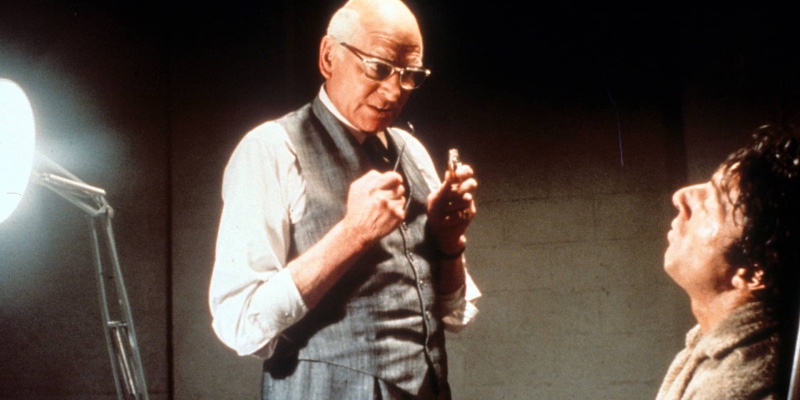
The torture scene. One of the most famous—even dreaded—moments in cinema history, with an all-time quotable line. What sticks on repeated watches is Szell’s calm, almost avuncular manner as he carefully arranges his instruments and repeatedly asks “Is it safe?” without elaboration. The answers he receives are insignificant; the pressure is all. Olivier took his key for Szell’s cruelty from watching a gardener cut roses with delicate and loving precision. In contrast to the rest of the film, there’s not a bit of gore. The scene is more harrowing for it.
Babe, the one who shrinks from confrontation, whose very name invokes helplessness, learns how to win. He first outlasts his pursuers and then attacks them head-on. True to his chosen sport, he accepts pain and even harnesses it. He smashes the bottle of oil of cloves he’s been using to numb his suffering. No longer naïve, Babe hasn’t succumbed to his brother’s jaded world view, either. He’ll take a stand despite his terror.
Critic Pauline Kael loathed the film, calling it Schlesinger’s worst and a “Jewish revenge fantasy”. While that judgment isn’t completely off base, consider how much Babe has lost by the end of the movie: his brother, his girl, his possessions, perhaps even his desire to run. The people he loved most have lied to him and betrayed him. If Marathon Man is a fantasy, it’s a masochistic one.
Goldman wrote a sequel novel, Brothers, in 1986. While it’s enjoyable to revisit some of the characters, the story veers sharply into speculative fiction and if anything is even more downbeat than Marathon Man. It wound up being Goldman’s final book. He said in later interviews that he’d simply “run out of juice”. Perhaps the book and film were two branches of the same lightning strike, not to be repeated.
Had Marathon Man been given to a director of standard action movies, it likely wouldn’t have the critical reputation it does today. Equally, if its producer hadn’t had a razor eye for detail and box office appeal, the film might have faded into art house obscurity. From above-the-title stars to line crew, every element of the production elevated the finished product in a way that rarely happens, especially at the size and scope of major motion pictures. If you’ll pardon mixing sports metaphors, everybody brought their fastball.
That’s why we still enjoy watching the film. But why do we still feel it, as sharply as moviegoers did in 1976?
Marathon Man endures because its core nightmares are timeless: Of being watched, of being trapped and alone. The fear that something malevolent waits in the dark, just out of our sight. And, of course, that terrible dread when we can’t run fast enough in our dream to keep whatever chases after from inexorably closing the distance.

Glen Erik Hamilton
A native of Seattle, Glen Erik Hamilton's novels have won the Anthony, Macavity, and Strand Magazine Critics awards, and been nominated for the Edgar, Barry, and Nero awards. His series featuring semi-reformed thief Van Shaw has been called “outstanding” (Publishers Weekly), “perfect mix of serious crime and caper movie” (Criminal Element), and “a must-read series” (Mystery Scene Magazine). The latest, Island of Thieves, was named one of USA Today's "5 Books Not to Miss". Follow him at glenerikhamilton.com.