Melodrama-Monster-Myth: What Twin Peaks Taught Me about Subverting Genre
"That genre slipperiness is, I think, precisely what keeps the melodrama from feeling tropey and the horror from feeling unmoored."
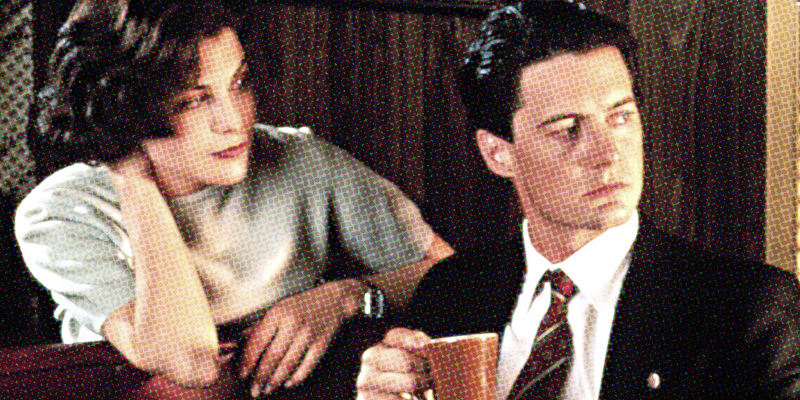
My introduction to Twin Peaks might have been the most seminal media event of my twenties. I watched it with a dear college friend, who told me it was one of her “favorite things,” and this first viewing was mostly about reveling in the show’s weirdness, being fascinated by the Red Room and chilled by Killer BOB and razzing the soap opera silliness of James and Donna, two teenagers in their obvious twenties who could not stop doing teenage things despite the malevolent supernatural presence saturating their town. This show remains one of the most generically layered pieces of media I’ve ever seen—a regionally-specific procedural drama and murder mystery, the first of its kind, with nods to the occult visions of Alistair Crowley. It is tonally bizarre, swerving without warning across comedy, sentimentality, and genuine horror. It’s still a wonder to me that Frost and Lynch were ever allowed to air it on primetime TV in the 90s.
Since that first viewing, I always assumed I enjoyed Twin Peaks despite its melodramatic elements, but a recent rewatch has me changing track on this. I’m not sure why exactly. Lynch passed away last year, and I’m sure my impulse to rewatch came at least partly from a sense of loss. Maybe nostalgia had me all sentimental. Maybe now, James Marshall and Lara Flynn Boyle (she actually was eighteen when the initial pilot was filmed) seem more to me, at forty, like the children they’re meant to represent.
Throughout season one, James and Donna play at being kid detectives, a B-plot alongside the more official designs of Kyle McLachlan’s plucky Agent Cooper, who is investigating the murder of Laura Palmer (Sheryl Lee). But Laura is “full of secrets,” part homecoming queen, part shifting wraith made all the more mysterious by being dead. In one scene, the teens acquire a tape Laura recorded for her therapist. They are then forced to listen to the friend they thought they knew whisper lustily about the adult “mystery man” she was having an affair with.
“I think a couple of times he’s tried to kill me. But guess what…as you know, I sure got off on it.”
The scene is uncomfortable to an almost humorous degree. Puppy-eyed James, who was in love with Laura, is sullen and dumbstruck. Donna, true to character, begins to weep. In this moment, it becomes obvious that these kids, armed with their earnest teen love tropes and suburban living room sensibilities, are completely ill-equipped to be in the story they’re in. Drugs, sex abuse, incest, prostitution, ancient eldritch beings that stalk the woods, owls that are not what they seem. These characters are in dark and uncharted waters, not only in their story, but in their genre. And in that moment, it feels as if they know it in their bones. In season two, when Donna visits Laura’s grave, she dissolves into tears again:
“You’re dead, Laura, but your problems keep hanging around! It’s almost like they didn’t bury you deep enough!”
Film scholar Linda Williams defines melodrama as a “body genre,” characterized by emotional excess, most often exhibited through weeping. She writes about Twin Peaks as a “serial-thriller soap.” Frost and Lynch she refers to as “dark sentimentalists,” which seems like a contradiction. But in the tape scene, and in many others throughout the show, there’s a pathos at work that, though it may be self-aware, is very much sincere. It’s a kind of sentimentality that works with the narrative’s horror rather than against it. That genre slipperiness is, I think, precisely what keeps the melodrama from feeling tropey and the horror from feeling unmoored.
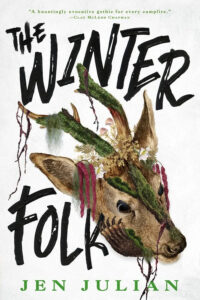
As a visual medium, what Twin Peaks does can’t be fully captured in prose, not in the same way. But as a novelist, I’ve taken its genre lessons to heart. I am fascinated by domestic horror. What wonderful uncanniness there is to find in homey places, in the dark factures beneath family and community. In Red Rabbit Ghost, my young protagonist, Jesse, works his way through a tangle of smalltown secrets—numerous crimes and affairs and power struggles, including the fallout from his own teenage heartbreak—before he finds himself at the edge of a terrifying abyss in a North Carolina swamp. In my newest novel, a Gothic portal fantasy called The Winter Folk, a woman named Moth takes a job at a magic lodge in Appalachia, its supernatural residents ranging anywhere between quirky fae critters to eldritch nightmares. Moth, too, is plagued with a toxic family drama suited for a soap, but she, like me, is always trying to square the mundane with the mythic, her longing for comfort and safety conflicting tragically with her longing for the unknown.
Nowadays, I’ve started to think of genre as a kind of mythology. It’s all our fears and hopes and expectations bound up into narrative patterns that are, if not sacred, at least protected by a cultural inclination toward the known, the containable. We already know the mythology of the small town, the woods, the haunted house. Even a horror story feels nice and cozy when it’s one we already know. To shatter and rearrange genre, therefore, is to create a new mythology. This is what I think Twin Peaks does. I believe stories are most alive when they do that. I feel most alive trying to write stories like that.
***
Works Referenced
“The Last Evening.” Twin Peaks, season 1, episode 8.
“The Man Behind the Glass.” Twin Peaks, season 2, episode 3.
Williams, Linda. “Film Bodies: Gender, Genre, and Excess,” Film Quarterly, Vol. 44, No. 4 (Summer, 1991), pp. 2-13.
—. “Twin Peaks: David Lynch and the Serial-Thriller Soap.” The Contemporary Television Series, edited by Michael Hammond and Lucy Mazdon. Edinburgh University Press, 2005. pp. 37-56.

Jen Julian
Jen Julian's previous publications include a short story collection, Earthly Delights and Other Apocalypses (Press 53, 2018), which was the winner of Press 53's Short Fiction Prize, as well as work in numerous literary journals, most recently a story in Third Coast Magazine, which received distinction in Best American Short Stories 2023. Jen holds a PhD in English from the University of Missouri and an MFA in Fiction from UNC Greensboro. A 2016 Clarion Alumna, she has contributed fiction both to the Sewanee Writers' Conference and the Texas Book Festival. These days, Jen lives in the mountains of North Georgia with her enormous ginger cat and teaches creative writing at Young Harris College.