Who would have thought a turning point in John Grisham’s career would be supporting the losing candidate for speaker of the house in the Mississippi state legislature.
“If my friend had won, I was going to be chairman of the Judiciary Committee, which is a big committee, a lot of work, and it would have sucked all of the energy I had for practicing law,” he says. And at thirty-three, he would have become one of the legislature’s youngest committee chairs in state history and he probably would never have written his second novel, The Firm. His first, A Time to Kill, would have been lost to the ages. Today, the New York Times bestselling author has sold more than 350 million books.
Three years earlier, Grisham had faced a different, more disturbing turning point inside a courtroom observing a trial of a rapist who attacked a young girl and her sister. “Writing was never a dream until it happened when I was thirty years old, and I’d been a lawyer for four or five years,” he says.
“I was in the courtroom all the time. I was trying cases and I had a feel for it. My goal was to be big-time courtroom lawyer. But that’s hard in a small town.” He and his wife, Renee, lived in tiny Southaven, Mississippi.
That’s when he sat on a hard wooden bench in a Mississippi courtroom to observe the rape trial.
“Once she broke down for the last time, the judge said, ‘Let’s break for a recess.’ Everybody fled the courtroom. I couldn’t wait to get in my car and compose myself. It was just terrible,” Grisham says. “I just started crying as had everyone else in the courtroom because the little girl’s testimony was so horrible…What he did to this little girl and her sister was beyond sadistic…We just heard her tell the story. I was in a ramped-up state of just hatred. There’s no other word for it.”
Then he realized he’d left his briefcase behind. He returned to an empty courtroom except for the rapist still at the defendant’s table, guarded, but unchained, waiting for the trial to reconvene.
“He was sitting right there, and I walked right by him, and I thought if that had been my daughter and I could get a gun, I could blow his brains out. I saw that jury, who were all in tears, and asked myself, ‘Now what are you going to do with me?’ That became this all-consuming story that stayed with me for a long time…What would you do as a father? Those of us who are fathers just can’t imagine…That moment changed my life.”
It started his writing career and his first novel, A Time to Kill.
“I did it because I thought it was a great idea as seen through the eyes of a young idealist lawyer in a small town. That’s what I was…It inspired me. I thought, what if a father did that and he became my client. And I had the biggest trial of the century in Podunk, Mississippi, but with national attention––everything lawyers dream of. Wouldn’t that be great? How could I win that case? Maybe I can capture this—this horribly raw emotion of what people go through. And that’s how it happened.”
He wrote a thousand pages from the fall of 1984 to the spring of 1987.
“It had so much crap in it, we cut a third of it and it was still too long. I had written it on a court reporter steno pad, and I kept one in my briefcase wherever I went. If I was in court and there was a break, I would always sneak off to the law library or witness room and I would sit down and I would write the story. A lot of it was written at the state capitol because there was so much wasted time there. But I always had the steno pad. When I finished, there was a stack of 20 or 30 of them. I left in January of 1987 for a 90-day (legislative) session, and I told my secretary that was her project to type it up and she did.”
He was almost finished when another turning point appeared on the bestseller lists. Scott Turow’s legal thriller Presumed Innocence was published to much acclaim and a movie soon followed. “That was a big moment in my life when Scott published Presumed Innocent.” It inspired Grishman to keep going. “You know what it’s like. It’s so easy to get discouraged…Who wants to hear from me? What have I got to say? I saw the magic. My wife said, ‘Get busy and finish your book.’”
It took about three months to find an agent. His secretary would send out ten queries at a time to agents and editors. “I was away at the state capital. I told my secretary when you get one back, save the rejection letter for me, go to the next one on the list, write the same cover letter, same synopsis, same three chapters and send it off. At any one time we had ten submissions circulating around New York. I had fifteen or sixteen rejections from agents and about that many from editors. Then about April 15, 1987, the first magic phone call came from New York. It was from Jay Geron, and he said, ‘I want to be your agent.’”
“Jay did not try to edit the book. Jay took the book to all the people who had already said no to me. They said no again.”
Wynwood Press finally picked it up in April 1988 and published A Time to Kill in June 1989. Bill Thompson, in the twilight of his career (he discovered Stephen King), edited the book.
“Bill took A Time to Kill and did some heavy editing, which it needed. We probably cut a third of it…I said I’m not doing this again. I’m not going to write stuff they’re going to cut out.”
Grisham and Renee had never been to New York City, so they maxed out their credit cards and scheduled lunches to meet his agent and editor. “We had a great time.”
“Bill said it would come out in a year.” So, they went back the following May and met him for drinks at the St Moritz Hotel on Central Park. Bill pulled out a copy of A Time to Kill. “It was the first time I saw it.”
The small publisher printed 5,000 copies and Grisham bought a thousand of them. The book didn’t sell. In fact, the book didn’t go to paperback until years later. “It was a non-event,” Grisham says.
He still had to do something with the books he’d bought. “Out of desperation, I went to my local library and said, ‘Hey buddy, I’ll take this show on the road.’” He visited thirty-five Mississippi towns.
“The smaller the town the bigger the crowd.”
The local Friends of the Library would make tea and cookies, and they’d have a party while for six weeks he sold A Time to Kill out of the trunk of his car.
“I was trying to unload the books. I finally sold nine hundred. I kept a hundred because I ran out of time. I’m now down to about sixty.”
The first hardcover printings are now worth about $3,000 each. “They’re well protected,” Grisham says and grins.
“At one point I had a thousand copies in my office and Wynwood screwed up and sent me two thousand. I sent a thousand back…For a couple of weeks I had 2,000 copies, worth $6 million today. It wasn’t the first fortune I lost practicing law.”
“A year dragged on and Jay told me to start writing my next book…I sent him a two-page summary of The Firm and he went ballistic. He said this is a big book. Get to work on it.”
“A Time to Kill came out in June of ‘89. I was almost finished with The Firm and my agent really wanted to see The Firm. My wife was always crazy for the idea. She liked the book a lot. So, when I got tired of selling books out of the trunk for A Time To Kill, I went home for the month of August of 1989 and I said, ‘Okay, I’m broke. I’m out of money. My law office has gone to crap. I’m going to almost close the door of my law office and go home and finish The Firm.’…I sent the book to New York to my agent…in early September of 1989. He wasn’t disappointed.”
“He wanted a bunch of crap in it. He wanted a bunch of gratuitous sex and violence and stuff like that and I said, ‘Jay. I don’t write that stuff. I’m not going to change my story. I believe in the story.’ We went back and forth…I got lucky and settled a lawsuit, so I had a little money. So, I got really independent…I wasn’t going to make any changes.”
“He was showing the book to a few editors and there was no interest in The Firm… He called at the end of the Christmas season of ’89 and says, well, nothing happens in December and I thought well nothing happens in August or July or January. What kind of business is this? So, the first week of January of ’90, unknown to me, copies of the manuscript surfaced in Los Angeles and started making the rounds and we sell the film rights on the first Sunday of January 1990 to Paramount.”
“When that happened, it was a big story and suddenly the publishers woke up…We sold it to Doubleday about two weeks later and we started selling the foreign rights. The whole year of 1990 was a blur as we sold the rights all around the world. My agent was very smart. We kept all the foreign rights ourselves. We negotiated all of the deals through a foreign agent, and still to this day, I have all the foreign rights.”
“When The Firm came out almost two years later, I went to bookstores in the Mid-South area—Memphis, Jackson, Tupelo, and Little Rock. There were still copies of A Time to Kill on the shelf for sale, and I bought them all. The book had not sold.”
Then The Firm sold seven million copies. Tom Clancy, JK Rowlings and Grisham are the only English-speaking authors to have ever had two million copies of a novel published on first printing.
“It was a total fluke. I had nothing to do with it. It was just a stroke of luck,” he says. The Firm was made into a popular movie, as was A Time to Kill years later.
Along the way, had any of the three key turning points in his life gone the other way, Grisham might still be a small-time lawyer in Mississippi. Yet his fateful encounters for his first novel didn’t stop there.
“What made A Time to Kill was The Firm,” Grisham says. “It got a big second life.”
___________________________________
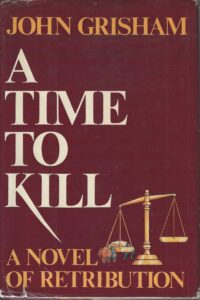
A Time To Kill
___________________________________
Start to Finish: Two and a half years
I want to be a writer: Age 30
Experience: Trial lawyer
Number of Agents Contacted: More than 50 agents and editors.
Agent Responses: About 16 rejections from agents and the same number from editors.
Agent Search: Three months. Had ten queries circulating at a time.
Time to Sell Novel: Rejected by 28 publishers over four months
First Novel Agent: Jay Garon
First Novel Editor: Bill Thompson
First Novel Publisher: Wynwood Press
Inspiration: Scott Turow’s legal thriller Presumed Innocent. “I read the book immediately, and I saw the magic.”
Advice to Writers: Outline and adjust as you go. Set a daily writing goal and eliminate distractions.
Webpage: jgrisham.com
Like this? Read the chapters on Lee Child, Michael Connelly, Tess Gerritsen, Steve Berry, David Morrell, Gayle Lynds, Scott Turow, Lawrence Block, Randy Wayne White, Walter Mosley, Tom Straw. Michael Koryta, Harlan Coben, Jenny Milchman, James Grady, David Corbett. Robert Dugoni, David Baldacci, Steven James, Laura Lippman, Karen Dionne, Jon Land, S.A. Cosby, Diana Gabaldon, Tosca Lee, D.P. Lyle, James Patterson, Jeneva Rose, Jeffery Deaver, Joseph Finder, Patricia Cornwell, Lisa Gardner, Mary Kubica, Hank Phillippi Ryan, I.S. Berry, Heather Graham, John Gilstrap, J.D. Barker, Kate White., Lee Goldberg, Isabella Maldonado, Meg Gardiner, and Megan Abbott, K.T. Nguyen, Bruce DeSilva, and Ellen Meister.